



























Chloé Zhao’s Hamnet approaches William Shakespeare, a figure so foundational to the Western canon he has become a global cultural export, not through the grandeur of his stagecraft but through the silence of an unmarked grave. The film is an imagined history, proposing that the playwright’s defining tragedy, Hamlet, was born from an even greater personal one: the death of his eleven-year-old son.
It is a story about the profound, world-altering grief that follows such a loss and how that sorrow was alchemically transformed into a masterpiece. The film’s atmosphere is intensely personal and emotionally exposed, stripping away the pageantry of historical drama to focus on the raw, elemental experience of being human.
It positions storytelling as a necessary act, a method for processing the unbearable and giving shape to the void left by death. This approach reframes a universally known play as a specific, intimate act of mourning, making its themes accessible across any cultural divide.
Mythic Union in the English Countryside
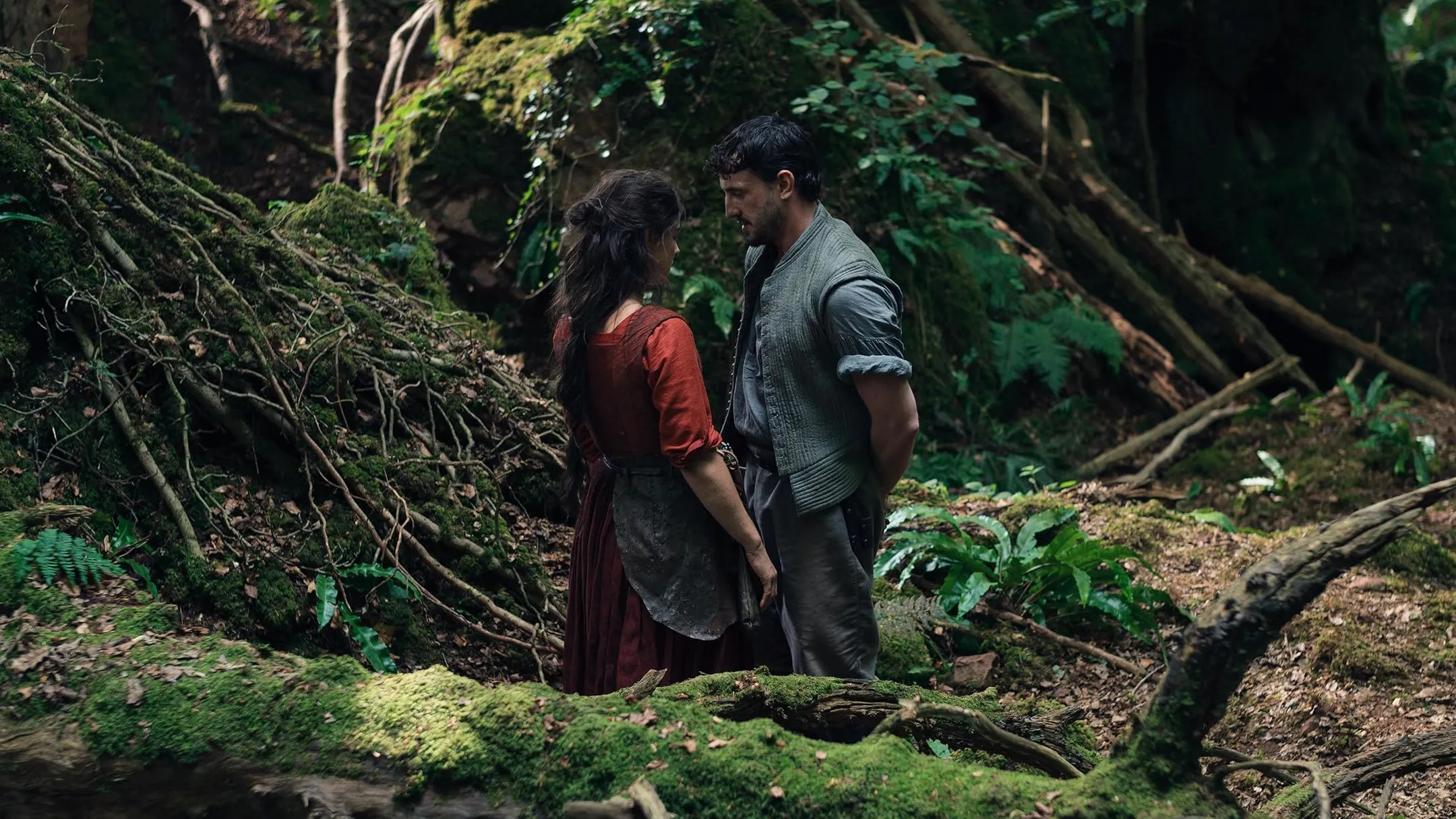
The film’s emotional center is Agnes (Jessie Buckley), a woman portrayed as a force of nature who exists outside the rigid social structures of her time. Perceived by the local community as a “forest witch,” she is a figure of both suspicion and wonder, her deep knowledge of herbal remedies and her command of a pet falcon marking her as separate.
This characterization taps into a long history of folklore surrounding women who live in harmony with the natural world, representing a pre-modern, intuitive wisdom. Zhao’s camera frequently frames her within the embrace of the forest, suggesting that her identity is inseparable from the ancient, untamed land itself. Into this world enters William (Paul Mescal), a quiet Latin tutor burdened by his father’s debts and disapproval. His fascination with Agnes is immediate.
He sees in her a vitality and authenticity that his own life, circumscribed by duty and words, sorely lacks. Their connection is less a simple romance and more a symbolic merging of distinct energies: his structured, intellectual world finds a necessary counterpart in her elemental spirit. Their passionate courtship and marriage defy the objections of his stern parents, who see her as a wild and unsuitable match. The births of their children are staged as critical symbolic moments.
Their first daughter, Susanna, is born outdoors, with Agnes finding strength from the earth. The later birth of the twins, Hamnet and Judith, is forced indoors by her mother-in-law, a visual representation of her wild spirit being brought within domestic confines. This shift foreshadows the growing distance in their marriage, as William’s burgeoning ambition as a playwright pulls him toward London, leaving Agnes and the children behind in Stratford-upon-Avon.
A Sickness of the Soul
The world of the children is established with a loving specificity, particularly the profound bond between the twins, Hamnet (Jacobi Jupe) and Judith (Olivia Lynes). Their favorite game of swapping clothes and identities is a playful, innocent act, yet it resonates with the theatrical devices of mistaken identity that would later populate many of William’s comedies.
Here, this trope is re-imagined with a devastating gravity. When the bubonic plague reaches their home, it is Judith who first succumbs to the fever. In a desperate, selfless act of love, Hamnet insists on taking her place, hoping to trick fate and draw the illness into himself.
This moment of magical realism transforms a historical tragedy into a deeply personal sacrifice, elevating the narrative to the level of myth. The subsequent scenes depicting Hamnet’s rapid decline and death are unflinching. The film forces the viewer to bear witness to the family’s helplessness. Agnes’s grief is a physical, all-consuming force; Buckley portrays it not as sadness, but as a primal severing, a visceral agony that leaves her unmoored from the world.
Her reaction is a stark contrast to William’s. He returns from London to find his only son gone, and his sorrow is a quiet, paralytic shock that he cannot articulate. This inability to connect in their mourning opens a chasm between them. Agnes accuses him of a failure to be present, of an absence that is both physical and emotional. Their shared loss becomes a source of division, and the family home transforms into a haunted space, its silence thick with unspoken anguish and the palpable presence of an absence.
The Quiet Gaze of the Auteur
Chloé Zhao’s direction is the film’s defining feature, providing a cinematic language that is both patient and deeply perceptive. She prioritizes emotional authenticity over plot mechanics, allowing moments of quiet observation to carry immense weight.
A long take of the wind moving through the trees or the camera lingering on the texture of a wooden table creates a rich, lived-in world where feeling takes precedence over action. Her visual style shares a spiritual quality with the work of filmmakers like Terrence Malick, employing natural light, especially during the magic hour, to give the English countryside a poetic, transcendent feel.
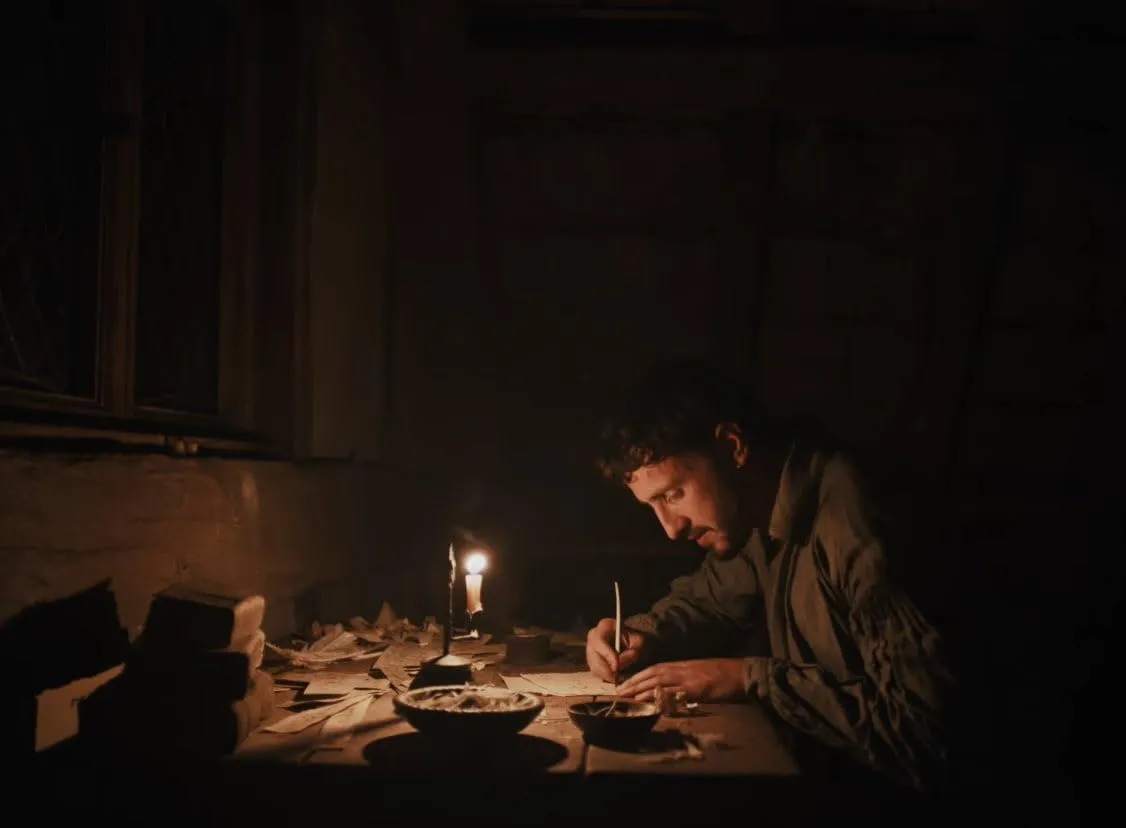
This aesthetic choice is a deliberate departure from the staid conventions of most British period dramas. The cinematography by Łukasz Żal is essential to this vision. His camera moves with a quiet grace, contrasting the vast, open freedom of the landscapes Agnes inhabits with the dark, almost claustrophobic candlelight of the indoor spaces.
The film’s sound design amplifies the sense of unease, with the constant whisper of wind or the distant rumble of a storm acting as an auditory omen. Max Richter’s score functions similarly, a subtle and atmospheric presence that weaves through the narrative until the climax, where the full, heartbreaking force of his piece “On the Nature of Daylight” is unleashed.
The performances are perfectly attuned to this delicate style. Jessie Buckley is astonishing as Agnes, conveying a spectrum of emotion from fierce maternal love to a sorrow so profound it seems to crack the earth. Paul Mescal delivers a wonderfully understated performance as William, revealing the oceans of pain beneath his reserved exterior.
He makes the character’s turn to art not an escape, but a desperate act of translation. And Jacobi Jupe’s earnest portrayal of Hamnet is crucial; he gives the boy a bright, tangible presence that makes his loss truly devastating.
Theater as a Conduit for Grief
In the silent aftermath of his son’s death, William returns to London and does the only thing he knows how to do: he writes. He channels his fractured memories and incommunicable pain into the structured narrative of a play, one Agnes believes is a comedy. This creative act is portrayed as a desperate attempt to make sense of the senseless.
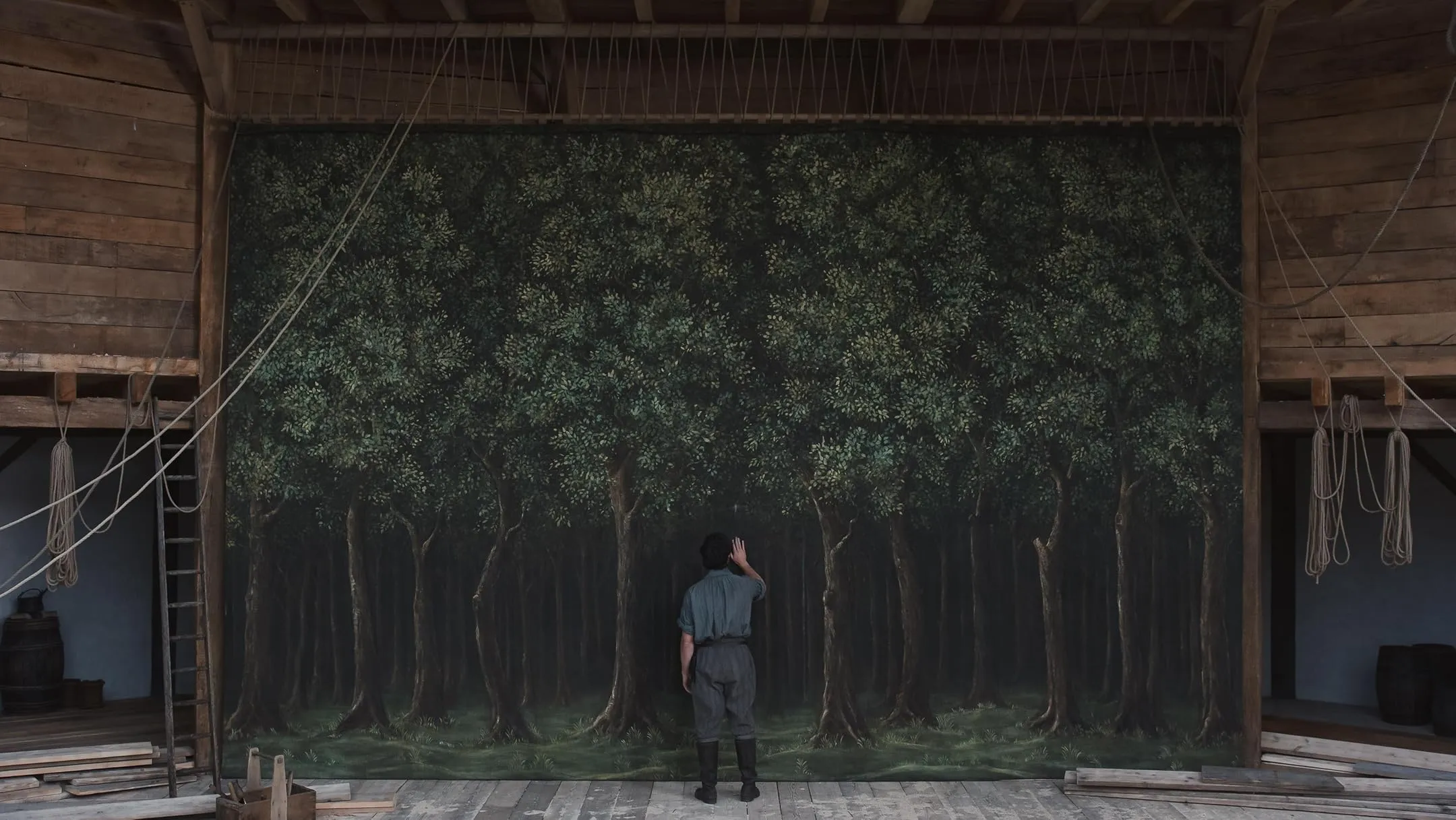
He transforms his grief into art, with the stage becoming the “undiscovered country” where he can commune with the ghost of his child. The elements of his life—a son with an interchangeable name, a house steeped in mourning, a feeling of being haunted—are reconfigured into The Tragedy of Hamlet. The film’s final, masterful sequence takes place at the Globe Theatre during the play’s premiere.
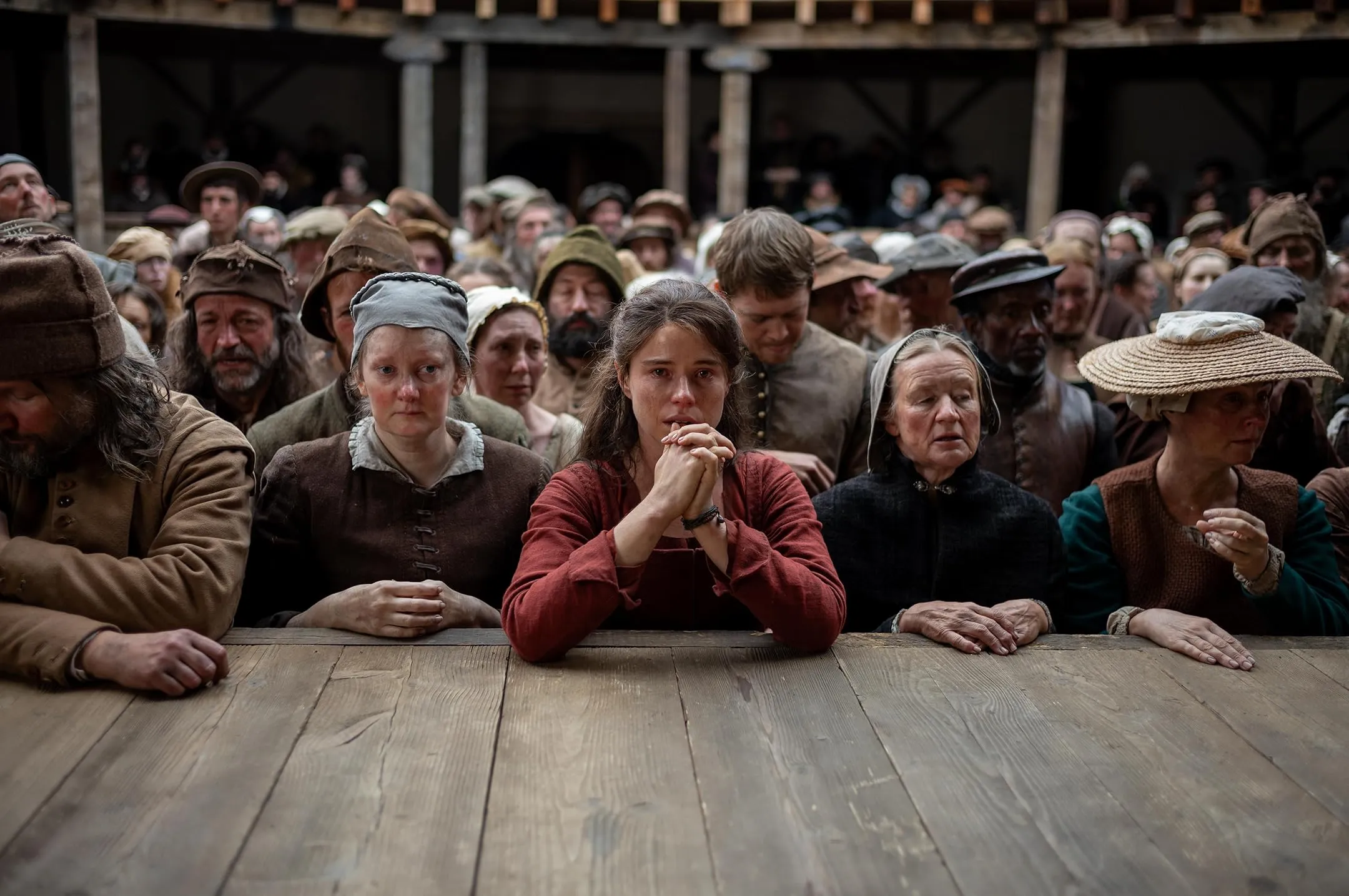
Agnes travels to London and sits in the audience, completely unaware of the story she is about to see. This scene is the emotional culmination of the entire film. As the drama unfolds, she recognizes pieces of her own life, her own sorrow, reflected back at her.
When William himself walks onto the stage as the Ghost, cloaked in white, the performance becomes a direct, personal address to her across the theater. It is an act of confession, an apology, and a shared acknowledgment of their pain. The play becomes a conduit, a vessel for the grief they could not express to one another. It does not offer a simple reconciliation or an easy healing.
Instead, it creates a moment of profound communion, a shared space where their individual suffering can be seen and understood. The film concludes with the powerful idea that art can serve as a lifeline, transforming a private, devastating loss into a timeless and universally understood human experience.
Hamnet premiered at the Telluride Film Festival on August 29, 2025, and will also screen at the Toronto International Film Festival on September 7, 2025. The film will have a limited theatrical release in the United States starting November 27, 2025, with a nationwide expansion on December 12, 2025. Domestically, the film will be distributed by Focus Features, and internationally by Universal Pictures.
Full Credits
Director: Chloé Zhao
Writers: Chloé Zhao, Maggie O’Farrell
Producers and Executive Producers: Liza Marshall, Pippa Harris, Nicolas Gonda, Sam Mendes, Steven Spielberg (Producers); Chloé Zhao, Kristie Macosko Krieger, Laurie Borg (Executive Producers)
Cast: Jessie Buckley, Paul Mescal, Emily Watson, Joe Alwyn, Jacobi Jupe, David Wilmot, Olivia Lynes, Bodhi Rae Breathnach, Freya Hannan-Mills
Director of Photography (Cinematographer): Łukasz Żal
Editors: Chloé Zhao, Affonso Gonçalves
Composer: Max Richter
The Review
Hamnet
Chloé Zhao’s Hamnet is a work of profound emotional intelligence and cinematic grace. It transforms a historical footnote into a devastatingly intimate epic of love and loss. Anchored by breathtaking performances from Jessie Buckley and Paul Mescal, the film uses its patient, lyrical style to explore the way art can become a vessel for unspeakable grief. It is a quiet, powerful, and deeply moving cinematic experience that re-contextualizes a foundational work of literature, making it feel immediate and new. A masterful reflection on sorrow and creation, it is an unforgettable piece of filmmaking.
PROS
- Jessie Buckley and Paul Mescal deliver astonishing, deeply felt performances.
- Chloé Zhao's patient, naturalistic direction creates a powerful emotional intimacy.
- The stunning cinematography and atmospheric sound design build a rich, immersive world.
- It offers an intelligent and moving re-imagining of the origins of a literary masterpiece.
CONS
- The deliberate and meditative pace may feel too slow for some viewers.
- Its focus on grief is relentlessly sorrowful, which could be emotionally taxing.
- The use of a well-known Max Richter track during the climax might feel emotionally manipulative to some.