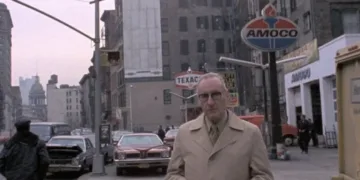
















Nova 78’ is less a documentary and more an unearthed artifact, a grainy portal to a New York that exists only in memory. The film reconstructs the 1978 Nova Convention, a three-day gathering of the American counterculture to honor the writer William S. Burroughs.
Held in a Manhattan where punk’s energy still crackled in the air, the event was a convergence of artistic and intellectual ferment. Assembled from reels of lost footage shot by director Howard Brookner, the film has a raw, immediate quality.
It drops the viewer directly into the proceedings without explanation, capturing a moment when the lines between music, literature, and performance art dissolved completely. We are not watching a historical summary; we are attending the event itself, witnessing a culture defining itself in real time.
A Collision of the Avant-Garde
The convention unfolds as a chaotic spectacle of creative expression, a living document of an American avant-garde in transition. The general atmosphere is a charged mixture of punk defiance and Beat generation intellectualism, where aging poets shared space with a new wave of performers. This generational crossover is the event’s defining cultural texture.
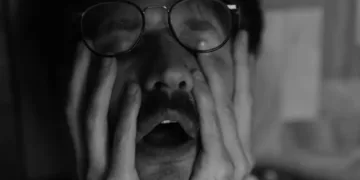
We see the raw energy of a nascent punk scene paying homage to an older, more literary form of rebellion. The observational, fly-on-the-wall camerawork mirrors the raw spirit of the art on display, refusing to editorialize and instead capturing the event’s unpolished immediacy. The camera lingers on audience members, their faces a mix of rapt attention and genuine confusion, reflecting the challenging nature of the work presented.
Performances are memorable for their sincerity and their strangeness. Frank Zappa, a musician not known for literary pursuits, earnestly reads a grotesque passage from Burroughs’s Naked Lunch, explaining his admiration for a book he considers an exception to his dislike of reading.
Patti Smith takes the stage to manage the announced absence of Keith Richards, turning potential disappointment into a moment of charismatic power and offering a few dollars from her own pocket to anyone demanding a refund.
Other contributions are intentionally difficult, pushing the audience toward discomfort. The experimental sounds of Philip Glass and John Cage fill the theater, while an interpretive dance by Merce Cunningham feels both awkward and profound. Behind the scenes, impromptu conversations reveal the practical and philosophical currents running through the event, all of it captured with the same unfiltered directness.
The Still Point of a Turning World
At the center of this maelstrom is William S. Burroughs himself. A man in his sixties, dressed in a conservative suit, he presents a stark visual contrast to the youthful energy surrounding him. He is the event’s philosophical anchor, an enigmatic presence whose ideas give the gathering its purpose.
The film explores the contradictions of his persona: the reserved elder who fires guns and handles knives, the soft-spoken intellectual whose work plumbs the depths of violence and societal decay. He is seen in many modes: the detached academic on a panel discussion, the morbid humorist connecting his fictional character Dr. Benway to the recent Jonestown tragedy, and the sharp political commentator.
His global awareness is particularly striking. In a quiet, almost casual conversation with poet Allen Ginsberg, Burroughs’s analysis of the growing turmoil in pre-revolution Iran is startlingly clear-sighted and informed. From a vantage point in New York, their discussion demonstrates a sophisticated understanding of international affairs that counters any notion of an insular American underground.
This moment underlines the seriousness of the intellectual project at hand. The film also captures his principled stands on social issues, including a firm defense of homosexuality against political attacks. Glimpses of Burroughs away from the theater, walking through the city or riding in a car, offer a different view. These scenes suggest the calm observational process from which his radical, disruptive art emerged, painting a full portrait of a complex cultural figure.
The Future as Seen from the Past
Nova 78’ documents a specific historical moment and also feels strangely contemporary. The ideas debated with such intensity on stage in 1978 have not lost their urgency; they have perhaps found their moment. Burroughs’s statements, in particular, resonate with modern anxieties about information, power, and reality itself. His theories on societal control through language and technology seem predictive of a world shaped by social media algorithms and digital surveillance.
His insistence that space exploration should be about finding a new dimension of existence, not simply transplanting old problems to a new location, speaks directly to current debates about humanity’s future. The film’s most potent quality is its depiction of this foresight. The conversation about Iran’s political trajectory, recorded just before its historic revolution, serves as undeniable evidence of the sharp, prophetic lens through which Burroughs and his circle viewed the world.
The documentary captures a period of fearless artistic risk, showcasing a creative ecosystem where experimentation was the goal, not a means to a polished product. Watching it now raises critical questions about our own cultural landscape.
It forces a comparison between that era’s raw, unfiltered creativity and today’s often commercialized and carefully branded art forms. The film is a powerful image of a time when the future felt radically open to reinvention and when a genuine counterculture could articulate a potent critique of the present.
NOVA ’78 is a documentary film that premiered at the Locarno Film Festival in August 2025. The film focuses on the Nova Convention that took place in New York’s East Village in 1978. This counterculture event featured performances by artists such as William S. Burroughs, Patti Smith, Frank Zappa, Allen Ginsberg, and Laurie Anderson. The documentary utilizes newly restored 16mm footage of the convention captured by Howard Brookner, Tom DiCillo, and Jim Lebovitz, with sound recorded by Jim Jarmusch.
Full Credits
Directors: Aaron Brookner, Rodrigo Areias
Producers: Pinball London, Bando à Parte
The Review
Nova 78' Review
Nova 78' is a vital, unfiltered transmission from a lost cultural moment. It succeeds not as a conventional documentary but as an immersive experience, dropping the viewer directly into the creative chaos of the 1978 New York underground. While its lack of context may challenge some, its power lies in its raw authenticity and the startling prescience of its central figure, William S. Burroughs. It is an essential artifact for anyone interested in the history of American counterculture.
PROS
- An authentic and immersive time capsule of 1970s New York counterculture.
- Features rare, restored footage of iconic artists and thinkers.
- Effectively captures a spirit of fearless creative experimentation.
- Highlights the surprisingly prophetic political and social commentary of William S. Burroughs.
CONS
- The lack of narrative guidance or context can be alienating for viewers unfamiliar with the figures.
- Some experimental performances may feel dated or inaccessible.
- Its observational style may feel slow or unfocused to some.