






















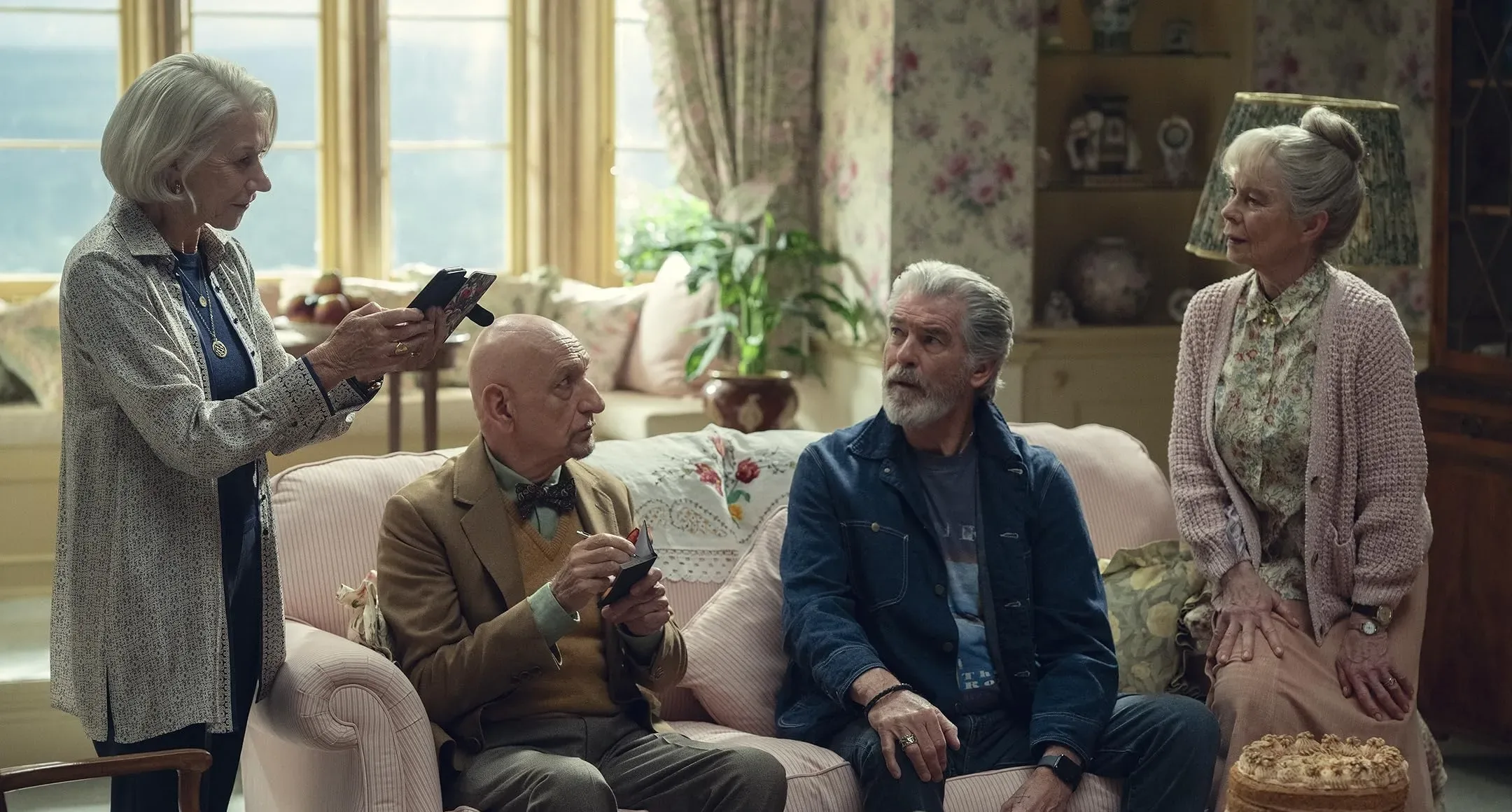

The English retirement village of Coopers Chase appears as a sanctuary of manicured lawns and genteel quiet. Within its idyllic grounds, however, a small group of residents has a peculiar hobby. Four friends meet each week to dissect cold case files, treating unsolved murders as a particularly stimulating intellectual exercise.
The club consists of Elizabeth, a sharp former operative of some kind; Ron, a retired union firebrand; Ibrahim, a precise psychiatrist; and Joyce, a new resident with a deceptively keen eye. Their theoretical game becomes dangerously real when a despised property developer, Ian Ventham, is found dead.
The Thursday Murder Club suddenly has a fresh case, and the killer is one of their neighbors. The film quickly establishes its lane in the crime genre. This is a “cozy mystery,” a story far more interested in the charm of its sleuths than the grim particulars of the crime.
An Exercise in Collective Charm
The film’s primary narrative engine is its cast, a collection of performers who understand the material’s specific frequency. Helen Mirren plays Elizabeth with a crisp authority that anchors the group. Her performance is built on subtle hints of a clandestine past, making her the story’s natural driving force and strategic mastermind.
Every decision flows from her, and Mirren ensures her intelligence never feels less than completely earned. As the activist Ron Ritchie, Pierce Brosnan cheerfully sheds his debonair screen persona for a more grounded, rebellious energy. His character provides a necessary spark of impatience, preferring direct confrontation to Elizabeth’s careful maneuvering, and Brosnan finds a comfortable comedic rhythm in the role.
Sir Ben Kingsley brings a quiet, meticulous dignity to Ibrahim, who functions as the group’s conscience and source of psychological insight. He is the one who considers the human cost. Rounding out the quartet is Celia Imrie as Joyce, who could easily be overlooked but becomes a key player. Imrie portrays her as an astute observer, a woman whose seemingly mundane comments on daily life often contain the key to a puzzle.
What elevates the film is the palpable chemistry between these four actors. The story works because their partnership feels genuine. The dynamic is well-defined: the gentle friction between Ron’s impulsiveness and Ibrahim’s caution, or the way Joyce’s unassuming warmth complements Elizabeth’s tactical steeliness.
Their banter feels unforced, and their collaborative spirit forms the movie’s emotional foundation. The supporting cast is equally strong. David Tennant is perfectly cast as the smarmy antagonist Ian Ventham, a villain whose odiousness is pitched for comedic effect rather than genuine menace. As PC Donna de Freitas, Naomi Ackie provides a necessary link to the official police investigation.
Her character’s arc from skeptical officer to willing conspirator mirrors the audience’s own journey with the club, and she has an excellent rapport with the main cast. Jonathan Pryce also adds a layer of emotional depth in his brief scenes as Elizabeth’s husband Stephen, whose struggle with memory is handled with a gentle, affecting touch.
A Puzzle Box with a Simple Solution
The central whodunit in The Thursday Murder Club is constructed less as a complex challenge for the viewer and more as a framework upon which to hang character interactions. This is a deliberate structural choice common to the cozy mystery subgenre.

By lowering the intellectual stakes of the puzzle, the narrative frees up space for social observation and character comedy. An attentive audience may identify the culprit well before the final act, because the film’s pleasure is not in the shock of the reveal. It is in the methodical, often humorous, process the club employs to get there.
The screenplay, from Katy Brand and Suzanne Heathcote, succeeds in its character-focused approach. The dialogue is filled with witty exchanges and moments of quiet humor, often derived from the juxtaposition of the group’s genteel environment with the grim subject of murder. The script uses these conversations to reveal character effectively.
We learn about Ron’s politics through his grumbling, and about Ibrahim’s precision through his speech. The narrative structure, however, is less consistent. The first half does an excellent job of establishing the world and the central conflict. As the story progresses and introduces more suspects and subplots, the initial momentum wanes.
The film lacks a certain propulsive energy, causing the second act to feel somewhat episodic. The investigation proceeds at a leisurely pace, and without a constant sense of rising tension, the story feels more like a pleasant stroll than a thrilling pursuit.
The Architecture of Comfort
Director Chris Columbus brings a familiar sensibility to the film, one honed on stories about community and unconventional families. His direction prioritizes warmth and accessibility, making the movie feel instantly comfortable and rewatchable.

He understands that the appeal of this story lies in its atmosphere, and he constructs it with methodical care. His visual language is one of security. He often frames shots to emphasize the grandeur of the location, using wide angles for the lush exteriors and warm, soft lighting for the well-appointed interiors. Every composition is designed to reassure the audience.
This feeling is amplified by the film’s visual design. James Merifield’s production design transforms Coopers Chase into a character in its own right, a perfectly realized fantasy of retirement that provides a striking contrast to the crimes that unfold there. It is a key storytelling device.
This idyllic setting is captured beautifully by cinematographer Don Burgess, whose polished and well-lit visuals give the film a lustrous, storybook quality. These technical elements all work in concert to create the quintessential cozy aesthetic. The unhurried editing pace and the inviting sets are tools used to signal to the audience that, despite the occasional dead body, they are in a safe and fundamentally decent world.
Beneath the Cozy Surface
The film operates on a simple thematic level, but its ideas about aging are its most interesting. The Thursday Murder Club actively subverts the stereotype of the feeble or irrelevant senior. Its protagonists are defined by their intellect and their wealth of experience, not by their age.
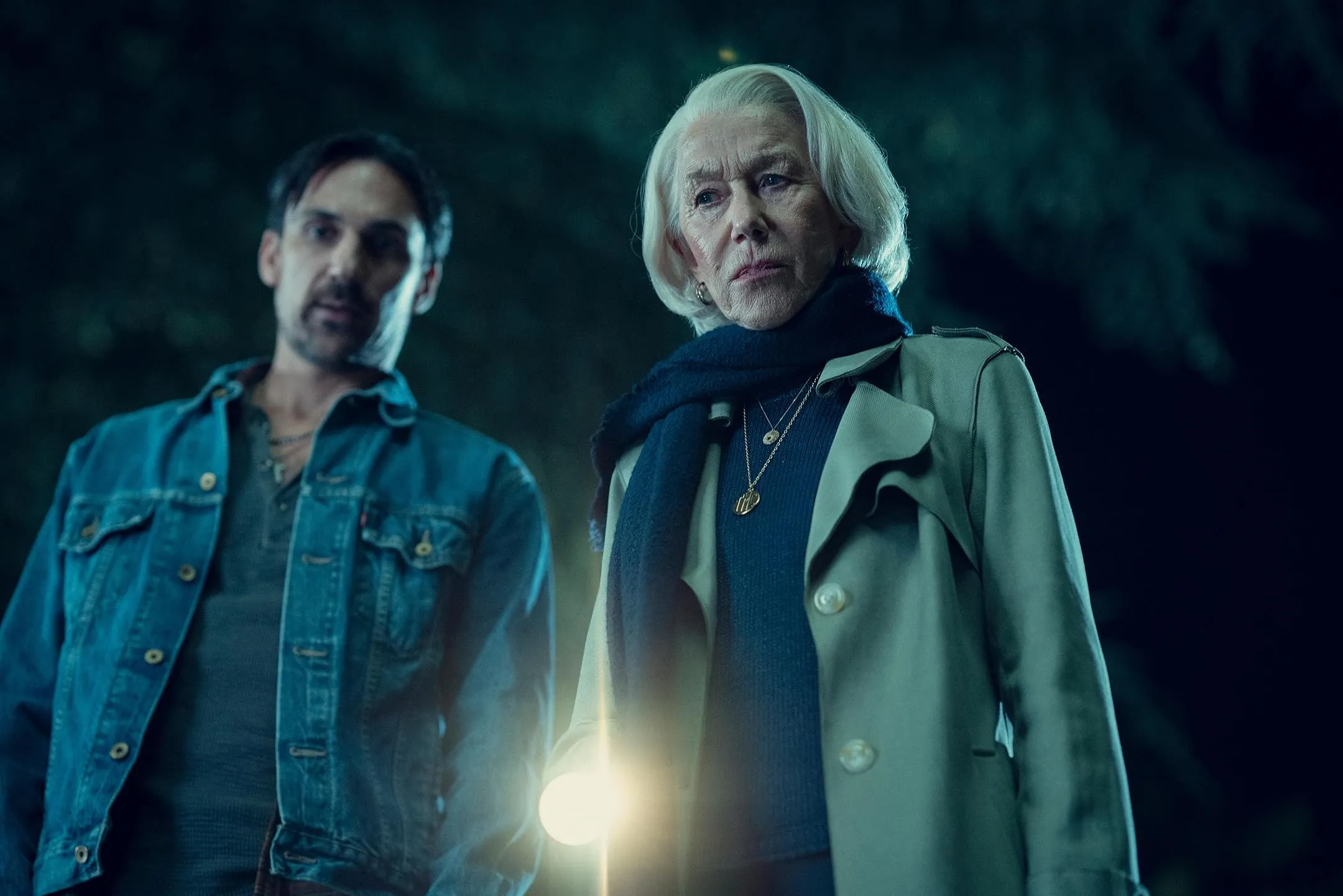
The narrative cleverly allows them to use the world’s dismissal of them as a strategic tool. Ibrahim’s psychiatric knowledge allows him to profile suspects, Ron’s history as an organizer helps him rally people, and Elizabeth’s spycraft is self-evident. Their perceived harmlessness grants them access and information that would be denied to others. In this story, age is a superpower.
The narrative also champions the idea of a found family, fitting squarely within a modern trend of stories focused on community. The success of the club depends entirely on the members’ ability to pool their disparate skills and knowledge, a classic storytelling trope about the strength of the collective.
The film even manages to touch upon serious subjects, like the cruelty of dementia, without breaking its optimistic tone. The subplot involving Stephen is used for moments of poignancy, adding emotional texture to Elizabeth’s character. This reflects a careful structural choice to use emotional depth as a seasoning, not the main course, thereby preserving the story’s essential, comforting nature.
The Thursday Murder Club is a British crime comedy film directed by Chris Columbus. Based on the novel by Richard Osman, the film premiered in selected cinemas on August 22, 2025. It will have its streaming debut exclusively on Netflix on August 28, 2025.
Full Credits
Director: Chris Columbus
Writers: Katy Brand, Suzanne Heathcote
Producers and Executive Producers: Chris Columbus, Jennifer Todd, Steven Spielberg, Jo Burn, Richard Osman, Eleanor Columbus, Holly Bario, Jeb Brody
Cast: Helen Mirren, Pierce Brosnan, Ben Kingsley, Celia Imrie, Naomi Ackie, Jonathan Pryce, David Tennant, Richard E. Grant, Daniel Mays, Henry Lloyd-Hughes
Director of Photography: Don Burgess
Editors: Dan Zimmerman
Composer: Thomas Newman
The Review
The Thursday Murder Club
The Thursday Murder Club is a triumph of casting and atmosphere over narrative tension. While the central mystery is too gentle to truly thrill, the immense charm of its veteran ensemble makes the investigation a delight to watch. The film is impeccably crafted to be cinematic comfort food, a warm and witty affair that prioritizes the pleasant company of its characters above all else. It succeeds beautifully as a cozy escape, even if it never aims to be a challenging puzzle.
PROS
- An outstanding ensemble cast with genuine, delightful chemistry.
- Witty, charming dialogue and a consistent, lighthearted tone.
- Gorgeous production design and cinematography that create an idyllic, cozy atmosphere.
- Effectively explores themes of aging, experience, and community.
CONS
- The central mystery is simple, predictable, and lacks suspense.
- The narrative pacing slows considerably in the film's second half.
- Low stakes may leave fans of more complex thrillers wanting more.