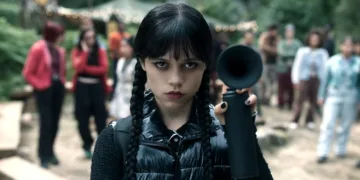









Wednesday Addams returns to Nevermore Academy not as the feared newcomer she once was, but as an unwilling campus celebrity. Her successful foiling of a demonic pilgrim has earned her a level of admiration she finds repulsive, a sentiment Jenna Ortega conveys with a masterful, withering glare.
The character’s signature disdain for social acceptance is immediately tested by fawning classmates, establishing her internal conflict for the semester. She would much rather be loathed. This desire for solitude is promptly shattered by a new set of problems.
A stalker begins leaving Wednesday cryptic, threatening messages, a direct violation of her guarded privacy. A more public threat emerges in Jericho, where a killer is murdering victims and plucking out their eyeballs with the help of crows.
The personal stakes are violently raised when Wednesday’s developing psychic abilities grant her a horrifying vision of her roommate Enid’s death. This premonition transforms her investigation from a morbid hobby into a desperate race against time, framing the central tension of the season.
An Autopsy of the Teen Trope
In a calculated pivot that feels responsive to a cultural exhaustion with young adult formulas, the series excises the first season’s love triangle. This surgical removal is the season’s most profound statement, a declaration that it seeks to mature beyond its initial framework.
The decision seems to be a direct acknowledgment of criticism from both viewers and its star, reflecting a new dynamic in the streaming era where actor agency can tangibly shape a narrative’s direction. This choice frees the story from the gravitational pull of predictable romantic beats, allowing it to invest its energy into the mechanics of mystery and the contours of horror.
The result is a narrative better suited to the binge-watching model, which thrives on plot momentum and suspense rather than the slow burn of courtship. This recalibration is not simply a plot adjustment; it is an evolution of the modern YA genre, which must now cater to an audience that grew up on its tropes and now demands something more complex.
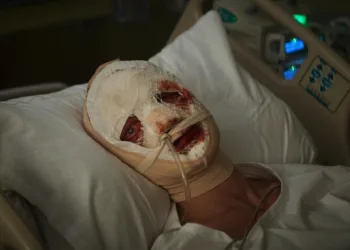
The show fills the void left by romance with a pronounced lean into the macabre. The horror is no longer just atmospheric; it is visceral. The crow-based murders, with their focus on ocular trauma, introduce a strain of body horror that is genuinely unsettling. This shift towards more graphic content speaks to a broader industry trend where streaming platforms, unconstrained by network censors, push the boundaries of genre content to distinguish themselves in a crowded market.
The horror is also more varied, blending the slasher-esque elements of the new killer with the psychological tension of an unseen stalker and the ongoing creature feature of the Hyde. The central mystery itself is a dense and rapidly unfurled construction. By introducing multiple antagonists and overlapping threats within its opening episodes, the series practically commands viewer attention.
This structural approach is a product of the streaming attention economy, where a show must deliver its core premise with immediate force. The brisk pacing ensures engagement, though it walks a fine line between compelling and convoluted, occasionally prioritizing plot mechanics over the quiet character moments that allow suspense to truly fester.
When Outcasts Join the In-Crowd
The show’s ecosystem is fundamentally altered by the full integration of the Addams family into Nevermore. Pugsley enrolls as a student, while Morticia and Gomez take up residence on campus, a move that places the entire clan inside the institutional walls. This decision raises a fascinating question about the nature of subversion.

The Addams family’s cultural power has always been generated by their stark contrast to the American ideal of normality. They were the singular, unapologetic oddity in a world that demanded conformity. By relocating them to a school populated entirely by supernatural outcasts, the series knowingly complicates their purpose.
The central satirical target shifts from the “normie” world to the very structure of subcultures themselves. This is most sharply observed through Morticia’s new role as head of fundraising, a clever plot device that critiques how institutions often absorb and neutralize counter-cultural figures by giving them a stake in the system.
This new proximity makes the mother-daughter conflict the season’s primary emotional engine. Their arguments are layered with thematic weight, functioning as a proxy for generational debates within feminism and individualism. Morticia, with her graceful and assured power, represents a more established, almost aristocratic form of female strength rooted in heritage and tradition.
Wednesday embodies a modern, more solitary version, one that is suspicious of lineage and fiercely protective of her autonomy. Their disagreements over the use of psychic visions are less about supernatural abilities and more about a daughter’s right to forge her own path, even if that path leads to danger.
The dialogue between them crackles with this tension, giving both Ortega and Catherine Zeta-Jones substantial material. The other family members, however, feel less essential to this new dynamic. Pugsley’s subplot provides a different view of the outcast experience, one based on inadequacy, but it remains secondary. Gomez’s role is largely reduced to that of Morticia’s devoted consort, his character still feeling more like a charming sketch than a fully realized individual.
The Deadpan Star and Her Orbiting Ghouls
Jenna Ortega’s performance remains the unshakable anchor of the series, a masterful exercise in restraint and precision. Her portrayal has become so definitive that it’s difficult to separate the character from her creative influence, especially given her new role as a producer.

She telegraphs Wednesday’s formidable intellect, defiant will, and deep-seated vulnerability through the slightest narrowing of her eyes or a subtle shift in posture. This is a performance built on stillness, one that rejects the demand for constant emotional broadcasting and in doing so, creates a far more compelling screen presence.
Her work is a significant moment for representation, presenting a complex, powerful Latina protagonist defined by her mind and her morbidity, not by tired stereotypes. The supporting cast is bolstered by noteworthy additions who understand the show’s peculiar tone. Steve Buscemi’s Principal Dort is a perfect example, his cheerful, cardigan-clad demeanor offering a sly critique of the “cool teacher” archetype who ultimately serves the institution’s interests.
Returning characters are given important space to evolve, preventing them from becoming simple accessories to Wednesday’s story. Enid, in particular, is more than just a colorful foil; she represents a vital alternative to Wednesday’s worldview.
Her strength is rooted in community, emotional expression, and optimism, providing a necessary balance and highlighting the show’s exploration of different forms of power. Their friendship is a sophisticated depiction of how opposites can strengthen, rather than simply tolerate, one another.
Bianca is also granted a more substantial arc that continues to subvert the “queen bee” trope by exploring the burdens that come with her siren abilities. The season is jolted with a necessary dose of anarchy with the brief return of Fred Armisen’s Uncle Fester. His appearance is a highlight, a reminder of the Addams family’s truly chaotic, anti-social roots, which stand in stark contrast to the more orderly, institutionalized world of Nevermore.
A Haunting in High-Definition
The show’s visual identity remains a primary talking point, especially its relationship with its most famous executive producer. In the episodes Tim Burton directs, his signature aesthetic is unmistakable. The world is presented through slightly distorted angles, and character designs, like a specific stop-motion animated creature, bear his indelible mark.

In other episodes, this distinct vision can feel diluted, smoothed over by the consistent, high-gloss finish that characterizes many big-budget streaming productions. This raises broader questions about the role of the auteur in modern television, where a famous director’s name can function as a powerful marketing brand, sometimes independent of their actual hands-on involvement in every frame.
The series is, without question, a triumph of technical craftsmanship. Mark Scruton’s production design is intricate and immersive, building a Nevermore that feels both like a gothic fantasy and a functional, lived-in school. The visual storytelling is most potent in its use of color.
The stark contrast between Wednesday’s monochrome palette and the vibrant hues associated with Enid is a constant, clever visual metaphor for their opposing worldviews. Colleen Atwood’s costume design is exceptional, operating as a core narrative tool.
Wednesday’s sharp, severe silhouettes are a form of armor, while the varied Nevermore uniforms subtly communicate the school’s different factions and social hierarchies. The score effectively underpins the show’s tone, using recurring musical motifs to build suspense and signal character arrivals, weaving a sonic tapestry that is as moody and intricate as the production design itself.
Wednesday Season 2, the highly anticipated return of the popular Addams Family spin-off series, premiered in two parts on Netflix. Part 1, consisting of four episodes, was released on August 6, 2025. Part 2, containing the remaining four episodes, will follow on September 3, 2025. The show is available exclusively on Netflix and can be streamed on the platform. Season 2 filmed in Ireland, specifically locations like Charleville Castle, Powerscourt House, Clonliffe College and Ashford Studios.
Full Credits
Director: Tim Burton, Paco Cabezas, Angela Robinson
Writers: Alfred Gough, Miles Millar, Matt Lambert, Valentina Garza, Lauren Otero, Erika Vazquez, Siena Butterfield, Kayla Alpert, James Madejski
Producers: Jenna Ortega (Executive Producer), Tim Burton (Executive Producer), Alfred Gough (Executive Producer), Miles Millar (Executive Producer), Kayla Alpert (Executive Producer), Steve Stark (Executive Producer), Andrew Mittman (Executive Producer), Kevin Miserocchi (Executive Producer), Jonathan Glickman (Executive Producer), Gail Berman (Executive Producer), Tommy Harper (Executive Producer), Karen Richards (Executive Producer)
Cast: Jenna Ortega, Emma Myers, Hunter Doohan, Joy Sunday, Georgie Farmer, Moosa Mostafa, Victor Dorobantu, Isaac Ordonez, Catherine Zeta-Jones, Luis Guzmán, Steve Buscemi, Billie Piper, Joanna Lumley, Christopher Lloyd, Thandiwe Newton, Owen Painter, Noah B. Taylor, Evie Templeton, Luyanda Unati Lewis-Nyawo, Fred Armisen, Jamie McShane, Frances O’Connor, Haley Joel Osment
Director of Photography (Cinematographer): PJ Dillon, John Conroy
Editors: Jay Prychidny
Composer: Chris Bacon
The Review
Wednesday
Wednesday Season 2 smartly excises its teen romance tropes for a darker, more focused mystery. While integrating the full Addams clan into Nevermore yields mixed results, the sharpened conflict between Wednesday and Morticia provides compelling emotional depth. Led by Jenna Ortega’s impeccable performance, the series is a visually striking and more mature outing that intelligently evolves its formula, even if its unique satirical edge is sometimes blunted by its new setting.
PROS
- Jenna Ortega's commanding and nuanced lead performance.
- The narrative is more focused and mature after removing the first season's love triangle.
- A welcome shift to a darker, more graphic horror tone.
- The complex mother-daughter dynamic between Wednesday and Morticia adds emotional depth.
- Exceptional production design and costuming create an immersive world.
CONS
- Placing the Addams family among other outcasts dilutes their unique satirical power.
- Supporting family members like Gomez and Pugsley feel underdeveloped.
- The fast-paced plot can occasionally feel convoluted and rushed.
- The distinctive Tim Burton aesthetic feels inconsistent across the season.