



















The film opens on an act of startling finality. A body is expelled from a speeding car onto asphalt that gleams under the cold indifference of a single streetlamp. Director of photography Garrett O’Brien frames the moment with a moody, laconic dread that promises a certain kind of picture. Then, the car returns to make the violence percussive, turning a man into a mere abstraction of flesh.
It is a brutalist prologue. This opening gambit, however, is a feint. The hardboiled texture dissolves almost immediately into the flat, fluorescent lighting of the Colt Lake police department, where we meet Deputy Sam Evans (Johnny Simmons). He is a man defined by what he is not: no longer the town’s golden boy, not a competent investigator, not quite present in his own life.
His stasis is the town’s stasis. Into this vacuum comes Bobby Gaines (Seann William Scott), a state agent who moves with the predatory confidence of a man for whom moral calculus is a quaint academic exercise. The film sets its stage: a confrontation between inertia and force.
The Charisma of Annihilation
Every film has a center of gravity. In Bad Man, it is unequivocally Seann William Scott. His performance as Bobby Gaines is not so much an impersonation of a character as an unleashing of a chaotic principle. The camera understands this, granting him a physical dominance in every frame he occupies.
Director Michael Diliberti often uses low-angle shots when Gaines asserts his authority, subtly positioning him as a figure of immense, almost mythic power looming over the cowed local officers. He is a kinetic force, his gestures expansive, his presence sucking the air from the room, while others are captured in static, passive compositions.
He wields dialogue as a blunt instrument, a stream of crude aphorisms and psychological provocations designed to dismantle anyone in his path. This is a performance fully aware of its own artifice. Scott refines the abrasive persona he is known for, shaping it into an archetype: the agent of chaos who exposes the rot in a closed system through sheer, unadulterated will.
He operates as a Nietzschean force, a man whose personal code exists entirely outside the town’s ossified moral framework. His charisma is a weapon, forcing the audience to become complicit in methods they might otherwise condemn, a classic manipulation of viewer psychology often employed by the most effective noirs.
A Gallery of Ghosts
Beyond its explosive center, the world of Colt Lake feels thin, populated by sketches rather than people. Sam Evans is a study in unrealized potential, a protagonist whose eventual turn toward action feels less like a character choice and more like a narrative requirement. For much of the film, he is framed as a figure lost in the background of his own story, visually and thematically marginalized.

His existential paralysis, his inability to escape the shadow of his past, is a compelling premise that the film never fully explores. The supporting cast orbits at a safe distance, their arcs incomplete. Rob Riggle, as the police chief, functions as a strange comedic disruption. His bizarre monologue about Ronald Reagan delivered to schoolchildren is a moment of surrealism so detached it seems to have wandered in from another film, a Brechtian flourish in a story that otherwise strives for a gritty texture.
The antagonists, led by a physically imposing Ethan Suplee, are pure menace without the psychology that makes evil compelling. They are obstacles, not characters, their evil a function of the plot. The film’s women are rendered with a similar lack of depth, existing as a love interest to be pined for or a strange quirk, like the villain’s banjo-strumming girlfriend. She is a memorable, vaguely Lynchian image, but an image is all she is, a surrealist detail in a film that has no larger surrealist ideas.
The Failure of Nerve
As a directorial debut, the film exhibits a profound uncertainty about its own identity. The visual grammar is inconsistent, shifting between the gritty, shadowy neo-noir suggested by its opening and a flatly lit buddy comedy. This narrative dissonance prevents the buildup of sustained tension.
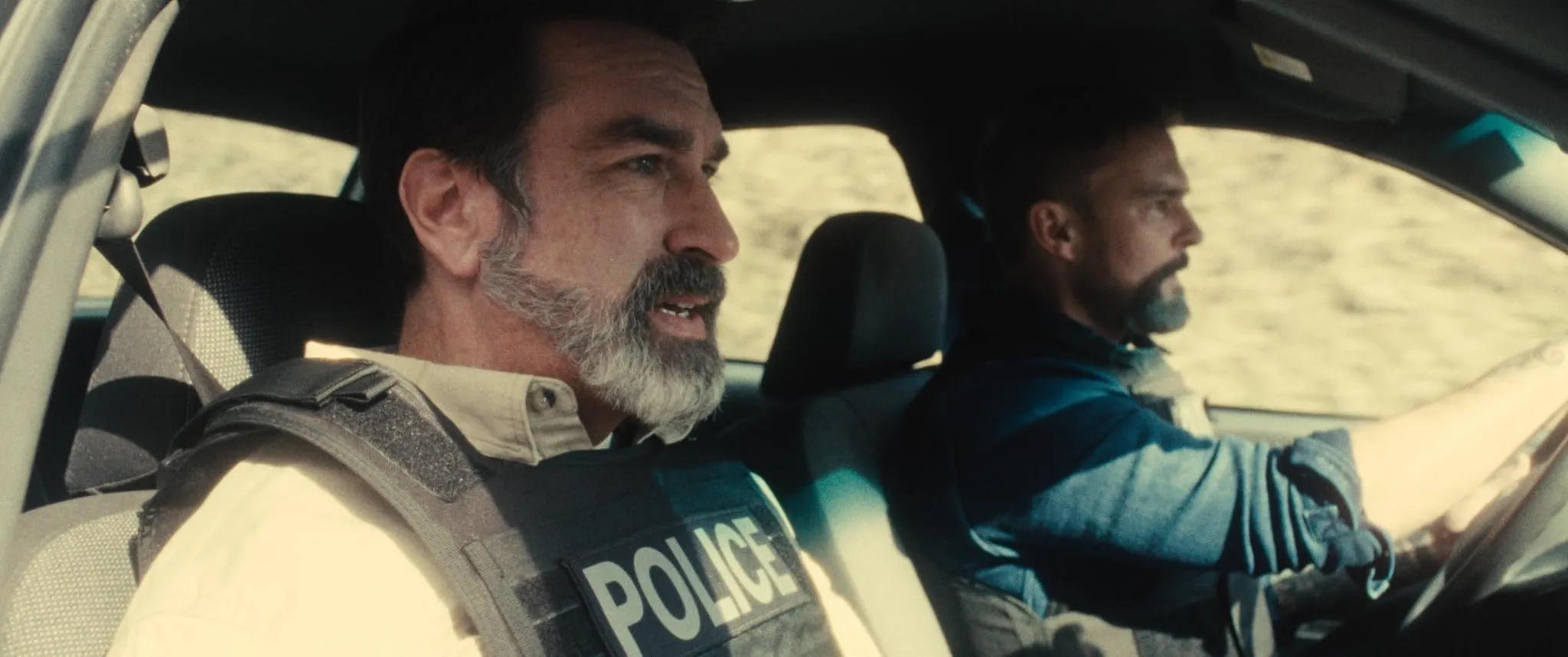
The film’s mise-en-scène is similarly generic, failing to give Colt Lake the distinct, suffocating personality that the best small-town noirs possess. The plot’s unsteady rhythm, with long, fallow periods of meandering, creates a sense of narrative entropy rather than propulsion. This structural wobble culminates in a third act that suffers from a critical failure of nerve.
The screenplay introduces a standard-issue twist, one that re-contextualizes events in a satisfying, if predictable, way. But it cannot leave well enough alone. A second, more convoluted twist is piled on top, a move that mistakes plot complication for thematic depth. This final revelation does not illuminate character or explore moral ambiguity; it simply ties the story into a neat, unconvincing knot.
It is a fundamental misreading of the genre. Noir finds its power in moral compromise and internal darkness, not in elaborate external conspiracies. By offloading responsibility onto a hidden plot, the script absolves its characters of their most interesting sins, choosing a simple mechanical resolution over a complex and resonant thematic one.
“Bad Man” is an action-comedy film that premiered at the Sidewalk Film Festival on August 24, 2025, and was released in the United States on September 5, 2025. You can watch it on digital platforms such as Apple TV, and Amazon Prime Video. The film follows Sam Evans, a deputy in a small Tennessee town, who is trying to tackle a local meth problem. He is sidelined when a hotshot undercover agent, Bobby Gaines, arrives and is hailed as a hero. However, Evans starts to suspect that Gaines may not be the hero he appears to be.
Full Credits
Director: Michael Diliberti
Writers: Michael Diliberti, JJ Nelson
Producers and Executive Producers: Warner Davis, Todd M. Friedman, Brian Levy, Shaun Sanghani
Cast: Seann William Scott, Johnny Simmons, Chance Perdomo, Lovi Poe, Kaitlin Doubleday, Ethan Suplee, Rob Riggle, Marcelle LeBlanc, Erik Audé, John Patrick Jordan, Jack Conley, Ian Roberts
Director of Photography (Cinematographer): Garrett O’Brien
Editors: Not Available
Composer: Andrew Orkin
The Review
Bad Man
Bad Man operates as a cinematic paradox. It is a vehicle for a magnetic, commanding performance from Seann William Scott, who injects a jolt of chaotic energy into every frame. Yet, his work is stranded within a film that lacks a coherent identity. The script meanders, the supporting characters are ghosts, and its narrative ambitions collapse under the weight of a clumsy, convoluted ending. It is a film built on a single, strong pillar, but the surrounding structure is too weak to stand. A fascinating failure worth seeing only for its central performance.
PROS
- A dynamic and charismatic central performance from Seann William Scott.
- Occasional moments of inspired, surreal comedy from the supporting cast.
- A stylistically arresting and brutal opening sequence.
CONS
- A severe tonal imbalance that shifts awkwardly between dark crime and broad comedy.
- Underdeveloped supporting characters and one-dimensional antagonists.
- An unfocused screenplay with significant pacing issues in its middle act.
- A convoluted and narratively unsatisfying third act with poorly executed twists.