

























Every aspiring filmmaker dreams of the perfect story, and Jeremy is no exception. His life, he believes, requires a grand gesture. He sees himself as the protagonist in a romance that needs a dramatic second-act turning point. This is the central delusion that fuels Driver’s Ed, a film that begins not with a car, but with a misguided artistic choice from its main character.
Played by Sam Nivola with a captivatingly earnest naivety, Jeremy is convinced that his high school love affair with Samantha (Lilah Pate) is about to be cancelled, a casualty of her first semester of college. His solution is pure, unfiltered teenage melodrama: drive hundreds of miles to Chapel Hill to win her back.
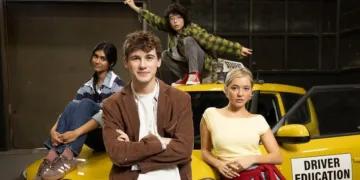
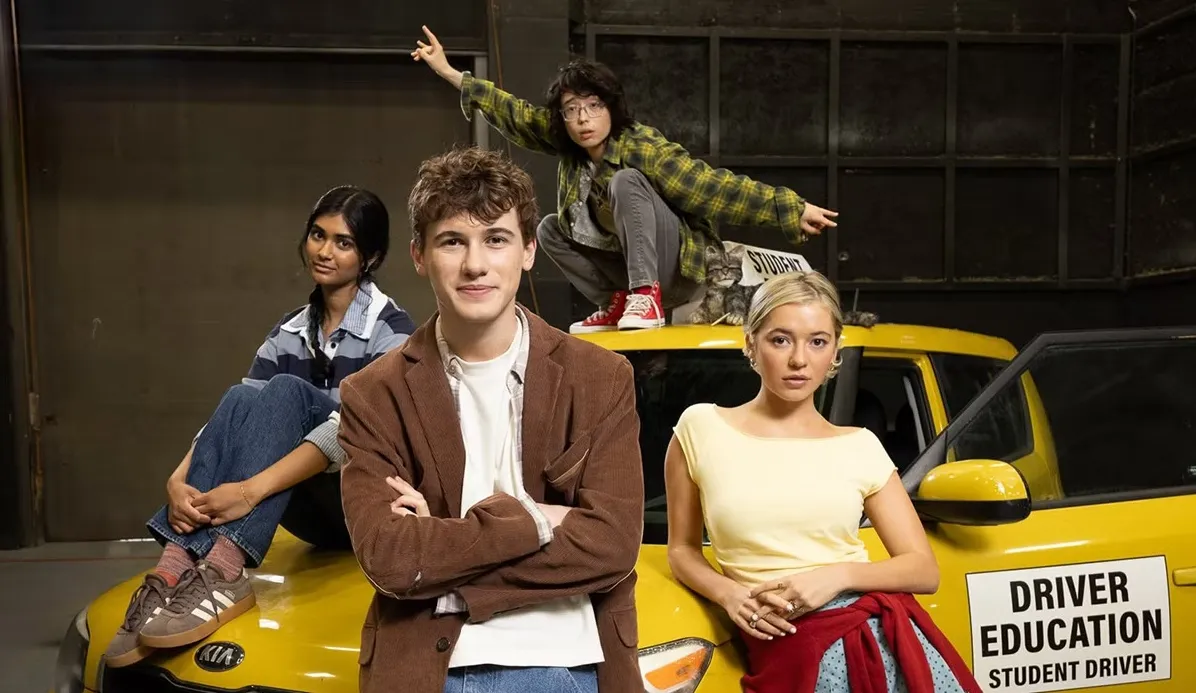
The chosen vehicle for this quest is, absurdly, the canary-yellow car from his driver’s education class. He steals it mid-lesson, a decision that immediately ensnares three classmates in his poorly conceived plot. They are not friends or willing co-conspirators. They are simply the unlucky audience forced to watch his romantic epic unfold from the back seat.
Four Archetypes in a Kia
The film’s pulse is found within the confines of its stolen vehicle, where a quartet of high school archetypes are forced into close quarters. Jeremy, the mission’s architect, is the sincere romantic lead whose idealism often shades into foolishness. Sam Nivola’s performance is essential here, grounding a potentially irritating character in a sincerity that makes his quest understandable, if not wise.
Beside him is Evie (Sophie Telegadis), the cynical observer whose sharp, droll pronouncements act as a constant check on Jeremy’s fantasy. Telegadis delivers her lines with a weary intelligence that suggests her cynicism is a carefully constructed defense mechanism. In the back, Aparna (Mohana Krishnan) represents the pressure of academic perfection. As the class valedictorian, her identity is tied to a future that this reckless detour puts in jeopardy; Krishnan skillfully shows the cracks forming in her controlled facade.
The undeniable standout, however, is Aidan Laprete as Yoshi, the blissfully detached stoner who serves as the film’s chaotic wildcard. Laprete’s performance is a masterclass in comic timing, but he also uncovers a surprising depth in the character. Beneath the vacant stare and nonsensical observations lies a hint of melancholy, making Yoshi the film’s unexpected emotional anchor.
Their forced proximity transforms the car into a mobile confessional. The sparse script relies heavily on the actors to create a believable bond, and they succeed in crafting a dynamic that feels authentic to the strange, temporary intimacies of youth. They may be little more than sketches on the page, but the performers animate them with a spirit that carries the narrative.
Laughs on a Road to Nowhere
Bobby Farrelly stages several effective comedic set pieces, many of which lean into the sheer incompetence of the characters. Jeremy’s panicked inability to navigate a simple traffic roundabout builds into a moment of sublime slapstick, his hysteria escalating as cars whip past him. The group’s decision to rescue and adopt a three-legged cat is another moment of inspired absurdity, a tender and funny detour that briefly unites the disparate personalities.
Yet, for every joke that lands, the film is hobbled by a screenplay that prioritizes its high-concept premise over basic narrative logic. The foundational weakness is the passengers’ compliance. It is never believable that these three students, especially the fiercely ambitious Aparna, would so quickly and easily consent to a cross-state felony. This glaring plot hole undermines the entire enterprise, turning the characters into pawns of the plot rather than active participants.
The structural problems are amplified by the adult subplot, a tonal misfire that feels imported from a different, much broader movie. Esteemed comedians Molly Shannon and Kumail Nanjiani are given little to do as the pursuing principal and the aggrieved driving instructor.
Their scenes are cartoonish and frantic, existing in a comedic universe far removed from the more naturalistic, character-driven humor of the teen storyline. Their chase disrupts the film’s pacing and feels entirely inconsequential, a B-plot that only serves to highlight the A-plot’s weaknesses. While films like Booksmart found fresh energy in the road trip format, Driver’s Ed seems content to follow a much older, more predictable map.
Familiar Vistas
The film drives squarely in the nostalgic lane of 1980s teen cinema, borrowing its chassis from the works of John Hughes. Like The Breakfast Club, it assembles a group of disparate high schoolers and uses their confinement to break down social barriers. The journey of self-discovery is the true destination, a theme the film handles with a gentle sincerity.
The problem is that it feels less like an homage and more like a timid imitation. It replicates the structure of those classic films without capturing their spirit or cultural specificity. This timidity is the film’s most curious quality. It brandishes an R-rating for its frequent use of profanity, yet its soul is pure PG-13. The world these teens inhabit is startlingly chaste and free of any real danger or complexity, a far cry from the messiness of actual adolescence.
This dissonance creates a film that feels safe to the point of being neutered. The Farrelly brothers once built their name on pushing comedic limits, but this solo effort from Bobby Farrelly seems afraid to offend, or even to surprise.
The result is a pleasant, watchable, and ultimately forgettable piece of entertainment. Its narrative engine sputters from a lack of believable fuel, and its attempts at edginess feel tacked on. The film’s saving grace is its charismatic young cast. They inject a welcome dose of life and authenticity into the proceedings, managing to find interesting moments in a story that consistently chooses the path of least resistance. They make the trip worthwhile, even if the vehicle itself is far from a classic.
The film Driver’s Ed is a coming-of-age comedy that premiered at the Toronto International Film Festival. The movie is about a high school senior who steals a driver’s ed car with his classmates to chase down his college-bound girlfriend. As of now, the film is not available to stream and has no U.S. distribution.
Full Credits
Director: Bobby Farrelly
Writers: Thomas Moffett
Producers and Executive Producers: David Stone, Bobby Farrelly, Jonas Pate, Aghi Koh, Scott Lambert
Cast: Sam Nivola, Molly Shannon, Kumail Nanjiani, Lilah Pate, Aidan Laprete, Mohana Krishnan, Sophie Telegadis, Alyssa Milano
Director of Photography (Cinematographer): Itai Ne’eman
Editors: Julie Garces
Composer: John Frizzell
The Review
Driver's Ed
Driver's Ed is kept afloat by the sheer charisma of its young cast, whose lively chemistry almost papers over the cracks in a deeply flawed script. While the film delivers a steady stream of lighthearted laughs, its unbelievable premise and an entirely disconnected adult subplot prevent it from ever gaining real momentum. It is a pleasant but ultimately forgettable trip down a well-worn cinematic road, a journey powered by charming performances in search of a better destination.
PROS
- A charming and energetic young cast with strong chemistry.
- Aidan Laprete’s standout comedic performance as Yoshi.
- Delivers consistent, if simple, laughs.
- Maintains a light, breezy, and easy-to-watch tone.
CONS
- The central plot is built on a foundation of unbelievable character motivations.
- The adult subplot featuring veteran comedians is underdeveloped and tonally jarring.
- Character arcs are thin and fail to move beyond their initial archetypes.
- Feels overly safe and formulaic, lacking a distinct creative voice.