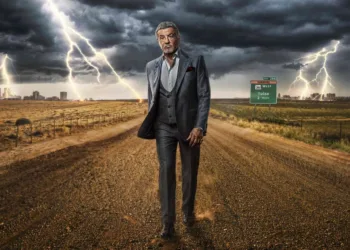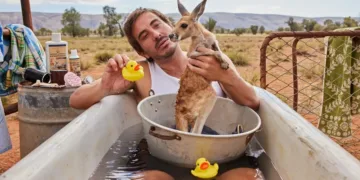







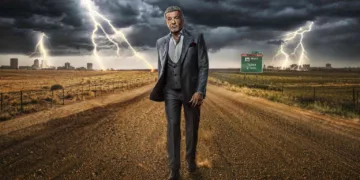











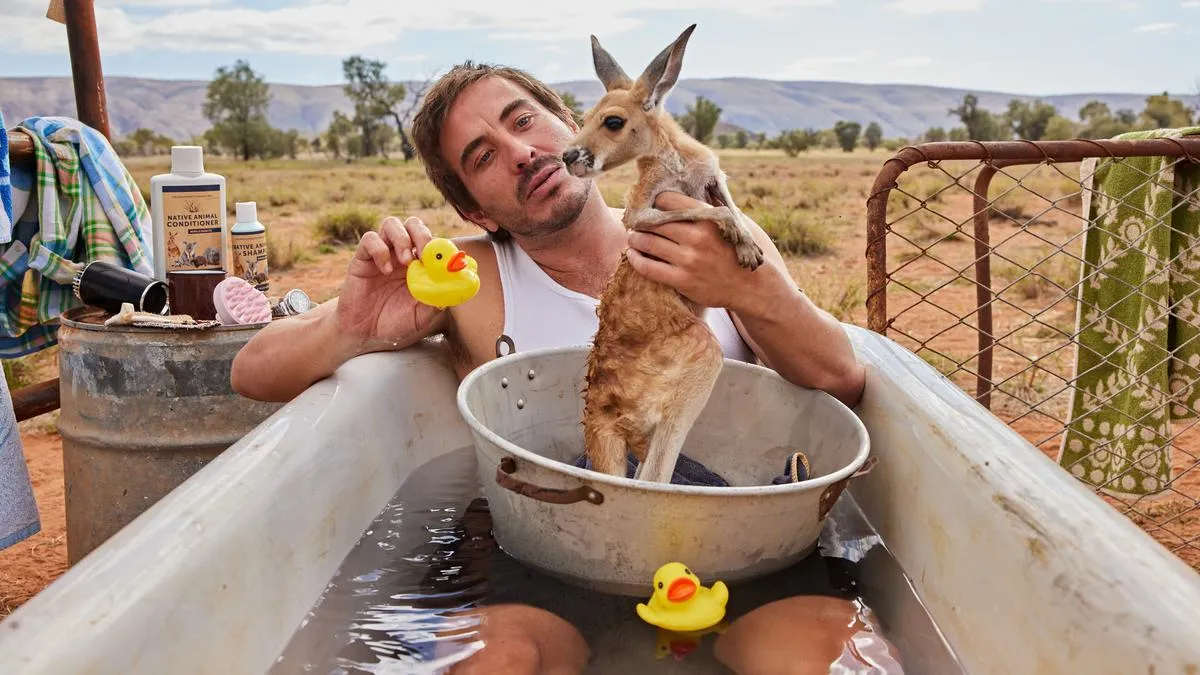

A disgraced television weatherman, a wrecked sports car, and a tiny kangaroo joey. These are the core components of Chris Masterman’s abrupt life change. His public persona implodes in Sydney after a comically ill-fated encounter with a dolphin. His escape route west is then cut short by a collision with a kangaroo on a desolate stretch of highway.
This moment of careless speed leaves him stranded and, more significantly, makes him the caretaker of the joey he finds in its mother’s pouch. The premise positions a man whose career was built on polished surfaces against the dusty, unscripted reality of the Australian outback. He is a character completely unequipped for the responsibility thrust upon him, a predicament that serves as the engine for this story of forced personal reckoning.
A Narrative Core in Search of a Center
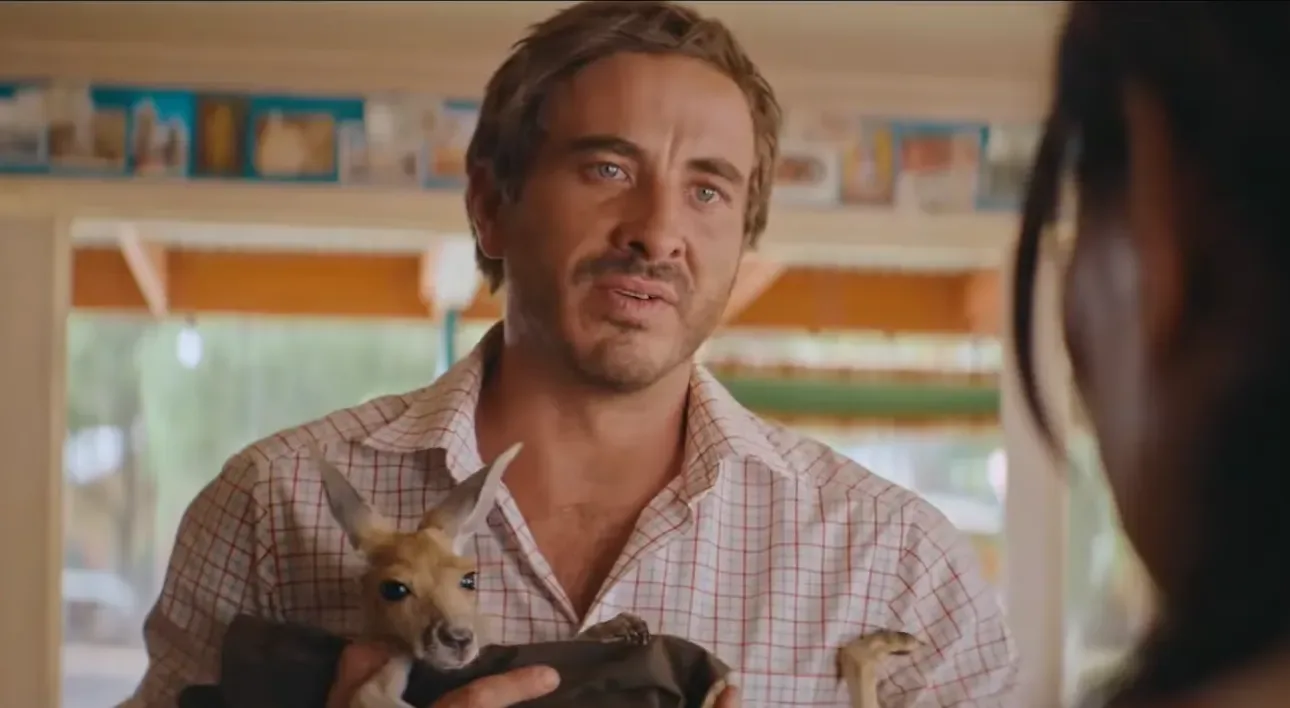
The film’s emotional architecture rests on two very different pillars. We have Chris’s journey, a familiar transformation from urbanite egotist to compassionate caregiver. Ryan Corr capably handles this arc, showing how the mechanical, daily routine of caring for a helpless creature slowly erodes his self-absorption.
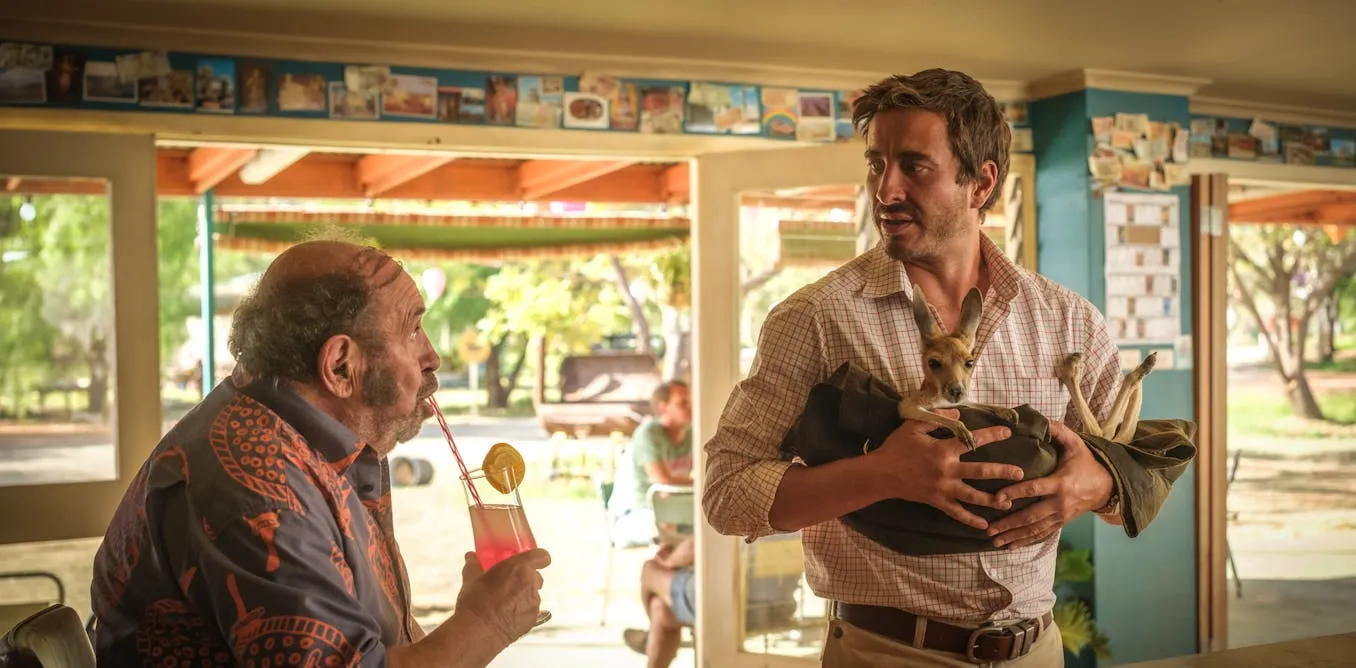
The change is not sudden; it is a gradual process built from sleepless nights and the quiet company of the joey, Liz. Yet, the narrative’s true gravity is found in Charlie, the young Indigenous girl who quietly observes Chris’s fumbling efforts. Played with remarkable poise by Lily Whiteley, Charlie is processing her own deep grief. Her connection to the local wildlife is presented not as a hobby, but as a form of stewardship and a link to her late father.
The script struggles to balance these two stories. At times, Chris’s redemption quest feels slight when set against Charlie’s more profound emotional landscape, creating a sense of divided focus that prevents the story from landing with its full potential weight. The film is steadied by a superb supporting cast. Ernie Dingo’s unhurried mechanic is more than comic relief; he embodies the town’s different rhythm of life, one Chris is forced to adopt. Rachel House, as the local pub owner, provides a sharp, skeptical counterpoint to the town’s growing acceptance of the newcomer.
An Outback Canvas of Calculated Beauty
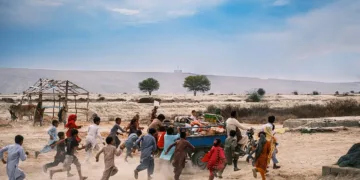
Visually, Kangaroo is impeccably crafted. Director Kate Woods and her cinematographer Kieran Fowler avoid the cliché of a monolithic, threatening outback. Instead, they present a landscape of specific beauty, from the golden light of early morning catching the texture of red rock to the stark silhouette of ghost gums against a twilight sky.
The initial image of Chris’s sleek, out-of-place car against this ancient terrain is a potent visual metaphor for his entire predicament. A major artistic choice that pays dividends is the use of real joeys. In an era of filmmaking saturated with digital creations, the tangible, unpredictable presence of the animals provides the film with its most authentic and charming moments. This grounding realism makes the emotional connections feel earned.
The film’s tone, however, can be uneven. For every scene of quiet, natural beauty, there is another that feels engineered for maximum sentimentality. The musical score sometimes swells too eagerly, and certain editing choices feel imported from a more commercial, less thoughtful picture. This creates a tonal push-and-pull between genuine sweetness and a cloying, manufactured charm.
Ambition Thwarted by Formula
The screenplay for Kangaroo reaches for significant thematic depth. It skillfully attempts to weave a connection between the way kangaroos are often dismissed as pests and the broader cultural condescension faced by rural communities.
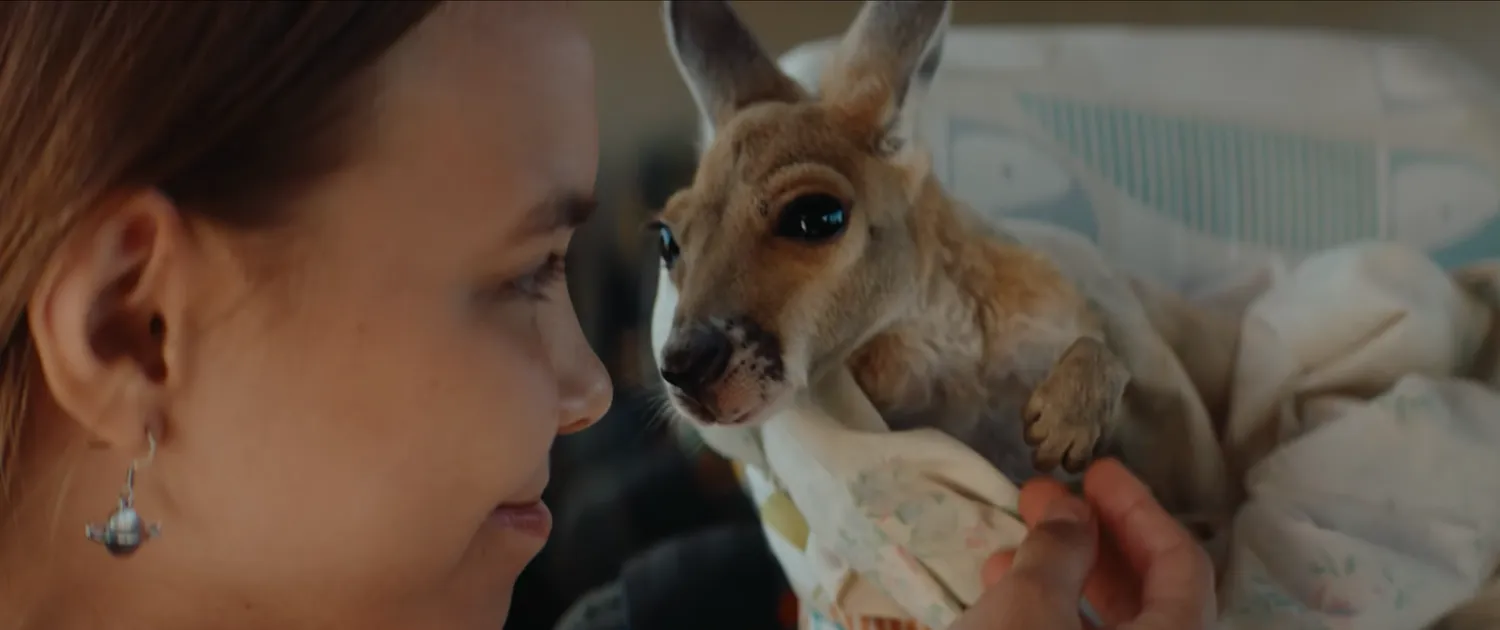
The casual cruelty of a hunter who insists he has a right to kill the animals is positioned not just as a threat to the film’s cute star, but as an extension of an attitude that devalues life outside the city. Chris’s education is therefore twofold: he learns to care for an animal, and in doing so, he learns to see and respect a community he initially disdained. This thoughtful thematic underpinning is what elevates the film above a simple family drama.
The narrative structure, however, does not always serve this ambition. The story follows the redemption template so closely that it leaves little room for surprise. The pacing becomes episodic in the second half, and the antagonist remains a thinly sketched symbol of opposition rather than a believable character.
The film also misses a crucial opportunity to explore the most painful part of animal rescue: the act of letting go. By opting for a neater, happier resolution, it avoids a more complex and honest emotional truth. The result is a film with undeniable beauty and a strong moral center, whose aspirations are visibly constrained by the predictable demands of its chosen formula.
Kangaroo is a family comedy film that premiered in Germany on August 21, 2025, and in Australia and New Zealand on September 18, 2025. It is inspired by the life of Chris “Brolga” Barns, the founder of The Kangaroo Sanctuary in Alice Springs. The story follows a disgraced TV host who becomes stranded in the Outback and teams up with a young Indigenous girl to rescue and rehabilitate orphaned joeys. The film was produced by Cultivator Films Australia, Bunya Productions, and Brindle Films, with StudioCanal handling distribution.
Full Credits
Director: Kate Woods
Writers: Harry Cripps, Melina Marchetta, Danielle MacLean, Peta-Lee Cole-Manolis
Producers and Executive Producers: David Jowsey, Greer Simpkin, Angela Littlejohn, Rachel Clements, Trisha Morton-Thomas, Louise Smith, Marian Macgowan, Anna Marsh, Ron Halpern, Elizabeth Trotman, Marcus Gillezeau
Cast: Ryan Corr, Lily Whiteley, Deborah Mailman, Rachel House, Brooke Satchwell, Rarriwuy Hick, Rick Donald, Wayne Blair, Trisha Morton-Thomas, Ernie Dingo, Emily Taheny, Ryan Clark, Roy Billing, Genevieve Lemon, Clarence Ryan
Director of Photography: Kieran Fowler
Editors: Chris Plummer
Composer: Matteo Zingales, Josie Mann
The Review
Kangaroo
Kangaroo is a film of immense visual charm and sincere intentions, carried by strong performances and the undeniable appeal of its animal stars. Its efforts to explore deeper themes of allyship and community are commendable. The experience is consistently hampered by a deeply predictable script that follows its redemption formula too closely, resulting in a story that is heartwarming but narratively safe. It is a pleasant and beautifully shot family film that chooses comfort over complexity at every turn.
PROS
- Beautiful cinematography showcasing the Australian outback.
- Strong, heartfelt performances from the entire cast, particularly Lily Whiteley.
- The use of real joeys provides an authentic and tangible charm.
- Thoughtful thematic ambitions connecting animal welfare to broader social issues.
CONS
- The narrative follows a highly predictable and formulaic path.
- An underdeveloped antagonist creates a lack of genuine conflict.
- The script's focus feels divided between its two main characters.
- Pacing becomes slow and episodic in the film's second half.