






















Cinema is often defined by its ability to illuminate, to bring what is hidden into the light. The documentary form, in particular, carries an expectation of revelation and clarity. Federico Cammarini and Filippo Foscarini’s Waking Hours challenges this convention by embracing the opposite: it is a film built from darkness and whispers. It locates its story in the deep woods of the Serbian-Hungarian border, a place physically and politically shrouded in shadow.
The film sidesteps the more common narratives of the migrant crisis, which tend to focus on the perilous journey of refugees, as seen in works like Human Flow. Instead, its subjects are the Afghan smugglers who facilitate these crossings, figures who must exist in a state of near-total invisibility. Through an unflinching observational style that rejects narration and interviews, the film immerses the audience in the cold, tense atmosphere of the wait. It is a demanding piece of cinema that asks the viewer to see with their ears and to find a story not in what is shown, but in what is deliberately withheld from view.
The Grammar of Night
The film’s aesthetic is a masterclass in sensory storytelling, where the technical choices are inseparable from the subjects’ reality. Cinematographer Federico Cammarata employs darkness not as a void but as an active, tactile presence.

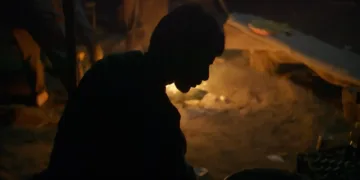
It is a shield that protects the men from surveillance and a constant source of unseen threat. Long, static takes force the viewer’s eyes to adjust, to search the deep black for a flicker of movement or a change in texture. When light does appear, it creates a stark chiaroscuro reminiscent of a Caravaggio canvas.
The orange glow of a campfire sculpts a face out of the blackness, only to let it dissolve back into shadow moments later. This visual language finds a potent parallel in the austere realism of Indian Parallel Cinema, where directors like Satyajit Ray used natural light and shadow to convey emotional truth without artifice.
The sound design is equally crucial. In the absence of a musical score, the environment itself provides the soundtrack. The sharp snap of a twig carries immense weight, while the distant, metallic clang of the border fence is a constant, oppressive reminder of the barrier that defines their lives. The layered sounds of phone calls in Dari create a sense of a larger, unseen network, making this small, isolated camp feel like one node in a vast, clandestine web.
Humanity by the Campfire
For much of its duration, Waking Hours presents its subjects as functions rather than people. They are silhouettes and disembodied voices, their conversations purely transactional, revolving around routes, payments, and “passengers.” A critical structural shift occurs as the camera is allowed closer to the warmth of a campfire.

This ancient, archetypal space of community becomes the film’s emotional stage. Here, the act of preparing and sharing food, specifically the kneading and baking of flatbread, becomes a powerful ritual. It is an assertion of culture and a creation of temporary domesticity in a world of total precarity. It is in this circle of light that anonymity gives way to identity.
We listen as Amanullah, a former Afghan government official, quietly shares fragments of his past. Another, younger man recounts his travels across Europe with a profound sense of disillusionment, his words painting a picture of a continent far crueler than the one imagined.
The power lies in the subtlety of these revelations. They are not dramatic confessions but tired, resigned reflections shared between men who understand each other’s unspoken histories. The film does not pry; it simply waits and listens, earning these moments of trust and transforming its subjects from shadows into men.
The Long Wait for a Phantom Home
Ultimately, Waking Hours is a profound meditation on the state of being in-between. The forest is a physical purgatory, a non-place between a lost past and an inaccessible future. The smugglers exist in a unique state of psychological limbo. They are gatekeepers to a “promised land” for which they themselves seem to hold little hope.

Their work is to guide others across a threshold they are permanently denied, making their existence a cycle of arrivals and departures where only they remain stationary. By refusing to cast moral judgment, the film complicates any simple understanding of the migrant crisis. It presents a stark reality without offering solutions, forcing the viewer to confront the complex human ecosystem that borders create.
The film’s quiet power lingers long after the screen returns to black. It leaves you with the chill of the forest air and a set of resonant questions: What is the human cost of a line on a map? How do people forge a community in the most transient of circumstances? It is a snapshot of an unresolved existence, a moving portrait of lives spent resisting erasure in the long, cold night.
Waking Hours is a 2025 Italian documentary film directed by Federico Cammarata and Filippo Foscarini. It premiered at the Venice Critics’ Week in 2025. The film follows a nocturnal journey in a forest with a group of Afghan migrants waiting on the Serbian-Hungarian border. The film is 78 minutes long.
Full Credits
Director: Federico Cammarata, Filippo Foscarini
Writers: Federico Cammarata, Filippo Foscarini
Producers and Executive Producers: Stefano Centini, Serena Alfieri, Federico Cammarata, Filippo Foscarini, Roberto Minervini, Dario Zonta
Director of Photography (Cinematographer): Federico Cammarata
Editors: Federico Cammarata, Filippo Foscarini, Sara Fgaier
The Review
Waking Hours
Waking Hours is a challenging piece of cinema that rewards the patient viewer. Its power comes from a bold aesthetic, using profound darkness and a meticulous soundscape to forge a deeply sensory experience. The film's steadfast observational method offers a rare, humanistic window into a hidden world, capturing the quiet endurance of men living on the fringes of Europe. It is a potent and unforgettable meditation on displacement.
PROS
- Exceptional cinematography and sound design that create a truly immersive atmosphere.
- Offers a unique and non-judgmental perspective on a rarely seen side of the migration crisis.
- The patient filmmaking style leads to genuinely intimate and earned moments of human connection.
- A courageous and artistically confident approach to documentary filmmaking.
CONS
- The deliberately slow pace and lack of action will not appeal to all audiences.
- Its refusal to provide context or narration can feel disorienting.
- The minimalist narrative leaves many background details and individual stories unexplored.