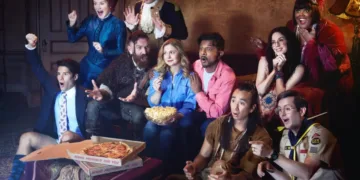






















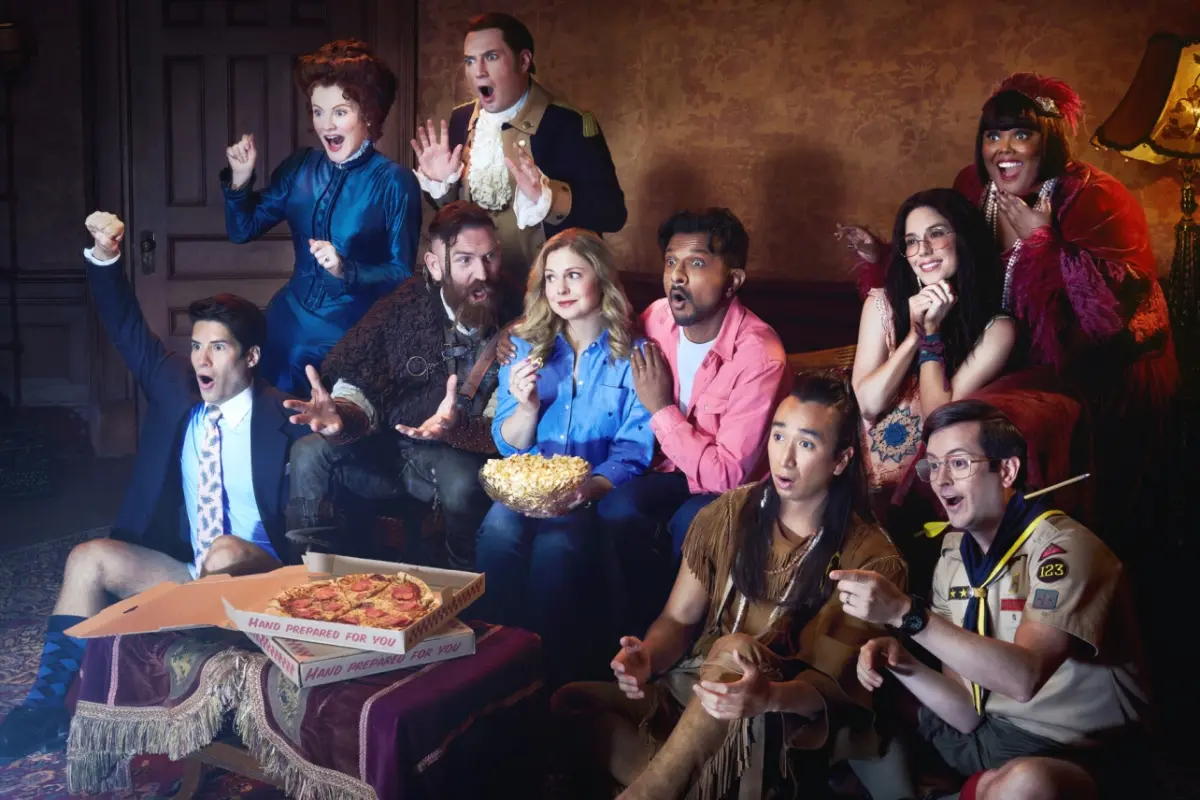

The Woodstone Mansion functions like a fixed stage for history’s oddities, a place where human foibles replay themselves for the entertainment of those still capable of boredom. Ghosts rests on a single philosophical premise: eternity as compulsory confrontation with the past. The American sitcom maps a domestic collision between the living custodians, Sam (Rose McIver) and Jay (Utkarsh Ambudkar), and the motley roster of spirits that arrive with the property. The mash of ordinary cohabitation and high-concept supernatural set pieces is the series’ most fertile laboratory for relational comedy.
The fifth season makes its intentions plain from the first frame. It begins with a clear, immediate crisis, one that centers on Jay’s soul. After an accidental and, in terms that wink toward myth, Faustian bargain with Elias Woodstone (Matt Walsh), a demon posing as a publicist, Jay enters a kind of existential escrow. Elias moves to collect on the debt, which necessitates Jay’s death. The premise, a living man hunted by a contractual supernatural collector, threatens the show’s domestic compact. The premiere “Soul Custody” establishes a register that mixes real stakes with the program’s characteristic low-level, anxious comedy.
The Narrative Calculus of Damnation
The episode’s main conflict, the threat to Jay, is rich with intellectual possibilities. Jay, singular among the living in his inability to perceive most of the dangers around him, treats impending oblivion with modern pragmatism. His escape plan is material in nature: he intends to die, return as a ghost, and take up residence in the mansion’s ghost trap where a tiny recliner already waits. The attempt to hack eternal judgment with architectural ingenuity reads as a wry piece of humor. It signals a contemporary reflex, the impulse to solve metaphysical predicaments through design and gadgetry.
The ghosts’ counterplan exemplifies collective, semi-rational improvisation. They will use Alberta (Danielle Pinnock) to seduce Elias and draw him into a vulnerable form long enough for capture. The plan, by turns elaborate and slipshod, registers the spirits’ stubborn human qualities and their organizational limits.
Here the show makes a conspicuous structural decision: the Elias thread is resolved quickly. Tension that accumulated across season four dissolves inside a single episode. The series signals a preference for episodic resetting. The writers pass on a drawn-out study of demonic coercion or a longer-term role for Elias as a recurring, bureaucratic form of evil. By wrapping the threat early, the script chooses immediate emotional relief over a slow excavation of trauma and consequence. The comedic possibility of Matt Walsh’s Elias as a corporate devil with mundane, petty ambitions is set aside in favor of restoring Woodstone to its cozy equilibrium.
The pivot depends on the “Sucked Off” Revelation, the episode’s decisive event. The capture attempt misfires and ensnares Carol (Caroline Aaron), Pete’s ex-wife, along with Elias. In an unexpected turn, Carol sacrifices her soul to free Jay. Carol, a figure long presented as self-interested and resentful, wins a form of redemption through a final selfless gesture. The exchange furnishes a surprising resolution to her complicated history with Pete (Richie Moriarty) and spares him the loss of a friend.
The theological consequence follows immediately: Carol is pulled out of the Hell portal’s hold. This outcome confirms an important piece of the show’s metaphysics. A single act of unequivocal benevolence can override a lifetime of moral ambiguity. The afterlife, in the series’ terms, assigns weight to moral currency as well as to unfinished business. That rule opens a straightforward path to Heaven for flawed Woodstone residents and establishes a precedent that will shape later trajectories. The exit also functions practically, trimming the mansion’s ghost population so the core ensemble retains prominence.
Spectral Intimacy and The Shifting Demographics
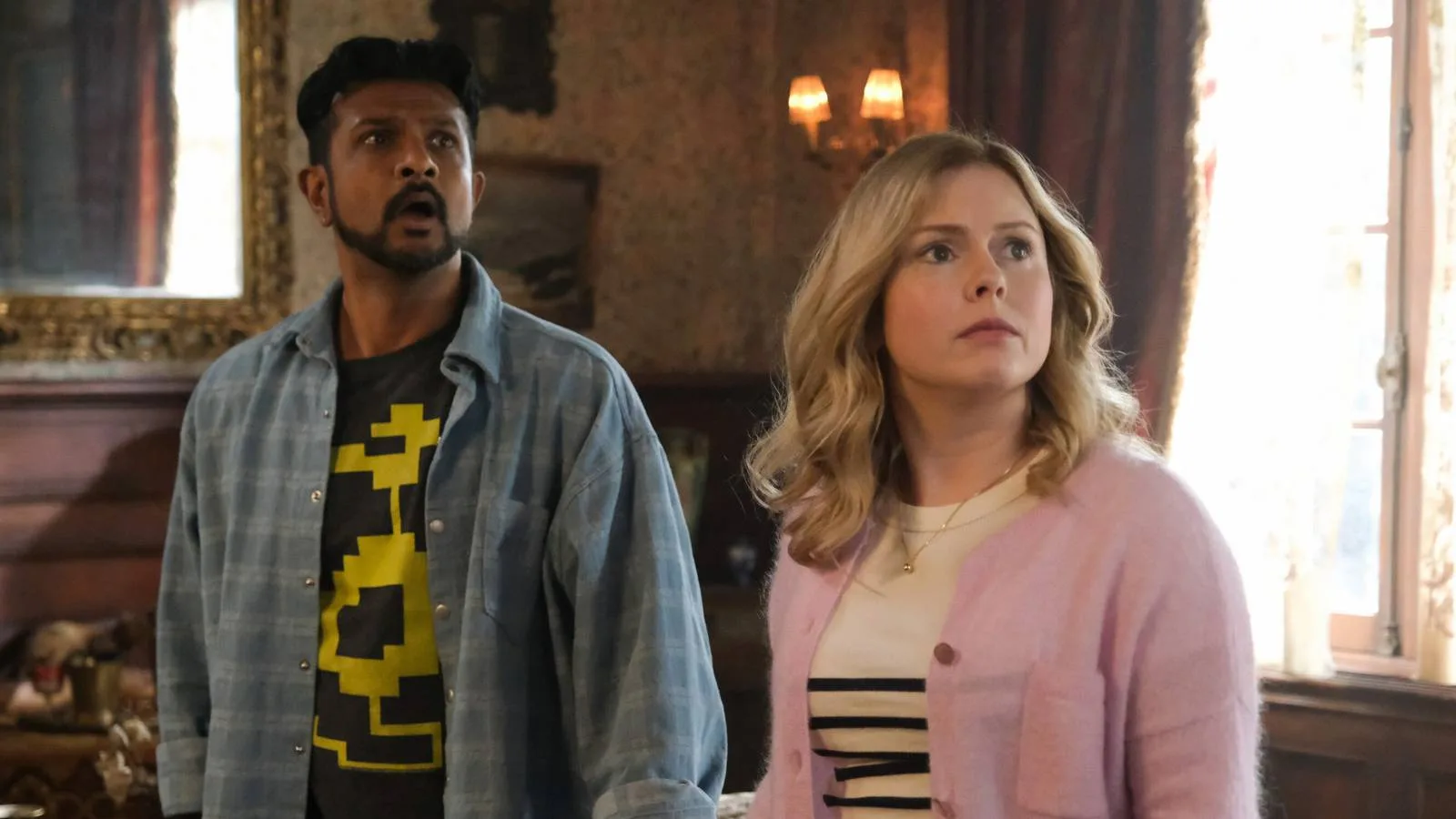
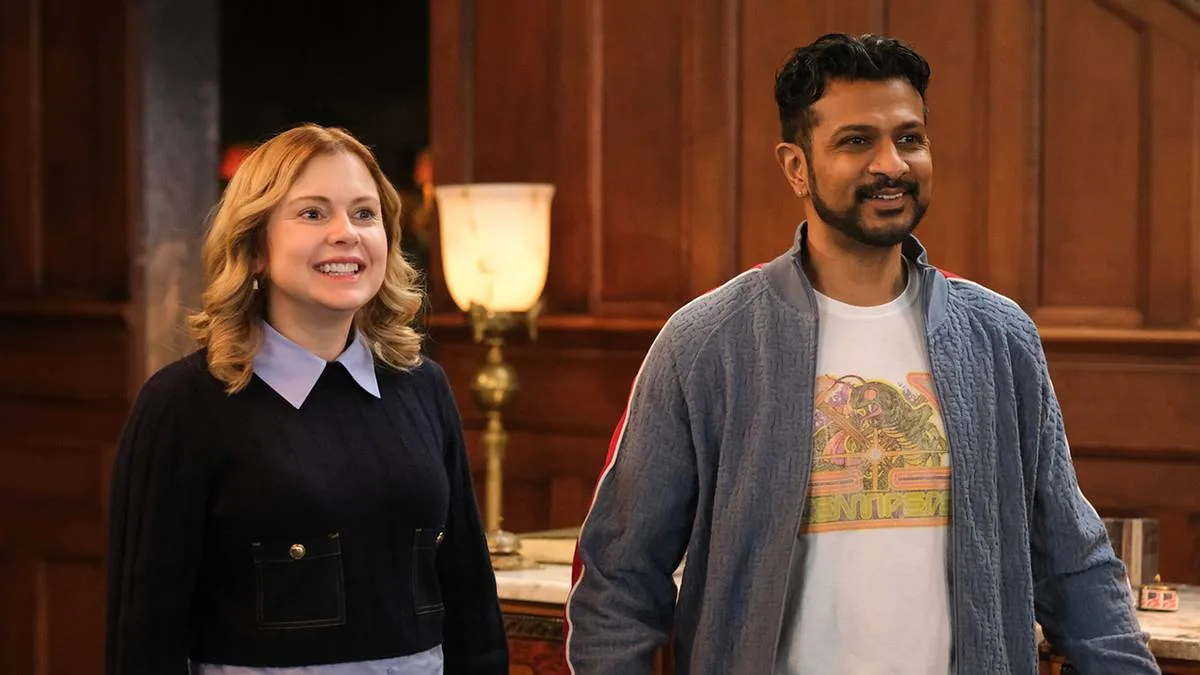
The emotional force of Ghosts derives from the genuine partnership at its center, between Sam and Jay. Rose McIver and Utkarsh Ambudkar produce a warmth that roots the show’s supernatural flights. Ambudkar’s Jay plays the necessary normalizer. His blindness to the majority of the supernatural antics makes his straight-man exasperation the glue of the comedy. He moves rapidly from alarm to dry sarcasm, giving absurd beats a human texture. Sam bears the perceptual load; as the resident medium she is the translator, tactician, and the person who keeps the two worlds intelligible to one another.
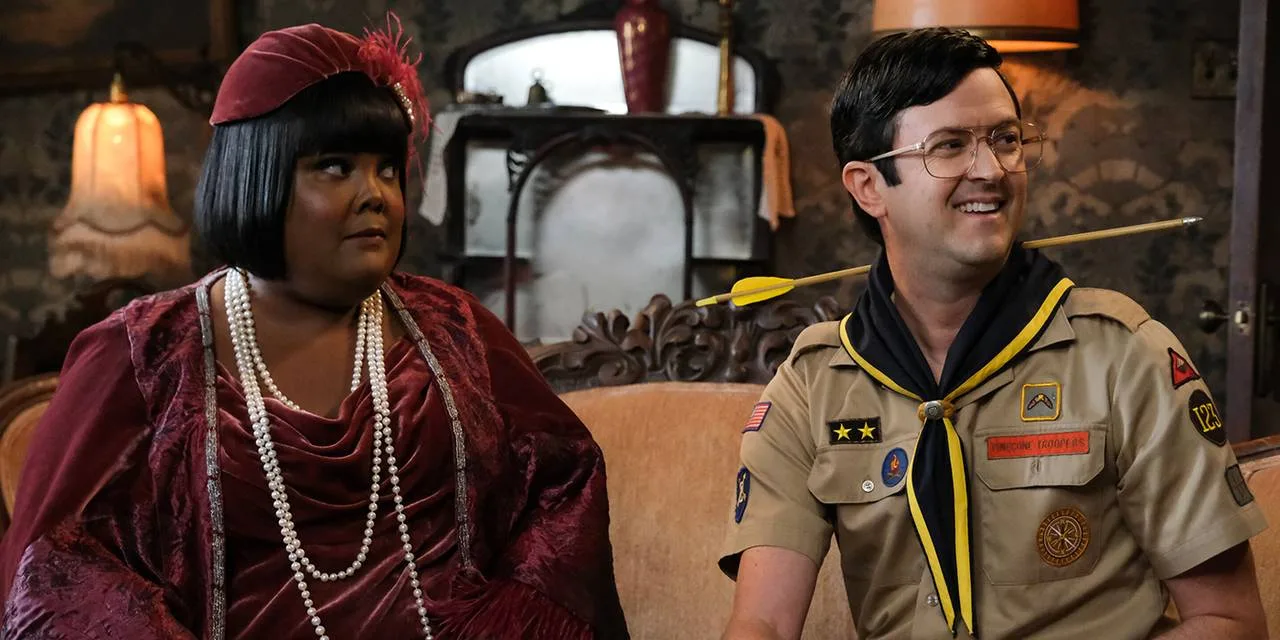
Among the apparitions, Pete and Alberta finally take a step forward together. Their commitment, even as other spirits snipe about it, introduces a playful, wholesome energy. The pairing, between a 1980s scout leader and a 1920s jazz singer, amounts to posthumous courtship and proves that basic desires for connection extend beyond mortal limits. This romance reframes unfinished business as a drive toward simple love.
The ensemble’s margins thicken with attention to Patience (Mary Holland). Her failed attempt to smite Elias becomes a personal reckoning. She faces the gap between righteous posture and inward moral work. That confrontation is an intellectual turn: the recognition that spiritual authority must be matched by private goodness. It marks her progress from outsider moralizer to integrated member of the household. The quieter inclusion of minor ghosts, like Nancy (Betsy Sodaro), in parlor affairs hints at a widening of the Woodstone community.
Performances remain uniformly strong. Brandon Scott Jones (Isaac) sustains a performance of historical ego that balances sharp timing with occasional vulnerability. Sheila Carrasco (Flower) supplies chaotic warmth and stands as counterweight to some of the mansion’s more formal spirits. Her unpredictability prevents the show from settling into repetitive rhythms and acts as a covert emotional anchor for the group.
The Aesthetics of Safety and The Power of the Perpetual Present
A central critique of Ghosts is its loyalty to comfort television mechanics. The program privileges mood and the sensation of warmth over long-term narrative consequence. Its shape favors cyclical return: crisis generates comedic spike and then the story reverts to an established, cozy baseline.
This choice produces a genuine consequence problem. The series raises alarms—near-death moments, demonic contracts, “sucked off” cliffhangers—then resists allowing loss or alteration to persist for the principal characters. The effect is reliably pleasurable viewing but it limits potential for sustained dramatic weight. The show settles comfortably inside its spectral bubble where trauma is temporary and banter persists. That differs from serialized examples where change tends to be durable and earned through true grief.
Still, the comedy remains incisive enough to justify this conservatism. Dialogue is smart and the series exploits anachronism—what the writers call temporal leakage—to comic advantage. The image of Sassapis, a 16th-century Lenape man, describing a “really popular podcast” captures the central joke: history made to confront modern life.
The season’s announced setups suggest the writers retain ingenuity for contained, high-concept episodes. A Viking Wedding and a Mummy Halloween installment promise new, self-contained comic situations. The emphasis on Patience’s arc indicates the season will favor interior, character-focused transformation rather than permanent alteration of the Woodstone foundation.
Final Assessment and Recommendation
Ghosts Season 5 returns with its mechanisms finely tuned. The cast performs at a high level, the humor sustains itself, and the ensemble dynamic continues to provide dependable comfort. The series’ chief weakness is structural caution, a reluctance to permit irreversible consequence to take root, which constrains opportunities for deeper narrative gravity. Even so, the program operates as an efficient and well-crafted engine for warmth and laughter.
One should Stream It.
The show remains warm, enjoyable, and tightly executed. It keeps returning to questions of legacy and redemption and squeezes substantial comedy from those concerns while electing a safer course for storytelling.
The television series, Ghosts (the American adaptation), premiered its fifth season on Thursday, October 16, 2025, on the CBS television network. The show follows Sam (Rose McIver), a woman who inherits a country estate and gains the ability to see and communicate with the diverse spirits who inhabit it, much to the exasperation of her husband, Jay (Utkarsh Ambudkar). New episodes of the comedy air weekly on CBS. Viewers in the U.S. can stream episodes live or on-demand via Paramount+, with episodes available the day after broadcast for Essential subscribers.
Full Credits
Director: Christine Gernon, Jaime Eliezer Karas, Utkarsh Ambudkar, Rose McIver, Katie Locke O’Brien, Nick Wong, Jude Weng, Pete Chatmon, Richie Keen, Alex Hardcastle, Kimmy Gatewood, Matthew A. Cherry, Cortney Carrillo
Writers: Joe Port, Joe Wiseman, Emily Schmidt, John Timothy, Lauren Bridges, Sophia Lear, Guy Endore-Kaiser, Rishi Chitkara, Julia Harter, Skander Halim, Zora Bikangaga, Talia Bernstein, Akilah Green, Josh Malmuth
Producers and Executive Producers: Joe Port, Joe Wiseman, Mathew Baynton, Jim Howick, Simon Farnaby, Laurence Rickard, Ben Willbond, Martha Howe-Douglas, Alison Carpenter, Debra Hayward, Alison Owen, Angie Stephenson, Pat Tookey-Dickinson, Matthew Mulot
Cast: Rose McIver, Utkarsh Ambudkar, Brandon Scott Jones, Danielle Pinnock, Richie Moriarty, Asher Grodman, Sheila Carrasco, Devan Chandler Long, Rebecca Wisocky, Román Zaragoza, Caroline Aaron, Matt Walsh, Mary Holland, Betsy Sodaro
Director of Photography (Cinematographer): Pierre Jodoin, Sylvaine Dufaux, Ronald Plante
Editors: Annie Ilkow, Simon Webb, Hugh Ross
Composer: Jeff Cardoni
The Review
Ghosts Season 5
The fifth season premiere demonstrates that Ghosts remains a masterclass in ensemble comedy, anchored by a phenomenal cast and consistently sharp humor. The series excels at forging deep, meaningful character connections, culminating in powerful moments of redemption and closure. However, its prevailing commitment to the "comfort TV" format leads to a structural conservatism, where high-stakes plots, such as Jay’s debt to the demon Elias, are resolved too swiftly. While expertly written and deeply charming, the show’s hesitation to allow irreversible consequences to linger limits its potential for deeper, long-term narrative impact. It is reliable, funny, and essential viewing.
PROS
- The ensemble maintains an exceptional, warm, and finely-tuned dynamic.
- Jokes, character quirks, and dialogue remain high quality and effective.
- Carol's "sucked off" exit provides an unexpected, powerful arc of redemption.
- The Pete/Alberta romance introduces a fruitful new source of development.
- Focus on figures like Patience allows for meaningful individual growth.
CONS
- High-stakes plots are resolved too quickly, sacrificing sustained tension.
- The reluctance to allow major, permanent consequences prevents deeper narrative weight.
- Adherence to the status quo may eventually lead to plot redundancy despite character evolution.