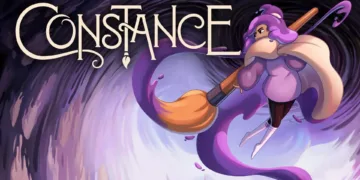










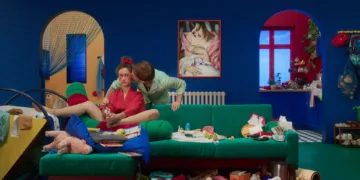
















Constance introduces itself as a beautifully hand-drawn action-platformer, yet the real frame of the experience lies in how that art supports a very specific emotional and mechanical design. The game follows the titular Constance, an artist buried under anxiety, depression, and professional pressure. Her awakening in a strange, painted reality establishes a clear systemic idea: level design, color, and visual damage act as a direct metaphor for her deteriorating mental state. Environments feel bright and charming on the surface, but chipped edges, decay, and broken structures echo her internal strain.
The main quest sends her after four Tears, each one holding a memory that exposes a key source of stress, such as harsh judgment from a teacher or exploitation in a workplace. Each memory feeds directly into the emotional stakes of the run, so every Tear collected functions as both a narrative reveal and a context shift for play. The writing treats these subjects with care and restraint, aiming for a gentle, supportive tone that still confronts heavy material. From a structural perspective, the game feels tightly assembled and approachable, with difficulty tuned in a way that feels deliberate and measured.
Brush Techniques and Consequential Movement
Moment-to-moment play gains its identity from agile, responsive movement. Constance fights and traverses with a massive paintbrush, and that tool anchors the set of brush techniques that drive both combat and platforming. The standout mechanic lets her dissolve into paint and dash, granting a brief window of invincibility that allows her to move through spikes, enemies, and traps. This single action sets the tempo for encounters; the spacing of hazards and enemies trains players to think of the dash as both a defensive escape and a precision movement tool.
Progression follows a classic Metroidvania structure. New brush techniques, such as wall-climbing or bouncing off marked surfaces, come from special canvases found around each zone. Each acquisition alters the mental map of the world, converting familiar corridors into new routing puzzles. Previously blocked paths open up, and the game leans on that loop of “return, reassess, execute” to build a satisfying sense of mechanical mastery.
Ink management ties these systems together. The Ink Meter acts as a shared resource for special moves. Every powered action drains it, and once the meter runs dry mid-sequence, Constance’s appearance darkens. From that point, Ink-linked abilities pull directly from her health pool. This creates a clear risk and reward structure that reflects her mental fatigue: pushing harder has a visible, immediate cost.
Platforming sections shift from pure timing exercises into sequences where players weigh resource expenditure against safety. Later challenges demand rapid chains of techniques, such as sequential dashes, grapples, and bounces in tight windows. The design reaches toward Celeste-style precision, which makes success feel like a hard-earned payoff for players who enjoy exacting control.
For players who care more about the story than the execution of high-tension platforming, accessibility options that reduce incoming damage provide a way to soften the mechanical stress without discarding the emotional arc. That choice respects different play styles while preserving the central link between mechanics and narrative.
Pattern Recognition and Configurable Self-Improvement
Basic paintbrush swings feel straightforward, yet the game layers strategy through the Inspiration system. Enemy types match their regions thematically, such as cyberpunk robots with shields, and they frequently exist to test the player’s understanding of recently unlocked brush techniques. A shielded robot, for instance, requires use of the dash to reach its exposed back, which reinforces the idea that movement tools are combat tools. Encounters become small exams on how well the player has internalized each mechanic.

Boss fights stand out as high points, built around pattern recognition and demanding platforming. One notable battle uses the Paint Stroke grapple as its core test. The boss attempts to heal high above the arena, and the player must chain grapples to close the gap and interrupt the recovery. The encounter forces players to treat movement as a weapon and rewards tight execution. While most bosses feel well judged, occasional auto-scrolling escape sequences spike the difficulty. Those segments can feel harsher and slightly out of step with the careful pacing elsewhere.
Character progression revolves around the Sketchbook, which acts as a constrained inventory grid for Inspirations, the game’s ability buffs. Each Inspiration occupies a specific amount of space, so loadout building becomes an exercise in spatial and strategic planning. Players decide how to allocate room for damage boosts, defensive perks, or movement utilities, and the finite layout keeps those decisions meaningful. Hidden Erasers expand the available space, turning exploration into a way to unlock new build possibilities rather than only raw stat gain. The system pushes players to think about configuration, not just accumulation, and it gives tinkering with builds a satisfying puzzle-like quality.
Death introduces another layer of choice through the Puppet’s Curse. After falling, players can return to the last shrine or choose to “persevere,” restarting in the same room while facing enemies with roughly 50 percent more health and damage. This option injects consequence directly into the loop of failure and retry. Accepting the tougher rematch cuts out backtracking, which appeals to players who prefer continuous pressure, while stepping back to the shrine offers space to reset. The mechanic acknowledges frustration and turns it into a clear, mechanical fork in the road, with each option shaping the texture of the current run.
Visual Metaphors and Narrative Depth
Presentation carries the emotional framework of Constance’s design. The hand-drawn art gives each area a distinct personality while maintaining a cohesive painted look. Locations such as an unsettling cloudy circus and a worn cyberpunk city feel imaginative and moody, tying visual motifs to Constance’s psychological state. Sound design supports that effect, with music that shifts from playful calliope themes to sweeping orchestral pieces. Each area’s soundtrack reinforces the emotional pulse of its encounters.

Exploration leans on a detailed map, complemented by a snapshot feature that allows players to pin notes or screenshots. It serves as a practical tool for tracking side routes and complex backtracking, a small quality-of-life feature that respects the genre’s tendency toward layered level design. Rewards for wandering off the main path skew toward functional upgrades. Secret rooms often contain small health or Ink boosts or crystals for buffs. These finds help with survivability and build expression, yet the most memorable discoveries are often structural, such as uncovering a shortcut that leads straight to a boss arena.
Narrative design ties every system back to Constance’s emotional journey. The main quest is broken up by short, playable memory sequences from her past. These scenes, such as a frantic violin rhythm sequence paired with cruel text from a teacher, transform psychological pressure into input-heavy gameplay. The stress is not only described; it is enacted through mechanics that ask players to feel the tempo and intensity of her anxiety. By pushing players through these focused, overwhelming sequences, the game delivers its message about anxiety and societal expectations in a way that feels direct and sincere.
The story reaches for a relatable space by keeping the specific details of Constance’s trauma sharp enough to feel personal yet broad enough to echo common experiences of burnout. The focus stays on exhaustion, performance pressure, and the fight against inner darkness. Through that framing, the mechanics, art, and sound work together to model how it feels to move through life under constant emotional strain, then carve out moments of hard-earned relief through play.
The Review
Constance
Constance excels by tightly weaving sensitive narrative themes with refined action-platforming mechanics. The core Metroidvania loop is elevated by the unique risk/reward of the Ink Meter and the compelling choice offered by the Puppet's Curse upon failure. While exploration rewards occasionally lack depth, the satisfying movement, inventive boss designs, and profound story about mental health solidify this title as an outstanding entry in the genre. It offers both deep mechanical challenge and genuine emotional resonance.
PROS
- Exceptional mechanical fluidity and responsive controls.
- Sophisticated integration of narrative and gameplay systems.
- The Ink Meter creates a compelling risk/reward challenge.
- Beautiful, cohesive hand-drawn art style and strong audio.
CONS
- Exploration rewards can feel minor (e.g., more crystals).
- One or two boss encounters have erratic difficulty spikes.