


























Devil Jam, from Rogueside, dresses the roguelite survivor formula in a thunderous heavy metal aesthetic. You play a rising rocker in a rock and roll version of Hell. The Devil rules the scene and runs a record label filled with demonic talent. The premise sets a clear objective: fight through infernal hordes and face Death in a grand Battle of the Bands.
The loop lands squarely in Vampire Survivors territory with auto-attacking weapons clearing arenas full of scaling enemies. The twist ties every shot to the beat, so combat fires in lockstep with the soundtrack and turns demon-culling into a metronomic performance.
The Fretboard Strategy
Devil Jam builds a mechanical identity that reads as more than imitation. It keeps the familiar “kill everything, grow stronger” cadence, then layers a rhythm-based system where every primary and secondary attack auto-fires on the musical beat. Survival depends on constant movement and frequent dashes, timed to slip past swarming threats. The design nudges you toward positioning rather than idle tanking, which keeps pressure steady across a run.
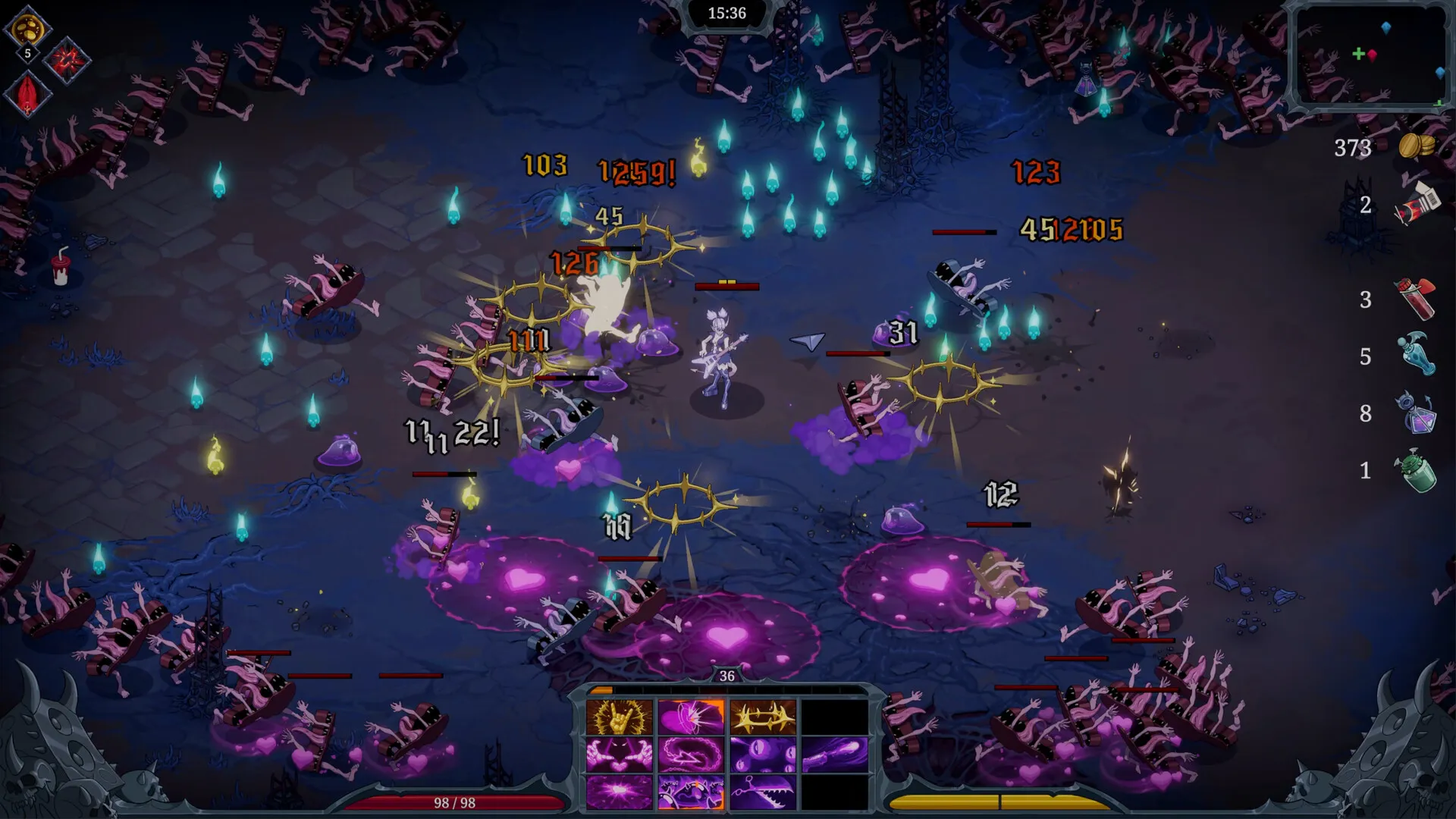
Depth arrives with a 12-slot inventory grid that mirrors a guitar fretboard. You place abilities and secondary weapons into specific slots, and the board cycles activations in a fixed pattern after four hits. Placement drives success. Passive tiles can sit next to weapons to modify them, feeding buffs like higher damage or crit chance to neighbors. Because placement locks for the duration of a run, early choices shape everything that follows.
The Seven Deadly Sins expand the build space with a spread of skills, and the permutations grow quickly. The range of layouts becomes wide enough that repeat runs rarely feel identical. Finished attempts send you back to the Backstage Hub for meta-progression. Quests handed out by the Devil pay currency, and you invest it in permanent stats such as strength and speed, which feeds a steady climb for future attempts.
Art, Audio, and Infernal Flavor
The visual presentation leads the way. Character art stands out, with lively interpretations of the Seven Deadly Sins. Each one holds a label role that fits the theme, like Gluttony as a catering cat and Wrath as Head of Security. Their pop-ups during level-ups add more than numbers, since the designs and personalities sketch small subplots. The effect echoes the flavor-forward approach of a game like Hades, where character moments enrich the grind.
The soundtrack anchors the experience with a mixed outcome. Early tracks set the tone, yet repetition creeps in, most noticeably in the hub. The music shines during a run’s escalation. New instruments fold in after boss kills, and the finale caps the arc with a full vocal track for the fight against Death.
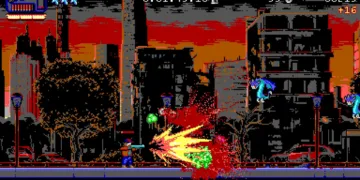
Combat and composition lock together cleanly at that peak. Visual clarity proves the soft spot. When enemies, projectiles, and triggered abilities fill the screen, the bold palette and flashy effects can crowd the view. Losing track of your character becomes easy and can turn big moments, including boss sequences, into avoidable deaths.
Boss Battles and Long-Term Engagement
A standard run lasts about thirty minutes, with wave scaling that keeps the pressure steady from start to finish. The single arena looks striking, yet it offers little environmental change. No distinct biomes or evolving hazards means every attempt unfolds against the same backdrop, which can introduce fatigue over time.

Boss fights sit at the center of the difficulty curve and show up roughly every ten minutes. The first two pull from a random pool for variety, and Death closes every run. Examples like the demon Carlos or Brutus with a tracking fireball ask for precise dodging and a tuned build. Health pools can run high, which pulls encounters toward endurance when a loadout lacks damage. The difficulty scale stays firm throughout.
Clearing a run exposes a content plateau. The same stage, enemy set, and boss lineup remain in rotation. The chief lever for extended play is a stack of difficulty modifiers. For a genre built on replay loops, new biomes or enemy varieties often refresh the experience, and Devil Jam focuses on scaling challenge instead of fresh assets. Veteran survivor fans who prize visual variety may find that single-track progression limits long-term interest.
The Review
Devil Jam
Devil Jam is a stylish, musically driven survivor-like that introduces genuinely clever strategic depth with its 12-slot fret-grid build system. The character art and metal aesthetic are executed excellently. However, the experience is severely hampered by its single, repetitive arena and the lack of substantial new content after completing the first run. The core loop is inventive and addictive, but its long-term replayability suffers due to the content scarcity. It is a solid entry in a crowded genre, distinguished by its mechanics, yet it needs more environments to feel like a complete package.
PROS
- Innovative 12-slot build system allows deep customization.
- Fantastic heavy metal aesthetic and unique character art.
- Rewarding permanent progression system via the Backstage Hub.
- The musical progression during a run is exciting and well-implemented.
CONS
- Monotonous experience due to the single arena/level design.
- Hub music becomes highly repetitive quickly.
- Visual clutter sometimes obscures the player during intense combat.
- Limited incentive for extended play after the first successful run.