





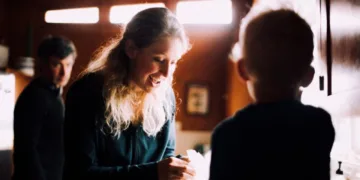








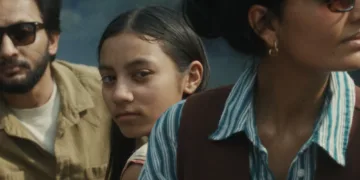










The life of Itto (Oumaïma Barid) first takes shape inside a space of suffocating contradiction, a quiet record of a world arranged along lines of economic and social distance. Moroccan filmmaker Sofia Alaoui’s feature debut, Animalia, begins by tracing the contours of wealth, observing a heavily pregnant young woman kept apart and yet exposed inside the palatial estate of her affluent in-laws. Marble floors, elaborate chandeliers, and a heavy, cultivated silence create an image of luxury that functions like a gilded cage. Alaoui fixes this vision early: domestic, class-based anxiety arrives before the cosmic.
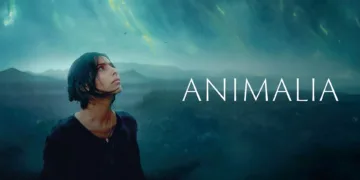
The later turn toward science fiction grows out of this social scrutiny and amplifies it into something apocalyptic. The core narrative emerges once the reality beyond the estate begins to erode. Strange meteorological signs, clouds thick with green lightning and an unnatural stillness, indicate a global disturbance with a mysterious source.
This event cuts Itto off from her husband and from the fragile safety of her marriage, pushing her beyond the controlled household and into a landscape saturated with uncertainty. The film shifts from an airless domestic drama to a solitary passage across the Moroccan terrain, guided by a pressure that feels personal and at the same time echoes a world sliding into spiritual doubt. The closing movement suggests an experience of transcendence, concerned less with decisive action and more with the dissolution of the self into a deep, mystical current.
Class, Isolation, and The Cost of Belonging
The film exposes fractures within Moroccan society long before the cosmic disturbance reaches any peak. Itto’s modest Berber background hangs over her life inside a wealthy, Francophone sphere. This inherited position places her under the cool, precise contempt of her mother-in-law, whose steady passive aggression fixes Itto as an outsider who can enter luxurious spaces yet never truly belong in them. Expectation presses on her from all sides. She negotiates her identity through language itself, drawing on French, Arabic, and Berber as a shifting code, a fragile method of handling her permanent sense of exclusion.
That pressure intensifies for a woman attempting this fraught class shift while carrying a child. The camera studies her early passivity inside the palace, a pose linked to inertia and social constraint. Once she is left behind during her desperate attempt to reach her husband again, that stillness breaks apart.
As she moves alone across the harsh open terrain, her vulnerability draws suspicion and open hostility from men in the villages she crosses. Pregnancy marks her exposed humanity and heightens her precarious state. The disaster framework acts like a philosophical solvent, stripping away the brittle protections of wealth and pushing Itto into direct contact with rural, less privileged communities.
Dusty villages stand as a stark visual and thematic counterpoint to the estate’s polished opulence. Her growing connection with Fouad, a fellow Berber delivery man, carries weight here. He offers a pragmatic link to her origins, and the way they relate to each other quietly questions the values and artificial security that shaped her previous life. The film suggests that social structures fracture first under the pressure of the infinite, laying bare the class anxiety and gendered danger that always existed beneath the surface.
The Aesthetics of Cosmic Dread and Transcendence
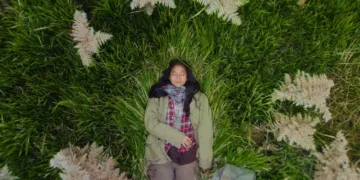
Alaoui and cinematographer Noé Bach work with the monumental Moroccan desert and mountain landscapes, using that scale to place human lives in a state of smallness before an indifferent natural world. Wide-screen compositions turn the domestic drama into an existential one. The tight, ornate comfort of Itto’s home gives way to the exposed, terrifying beauty of a desert road movie. This change in setting matters: the interior space of wealth falls away and the exterior space of the sublime opens.

Tension grows through persistent strangeness, with familiar threats held at a distance. The eerie green lightning, thick unnatural fog, and unsettling changes in animal behavior, dogs that bite with sudden malice and birds that plunge out of the sky, signal a shift in the fabric of reality. The invasion takes shape as an intrusion of thought and perception. Amine Bouhafa’s ominous score, heavy with low cello lines and somber bass, hints at a profound destabilization just beyond what can be seen. The sense of dread draws its strength from ambiguity, because the absence of a visible enemy invites the audience to pour its own anxieties into the void.
The film’s larger ambition appears in its decisive movement away from a strictly plot-driven science fiction climax. In the last third, the narrative leans into a spiritual, Malick-esque transcendentalism. This choice frames the event less as an alien incursion and more as an awakening. The story builds to Itto’s quiet, opaque encounter with the strange, cloud-like mist. Her contact with it appears as a loosening of individual identity into an idea of shared consciousness or interconnected universe.
The “infected” individuals make that notion concrete, speaking from a place of serene conviction, far from terror, repeating, “Everything will be all right.” This final abstraction tests the borders of the genre and treats the event as a philosophical experience and leaves scientific explanation to the side. The film proposes that humanity receives a brief, luminous glimpse of a greater reality, a last revelation granted as the old order dissolves.
Performance and Thematic Resolution
Oumaïma Barid carries the philosophical weight of Animalia through a concentrated, absorbing performance as Itto. She steadies the film as it moves into increasingly abstract territory. Her focus allows her to chart the role’s complex emotional line with clear conviction. Barid traces Itto’s movement from sulky passivity as a constrained daughter-in-law to the fierce, self-directed resourcefulness of a woman in flight. This performance sustains the idea that the cosmic event expresses itself through an intensely personal, human response.
Itto’s movement toward liberation unfolds against collapsing social and sacred structures. The film contrasts crowds seeking reassurance in holy places with a more mystical, agnostic perspective. The suggestion arises that the divine may be as elusive as a black ant on a black stone on a dark night. Itto’s self-understanding grows through personal emancipation gained outside the protective yet restrictive systems of class and traditional religion. Miracle and formal belief do not produce this change.
The film argues that the deepest gain offered by an apocalypse lies in the self-knowledge it compels. Animalia arrives as an eccentric, distinctive, deeply meditative debut. The dense opacity of its last act may unsettle viewers who ask for literal, definitive outcomes from their science fiction, yet the film stands as an alluring, thought-provoking meditation on social fault lines and the force of individual transformation.
The film Animalia is the debut feature from Moroccan-French writer-director Sofia Alaoui. It had its world premiere at the 2023 Sundance Film Festival on January 20, 2023. The story follows a heavily pregnant young woman named Itto who finds herself isolated and forced into a difficult road journey across Morocco when a sudden, inexplicable supernatural event causes the country to descend into chaos and emergency lockdown. This event challenges her position in a wealthy, class-conscious family and forces a spiritual reckoning. While the film has had various limited international releases, interested viewers should check local cinema listings or video-on-demand services, as it is scheduled for a theatrical release in the UK on December 12, 2025.
Full Credits
Title: Animalia (Among Us)
Distributor: Ad Vitam Distribution, Totem Films (International Sales)
Release date: World Premiere: January 20, 2023 (Sundance Film Festival), France: August 9, 2023, UK: December 12, 2025 (Theatrical)
Rating: 12A (UK Classification)
Running time: 91 minutes
Director: Sofia Alaoui
Writers: Sofia Alaoui, Raphaëlle Desplechin, Laurie Bost
Producers and Executive Producers: Margaux Lorier, Toufik Ayadi, Christophe Barral
Cast: Oumaïma Barid, Mehdi Dehbi, Fouad Oughaou, Souad Khouyi, Mohamed Az-El-Arab Kaghat
Director of Photography (Cinematographer): Noé Bach
Editors: Héloïse Pelloquet
Composer: Amine Bouhafa
The Review
Animalia
Animalia is a strikingly ambitious debut that fuses sharp social critique with deeply abstract science fiction, offering a profound, meditative experience rather than conventional spectacle. The film is anchored by a compelling central performance and stunning visuals that elevate the journey of personal awakening against the collapse of rigid social structures. While its highly opaque and mystical conclusion may divide audiences, its thematic depth and visual poetry make it a significant and alluring piece of contemporary world cinema.
PROS
- Blends social commentary on class and gender with existential, cosmic themes.
- Stunning cinematography captures the vast scale and desolate beauty of the Moroccan landscape.
- Oumaïma Barid effectively portrays the transition from passivity to fierce self-determination.
- Successfully creates a distinct atmosphere of dread and spiritual awakening.
CONS
- The highly mystical and ambiguous final act may frustrate viewers seeking traditional sci-fi resolution.
- The meditative tone leads to a measured pace that might feel slow to some.
- The exact nature and function of the "alien" event remain undefined and abstract.
- A few moments of thematic signaling are slightly heavy-handed.