
























![Kingdom Hearts Collection [I-III] Review](https://gazettely.com/wp-content/uploads/2026/10/Kingdom-Hearts-Collection-I-III-1-360x180.webp "Kingdom Hearts Collection [I-III] Review: KHII Holds Steady as Newer Entries Fluctuate 37")



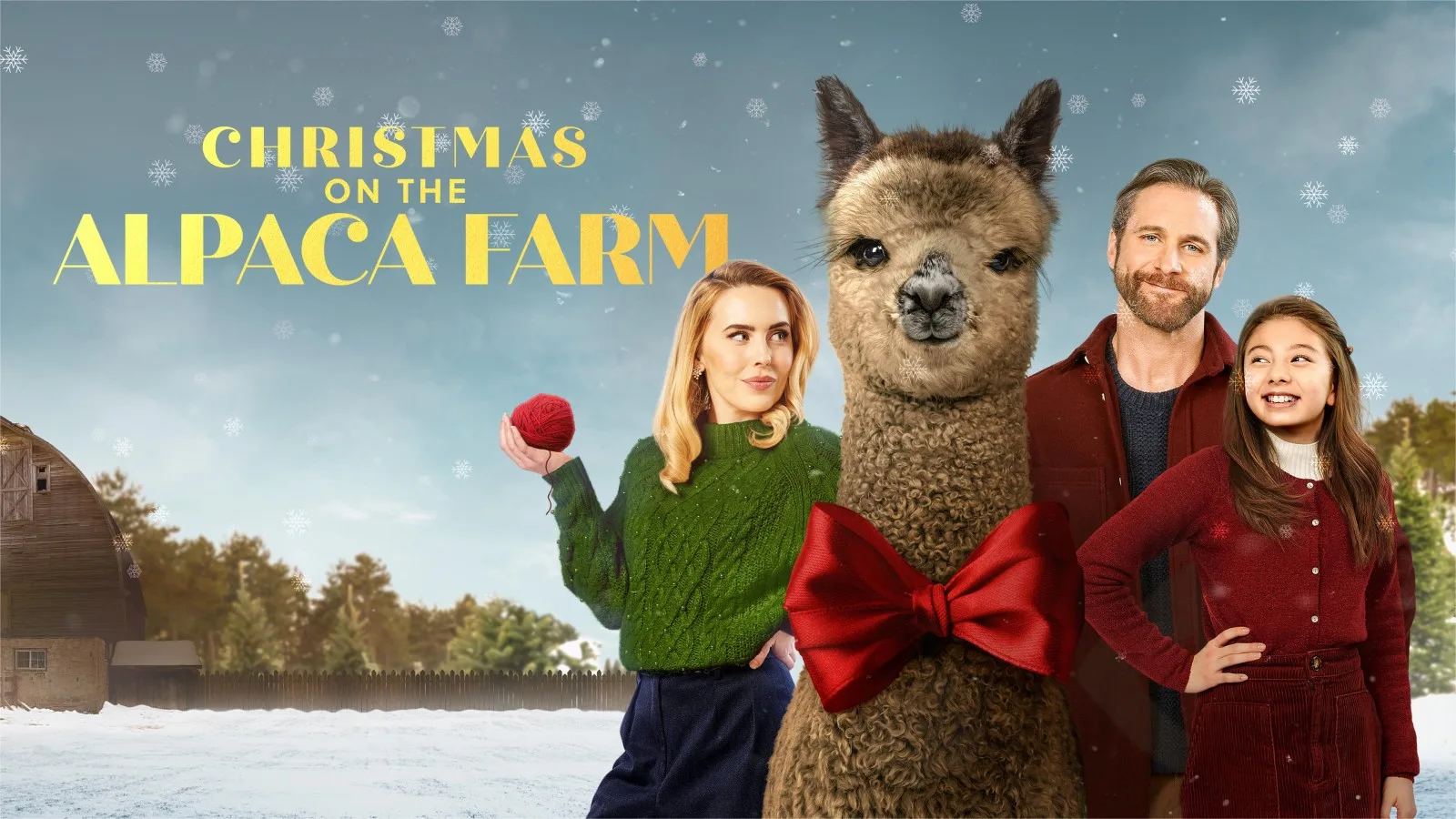

The holiday season returns storytellers to a familiar city-versus-country frame. Christmas on the Alpaca Farm offers a compact example of that frame, presented with festive charm and a focus on ethical fashion. The film began on television and later moved to a streaming platform. It follows Jess, a prominent Christmas-sweater designer in New York City whose professional identity depends on luxurious, sustainable textiles, specifically alpaca fleece. When her high-fashion employer favors cheaper, mass-market materials, Jess resigns and enters the Runway to Christmas contest, where she aims to win the capital and distribution needed to establish her own ethical brand.
Her pursuit of high-grade fiber leads her to Flannery Farms, where Andrew runs a small traditional operation and raises his young daughter, Georgia, after the death of his wife. The farm supplies the fleece Jess seeks, but its finances are imperiled after a broken contract with Jess’s former company. Jess needs the farm’s stock and Andrew’s technical knowledge. Andrew needs an economic solution to preserve the family business.
Their collaboration forms around a clear requirement: Jess must promise to use only 100 percent pure alpaca fleece with no synthetic blends allowed. That agreement sets the story as a negotiation between global aspiration and local integrity, with both Jess’s professional ambitions and the farm’s survival held in balance.
The American Formula and Global Archetypes: The Mechanics of Predictable Conflict
The plot follows the conventions of the American seasonal romance, a pattern that attracts broad audiences because its beats are familiar. A high-achieving urban figure relocates to a rural setting and must engage in physical labor and renewed social ties. The screenplay stages this shift with precision: an initial clash of values, Jess’s comic difficulty with farm tasks, Andrew’s gradual softening, and Georgia’s role as an emotional connector between the adults.
These structural choices speak to a global appetite for escapism in which tradition and personal connection hold moral weight. The Runway to Christmas contest functions as an external pressure that raises the stakes. Narrative tension peaks when Jess, feeling commercial strain, accepts a deal to blend the alpaca fleece for a larger department store. That choice creates a crisis of integrity that drives Andrew away and jeopardizes both the farm and the relationship.
Jess’s public defense of the 100 percent alpaca standard at the fashion show resolves that crisis. Her stand makes visible a commitment to Andrew’s values and redirects her career toward the craftsmanship she advocated. The film pairs that stand with fast reconciliation, an on-screen kiss, and the farm’s financial recovery. Those tidy outcomes illustrate how the genre arranges emotional closure with economy and predictability.
Integrity, Globalization, and The Fleece: A Study in Material Ethics
Material ethics organize the film’s thematic work. Andrew’s insistence on pure alpaca fleece functions as the story’s ethical benchmark. The narrative contrasts that benchmark with the waste and synthetic compromises associated with mass production, represented by Jess’s former employer. Dispute over fiber composition raises questions about globalization: local quality and artisanal practice face pressure when markets demand scale and lower prices.
On-screen alpacas provide recurring visual evidence of craft. The film devotes time to the animals, using close shots that emphasize texture and warmth. Those images aim to translate tactile qualities into cinematic sensation, often invoking the “squish” and “nuzzle” associated with high-grade yarn.
Seen through a cross-cultural lens, the screenplay simplifies a technical debate into an ethical rule. It treats 100 percent alpaca as a marker of purity. Viewers with experience in yarncraft will recognize practical reasons for fiber blends, which add elasticity and shape retention and prevent garments from losing form.
The film frames these technical trade-offs in moral terms, which reduces material complexity to an ethical binary. The production responds to that simplification by giving the product a localized identity, most notably through a hue called Flannery Blue, a color tied to the farm’s early-morning sky and to the lineage of place.
Production and Performance Context: The Aesthetics of Comfort
Assessing the production quality of Christmas on the Alpaca Farm begins with its identity as a television movie that privileges comfort. The visual design supports that identity: the lighting is bright and functional, the staging economical, and the overall budgetary footprint apparent. The film avoids cinematic stylization and instead presents a familiar, safe look that aligns with seasonal programming.
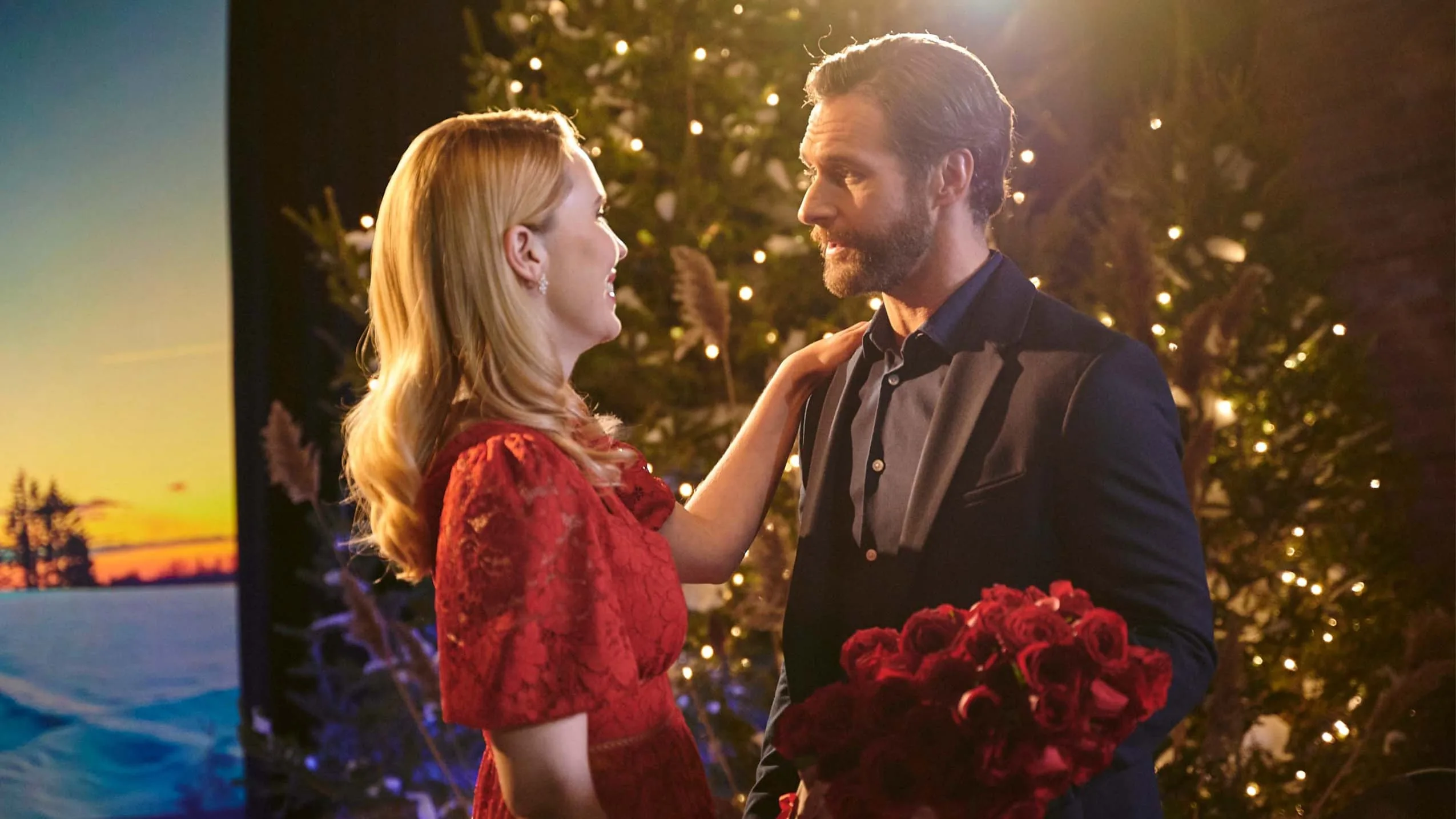
Kirsten Comerford and Matt Wells give performances calibrated to those formal choices. Comerford plays the ambitious designer and Wells plays the reserved farmer; both deliver portrayals that align with narrative needs and genre expectations. The acting keeps emotional registers accessible and sustains the romantic tension required by the plot without attempting deep stylistic daring.
Dialogue in the film signals mood directly. Lines such as “It feels like joy… like Christmas” serve as clear mood markers that guide audience response. The script favors straightforward exchanges that move scenes from conflict toward resolution with minimal ambiguity. Camera work and editing emphasize legibility and steady pacing over experimentation.
Measured against high-budget cinema, these elements may invite critique for their conservatism. Measured within the holiday romance format, they meet the project’s goals. The film condenses the conflict between corporate life and small-business craft into a compact, comforting feature, and the alpacas provide a tactile charm that reinforces the production’s warm, accessible tone.
Christmas on the Alpaca Farm is a holiday romance film that premiered on Lifetime on November 12, 2023. The movie follows a high-powered NYC Christmas sweater designer who quits her job over a conflict involving sustainable alpaca fleece and subsequently teams up with a struggling, widowed alpaca farmer to enter a major fashion competition. While it was initially released on Lifetime, the movie has since been made available on various streaming platforms, including Netflix and the Lifetime Movie Club, offering viewers a cozy, predictable dose of festive cheer.
Full Credits
Title: Christmas on the Alpaca Farm
Distributor: Lifetime, Netflix, A&E (Original Network/Studios varied by region/release)
Release date: November 12, 2023
Rating: TV-PG
Running time: 1 hour 30 minutes (90 minutes)
Director: Michael Kennedy
Writers: Michael Musi, Madison Walsh
Producers and Executive Producers: Jordana Aarons, Michael Kennedy, Michael Musi, Suzanne L. Berger, Fernando Szew, Hannah Pillemer, Jessica Labi, Tim Johnson, Barry Goldstein
Cast: Kirsten Comerford, Matt Wells, Ai Barrett, Diana Diaz, Samantha Espie, Rachael Crawford, Thom Zimerle, Golden Madison
Director of Photography (Cinematographer): Ryan Knight
Editors: Owin Lambeck
Composer: Kim Ho, Aleks Schürmer
The Review
Christmas on the Alpaca Farm
The film functions as a wholly predictable, yet strangely comforting, holiday confection. It skillfully uses the ethical conflict between sustainable alpaca farming and fast-fashion compromises to power its familiar romance structure. While the production quality is distinctly low-budget and the performances are serviceable rather than inspired, the movie delivers exactly the type of wholesome, low-stakes escapism the genre demands. The endearing presence of the alpacas helps sustain interest, anchoring the narrative’s appeal. It is a formulaic tale where integrity wins and the small business is saved, providing a reliable dose of festive cheer.
PROS
- Addresses the modern conflict between artisanal integrity (100% alpaca fleece) and commercial compromise (blending fibers).
- Adheres closely to the beloved, predictable structure of holiday romance, offering comfort and wish-fulfillment.
- The alpaca farm setting provides a fresh, charming backdrop and highlights a niche industry.
- The animals themselves are an undeniable source of visual appeal and endearment, elevating the overall mood.
CONS
- The narrative follows every expected beat of the genre, offering few surprises.
- The movie possesses a functional but distinctly low-budget aesthetic and simplistic visual storytelling.
- The thematic conflict over material blending simplifies a complex issue in textile science into a moral absolute.
- The acting is competent but does not elevate the dialogue or characters beyond their archetypes.