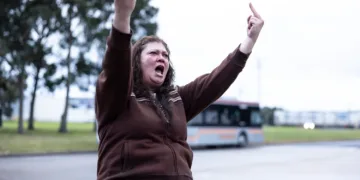



















Kateryna Gornostai charts the terrain of a nation’s young people, caught where inherited rituals of childhood meet the hard mechanisms of war. Filmed between March 2023 and June 2024, the documentary rejects the comfort of distance and plants its attention inside classrooms in Lviv, Bucha, and Borodianka. Onscreen titles arrive like grim coordinates, identifying each place by its distance from the front lines, turning ordinary kilometers into a language of risk and mortality.
The film follows a single school year, a cycle that usually promises continuity. Here, continuity takes on a different meaning. Learning reads as a quiet act of refusal in a landscape where destruction presses against the glass and the walls. Gornostai records a population living in a narrow interval between memory and the possibility of erasure. She keeps her gaze on the material facts of invasion, showing how education tries to carry a collapsing horizon while students and teachers wait for the next alarm.
Light and the Architecture of Absence
The film’s visual grammar commits to observation, leaving aside talking-head interviews and the packaged urgency of news archives. Oleksandr Roshchyn’s handheld camera moves with the bodies it follows, threading through crowded gymnasiums in restless lines that echo the students’ own kinetic charge.
That roaming energy meets the stillness of wide frames that hold vacant corridors and hollowed classrooms. The emptiness becomes its own statement: institutions designed for life now hold quiet, the kind that arrives after flight, after loss, after impact. The vacant spaces feel like rooms remembering what they used to contain, their silence pressing against the edges of the frame.
Light does its own ethical work here. Warm, intense tones recur, bathing faces and desks in a gold that reads like shelter, like a fragile insistence that childhood remains visible. The glow never cancels the surrounding concrete and grey; it sits beside it, precarious. The warmth suggests protection while also admitting how thin protection can be. The camera returns again and again to this tension between a lit interior and a damaged exterior, as if asking what it means to build a temporary sanctuary inside a world that keeps breaking.
Sound carries a parallel weight. Alexey Shmurak’s score uses avant-garde a cappella female voices, choral lines that rise and fall like a shared breath trying to steady itself. The voices feel spiritual and intimate at once, a human presence that refuses to become background. Their cadence is interrupted by the wail of air-raid sirens, a sound that functions like punctuation in daily life, carving time into before and after.
Gornostai’s attention settles on small, stubborn details: the blue and yellow of a student’s socks; a small child sprinting with unguarded joy through a building whose roof has been peeled back by a missile. The film suggests that, under enormous violent shifts, truth hides in what remains tangible, immediate, and seen up close.
The Pedagogy of the Wound
The title gathers meaning through the lessons the film watches unfold. A timestamp is the mark written on a tourniquet, the notation of the moment life begins to be counted through blood flow and deprivation. In Gornostai’s framing, education expands to include the procedures that keep the body alive.

Teen students handle rifles and fasten medical ties with a grim, trained efficiency that implies a future shaped by the ongoing state of conflict. The instruction reaches down to the youngest children. Teachers explain how to recognize boobytrapped toys and landmines shaped like harmless objects. They learn what to pack for sudden evacuation, delivered in the same measured classroom voice used for arithmetic.
The mind’s adaptation is mirrored by the adaptation of space. When schools collapse into rubble, teaching migrates to subway platforms, private backyards, damp basements. Equations appear on chalkboards in near-darkness. Physics emerges from the practical necessity of bomb shelters, principles delivered as a matter of structure and survival. History changes texture, turning into active defense of national identity against a force that seeks disappearance.
Each day begins with a ritual minute of silence, a collective pause that obliges the living to face the void left by the dead. Death is stitched into the school day as routine, and routine becomes a method of endurance. Knowledge becomes weapon-like in its function, and the classroom takes on the posture of a trench. The film points toward a consciousness being remade under the constant expectation of sudden, violent interruption, a way of thinking trained to live with the next siren already anticipated.
The Persistence of the Finite
An emotional divide emerges between children and the adults trying to shield them. On playgrounds, the youngest students burst into euphoric motion, an energy that seems to exceed their surroundings. Their laughter feels like a brief victory over gravity, a reminder that play rises from something deep and stubborn in the species. Teachers and parents carry a different weather in their faces: exhaustion, contained grief, the fatigue of vigilance.
Their burden shows in bomb shelters during singalongs, voices stretched into reassurance they know cannot be guaranteed. One young girl walks into a school library and collapses at the sight of her deceased father’s portrait on a wall of commemoration. The moment lands with a kind of nakedness that no institution can soften. The school absorbs it and tries to place it inside the day, as if grief can be taught to sit quietly in a desk.
The film also records the funeral of a beloved principal, forcing students to face the fact that mentors share the same vulnerability as the buildings they occupy. Everyday adolescence continues through this exposure. High schoolers film TikTok videos. They rehearse dance routines for graduation. They mark birthdays with small cakes in the dim corners of shelters. Regular life takes on the shape of resistance, a refusal to let invasion claim every gesture, every rite, every hour. Graduation arrives with traditional folk dances and a soundtrack of Abba, a celebration that feels desperate and luminous at once, a milestone balanced between ending and beginning.
Visiting soldiers speak to the class of 2023 and tell them their lives belong to them. The line carries a haunting ambiguity, spoken to teenagers standing at the edge of adulthood in a country still under fire. Gornostai’s film keeps returning to the experience of finitude: time measured by sirens, by minutes of silence, by the marks on a tourniquet. These students appear forged inside a state of constant, shifting adaptation, learning how to inhabit the present while the future remains dark and unwritten, a script withheld by circumstances that refuse to settle.
Timestamp premiered on February 20, 2025, in competition at the 75th Berlin International Film Festival and saw its North American debut at MoMA in late November 2025. The film offers a mosaic-style observation of teachers and students across Ukraine, from Bucha to Lviv, as they attempt to maintain the continuity of education amidst the ongoing Russian invasion. As of December 2025, the documentary is primarily available through specialized theatrical screenings, festival circuits, and via regional independent distributors like KimStim.
Full Credits
Title: Timestamp (Strichka chasu)
Distributor: Best Friend Forever, KimStim, Dulac Distribution, Cherry Pickers
Release date: February 20, 2025
Rating: CFF-15, NR
Running time: 125 minutes
Director: Kateryna Gornostai
Writers: Kateryna Gornostai
Producers and Executive Producers: Natalia Libet, Olga Bregman, Victor Shevchenko, Zoya Lytvyn
Cast: Olha Bryhynets, Borys Khovriak, Mykola Kolomiiets, Valeriia Hukova, Mykola Shpak
Director of Photography (Cinematographer): Oleksandr Roshchyn
Editors: Nikon Romanchenko
Composer: Alexey Shmurak
The Review
Timestamp
This documentary is a profound meditation on the resilience of the human spirit within a fractured reality. It rejects sentimentalism, choosing instead to document the quiet, persistent rhythm of life as it adapts to the presence of death. By focusing on the intersection of education and survival, the film captures an existential transition that feels both intimate and universal. It is a haunting, luminous record of a generation being forged in the dark.
PROS
- Visually striking observational cinematography.
- Emotional and evocative a cappella score.
- Honest, unvarnished look at childhood in wartime.
CONS
- Occasional pacing issues in the middle sections.
- The sheer number of locations can feel dizzying.
- Some individual stories lack deep narrative closure.