





























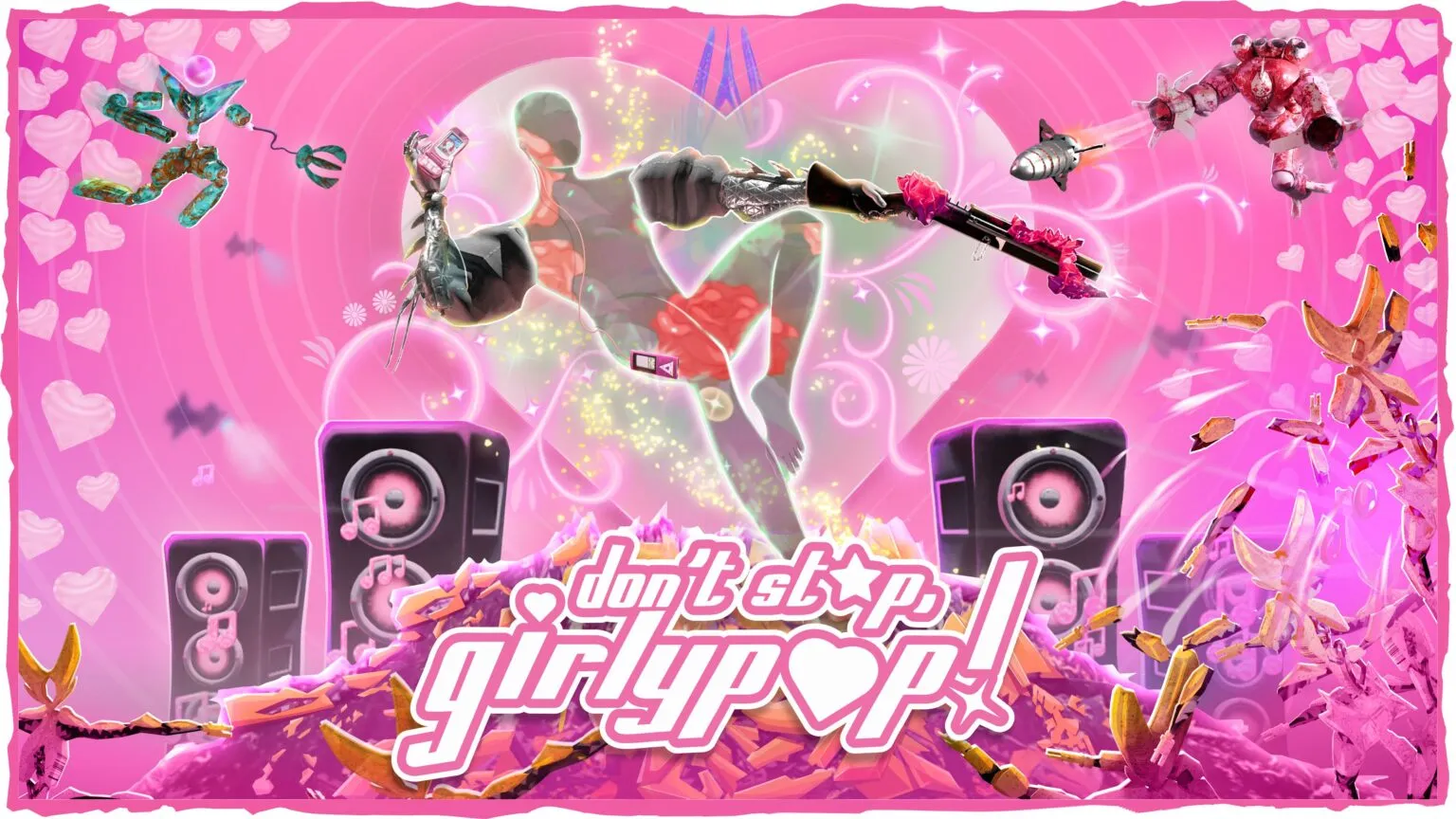

Don’t Stop, Girlypop! lands like a fluorescent dare aimed at a shooter scene that often prizes soot, steel, and restraint. Developed by Funny Fintan Softworks, the game plays like a digital dig through the early 2000s, pulling from the hyper-feminine look of “Dollz” avatars and the maximalist buzz of the Y2K internet. You step into the platform shoes of Imber, a half-faerie on the planet Xyzanthynum, charged with protecting a natural resource called “The Love” from the Tigris Nix mining corporation.
The corporate-threat outline reads familiar on paper, then the delivery reclaims it through objects that feel pulled from a childhood desk drawer. Mission updates arrive through a low-bitrate video call on a pink clamshell flip phone or through a digital tamagotchi, turning exposition into a toy-box interface and making the stakes feel filtered through nostalgia.
That same cultural signal carries into the design’s governing idea. The game treats motion as the price of staying alive. Damage output and health regeneration hinge on velocity, so speed becomes the condition for survival and aggression becomes a movement problem. The shooter fantasy turns into choreography, a “kinetic manifesto” that asks you to keep pushing forward, keep chaining actions, keep converting momentum into power.
Seen through a cross-cultural lens, the premise reads like a response to a global genre language that has long coded toughness as grit. Don’t Stop, Girlypop! chooses a glossy, hyper-feminine vocabulary and insists it can communicate force with the same clarity. The tone is playful, then the mechanics back it up with a strict rule set that rarely lets you relax.
The Architecture of Momentum and the Wave Hop Ritual
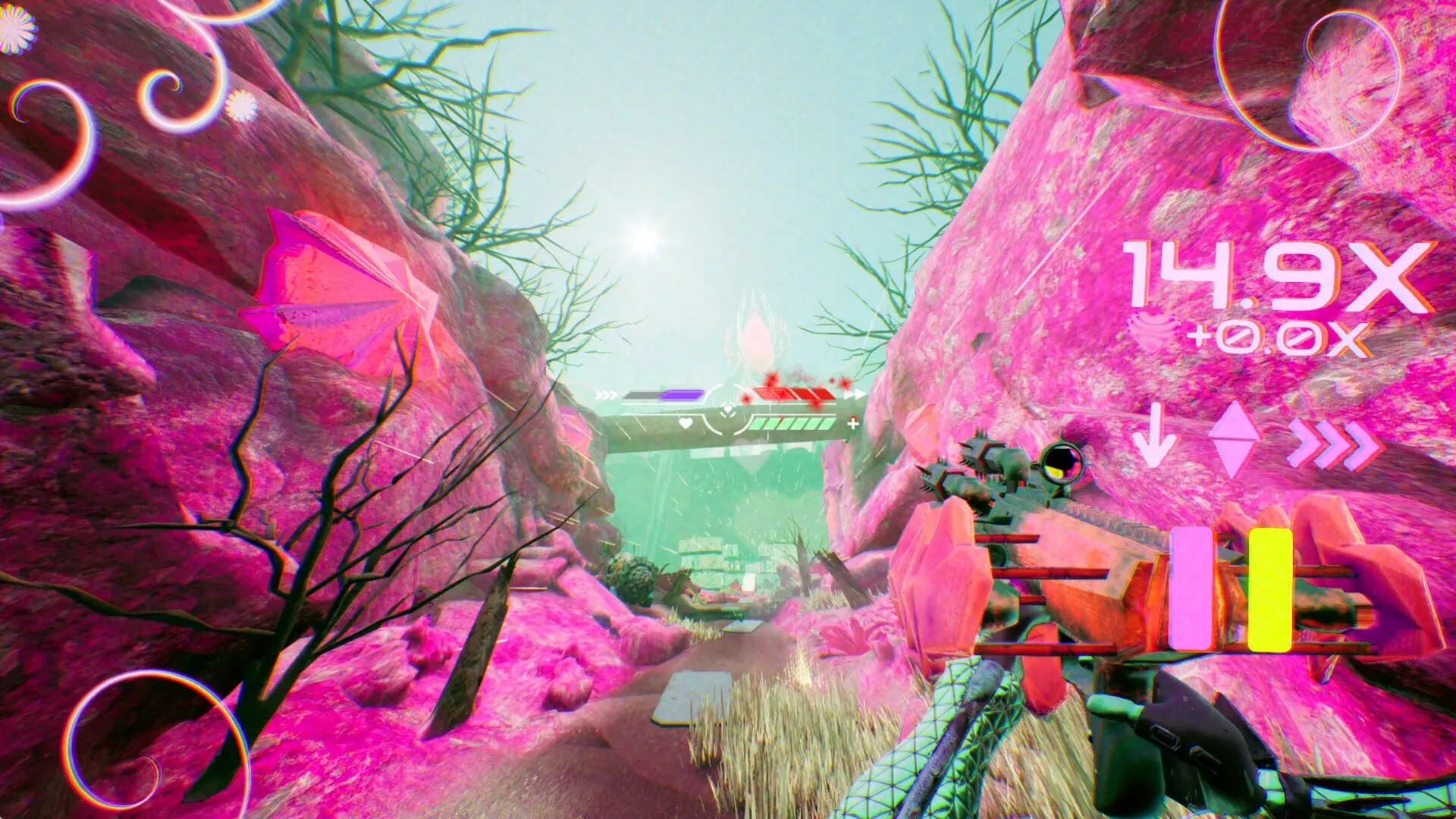
The mechanical center of the experience is the Wave Hop, a traversal technique with the timing pressure of a rhythm game. Layer a ground slam, a dash, and a jump inside a tight window and you trigger a pink silhouette plus an audible “whoosh” that signals a major speed boost.
Movement stops feeling like basic transportation and becomes a practiced skill. You begin to read spaces as launch lines, angles, and routes, where terrain exists to be converted into vectors. That framing matters because it shifts how the game communicates. It teaches through sensation and repetition, closer to learning a dance step than learning a loadout.
Level design supports this horizontal flight. Wide-open arenas and craggy rock formations give you room to chain maneuvers and correct mistakes without instantly collapsing your run. The toolkit keeps you moving: wall-running, rail-grinding, and a grappling hook push you away from pauses and toward continuous flow.
In sprawling combat zones, these systems click because the world seems built for forward drive. The geometry encourages long lines and sweeping turns, and the reward loop reinforces it by tying health and damage to speed. Narrative and mechanics meet here in a simple proposition. Protect “The Love” by staying in motion, by treating stillness as vulnerability, by making movement feel like identity.
The tension shows when the game steers you into traditional platforming demands. Jump height sits on the low side, and the physics feel tuned for horizontal carry. Sections that require upward movement can choke the smooth momentum you built on flat ground. The engine’s limitations become visible in those sequences. Speed can feel godlike across open terrain; a set of high ledges can feel sticky and slow.
Camera and aiming sensitivity add friction during high-speed wall runs, since the view sometimes shifts in ways that make target tracking harder. The game sells a fantasy of freedom through speed, then the geometry occasionally reins it in with platforming expectations that do not match the rest of the design’s priorities. That mismatch reads as a mechanical accent clash: one part speaks in forward rush, the other speaks in careful hopping and precision climbing.
Bubblegum Ballistics and the Philosophy of the Makeover
Combat operates like a high-speed puzzle, and the arsenal treats utility and destruction as equally valuable. The weapons arrive with a sense of playful specificity. A Magic Wand functions as a gravity gun, letting you hurl environmental hazards like exploding barrels into the fight. The shotgun turns into a close-range workhorse with an alternate fire that launches a bullet-spraying orb.

Shoot that orb mid-air and it can clear an entire room, turning a single shell into a concentrated burst of crowd control that reads like a fireworks trick. The SMG and Sniper Rifle fill more familiar roles, and the SMG still finds room for mischief by trapping enemies in bubbles of pink goop. For players who want a closer, sharper rhythm, the katana lets you deflect incoming projectiles and land finishing moves that fling you across the map toward the next target.
High-level play leans on weapon swapping that skips reload animations, keeping damage flowing with minimal downtime. That tactic fits the game’s thesis because it treats interruption as the enemy. When the inputs line up, the action can settle into a “flow state,” with gunfire blending into the hyperpop soundtrack until combat feels like one long measure of sound and motion.
The aesthetic layer ties directly into this mechanical tempo. Hit a function key and you can pause to apply stickers, bows, and glitter to your weapons. The “makeover” mechanic is woven into the identity rather than treated like a side activity. It suggests that presentation and performance matter here, that the look of the gun sits alongside its fire rate in the game’s value system.
Collectibles extend this arcade-leaning sensibility. Hidden finds can unlock retro filters or “big head” modes, leaning into an era of playful modifiers and exaggerated presentation. Enemies, often pink killer wasp robots, burst into showers of hearts. The violence is stylized through symbols and color, with “The Love” functioning as the thematic currency of conflict. The game frames combat as spectacle, and it commits to that framing with effects that make each kill feel like a pop-art detonation.
Sensory Overload and the Ethics of Accessibility
Sound acts as the game’s pulse. A relentless hyperpop soundtrack, filled with high-pitched female vocals and club-style beats, locks onto your movement. Land a perfect Wave Hop and the music seems to swell, giving the speed boost a physical sense of payoff. The shooter becomes performance. The rhythm of inputs and the rhythm of the soundtrack start to mirror each other, which makes the aesthetic feel less like decoration and more like a system that communicates success, timing, and momentum.
That alignment also speaks to the game’s cultural roots. Y2K internet style has always traveled well across borders through music, fashion, and online identity play, and Don’t Stop, Girlypop! treats that portability as a strength. It uses a globally recognizable pop language, then anchors it to strict mechanical rules that demand mastery.
The visuals commit with the same intensity, and that intensity can become a gameplay problem. The screen often fills with strobing lights, neon particles, and pink heart icons, which can make it harder to isolate threats during peak chaos. The boss fight against the Bullant captures the issue. This giant, shielded insect asks you to weaponize speed by baiting it into walls, yet the sheer amount of visual noise can blur the read and lead to frustrating deaths. The moment still fits the game’s thesis, since it asks for movement as problem-solving, but the presentation can obscure the information you need to execute cleanly.
The developer responds with a notably thorough set of accessibility options. Players can toggle a “lock-on” aiming system if high-speed traversal makes precision difficult. There are font options designed for dyslexia, plus filters that shift the color palette to support multiple forms of color blindness. Players can also reduce the intensity of strobing effects, keeping the maximalist presentation compatible with photosensitivity.
The game keeps the experience bite-sized at around four hours, which suits a loop built on sustained intensity. Levels stay short and focused, built for replayability and speedrunning more than long-form narrative depth. That scale keeps the core mechanics sharp, and it leaves the impression of a world that wants to be loud, playful, and welcoming on its own terms.
The Review
Don't Stop, Girlypop!
Don't Stop, Girlypop! is a radical, glitter-soaked departure from the traditional shooter, successfully blending high-speed kinetic movement with a vibrant Y2K aesthetic. While vertical platforming can feel restrictive and the visual maximalism occasionally obscures the action, the core "speed equals power" loop is incredibly satisfying. It is a focused, short-form experience that prioritizes style and inclusivity over narrative complexity. For those seeking a rhythmic, high-energy alternative to the gritty norm, it delivers a punchy and memorable ride.
PROS
- Addictive, momentum-based combat loop.
- Unique and bold Y2K visual identity.
- Stellar, reactive hyperpop soundtrack.
- Comprehensive accessibility features.
- Playful weapon customization.
CONS
- Sluggish vertical movement and platforming.
- Brief runtime with limited replay modes.
- Visual noise can cause combat confusion.