



























Gugu enters the film like a small act of resistance: glitter on his face, trophies in his room, color in his clothes, movement in his body, and a belief that he might one day save the world. He is almost 12, still young enough to treat hope as a practical plan, yet old enough to know that some adults look at him and see a problem.
Allan Deberton’s Gugu’s World is a Brazilian queer coming-of-age drama set near the Araújo Lima reservoir in rural Ceará. Its emotional life begins inside the home Gugu shares with his grandmother Dilma, the one person who accepts him without correction. Their bond gives him shelter, humor, and a daily proof that love can be simple.
That shelter begins to crack when Dilma’s Alzheimer’s worsens. Gugu hides her condition because the truth could send him to Batista, his father, a man whose disappointment turns Gugu’s self-expression into something to be judged. The film is intimate, colorful, and quietly piercing, built around a child trying to keep one safe room from collapsing.
Love, Memory, and the Terror of Being Sent Away
The central ache of Gugu’s World is brutally clear: Gugu must become an adult before childhood has finished speaking through him. He is still a boy who plays football, teases, dances, dreams, and decorates himself with fearless instinct. Yet Dilma’s decline places him in a moral position no child should occupy. He must guard the woman who has guarded him, and he must do it while hiding the evidence of her fragility.
The film understands this concealment as an act of love shaped by fear. Gugu is protecting Dilma, but he is also protecting the version of himself that can exist only in her presence. Without her, his body, clothes, voice, and gestures become exposed to Batista’s authority. The father’s disapproval carries the force of a sentence. It threatens to turn Gugu’s life into a negotiation with shame.
What makes the film so tender is its refusal to treat Gugu’s queerness as confusion or crisis. He is athletic, proud, funny, observant, and self-possessed. His queerness belongs to the texture of his being, like his love of football or his instinct for performance. The cruelty comes from outside. Batista’s judgment and Francisco’s bullying reveal how societies train children to police one another long before they understand what they are defending.
Dilma and Gugu’s relationship gives the film its pulse. Their teasing, routines, and shared affection carry a sense of lived history. Cyndi Lauper’s “Time After Time” links them to Gugu’s absent mother, turning music into a small shrine for memory. Around them, the reservoir deepens the film’s symbolic field. Water recedes. Buried things return. Family grief rises from beneath the surface, patient and unfinished.
Faces That Hold Too Much
Yuri Gomes gives Gugu a rare kind of screen life. His performance never feels arranged for effect. He moves with quicksilver confidence, then suddenly stills, as if listening for danger in the air. Mischief crosses his face, then calculation. Pride gives way to fear. Grief arrives in flashes that he tries to outrun. Gomes carries the film through presence, not speechmaking. He lets Gugu remain a child, which makes the burden placed on him feel heavier.

Teca Pereira’s Dilma is warm, sharp, and funny, with a love that feels practical rather than decorative. She does not accept Gugu from a noble distance. She lives that acceptance in ordinary gestures, in jokes, in permission, in the texture of a home where he can breathe. As her memory weakens, the film’s pain becomes almost physical. We understand that Gugu is losing a person, but he is also losing a climate. Dilma is the weather of his safety.
Lázaro Ramos gives Batista a colder, more constricted energy. The role could have been simple cruelty, but Ramos allows hints of injury and buried affection to pass through the character’s disappointment. Batista wounds Gugu because he cannot see him clearly, and perhaps because clarity would demand a change he is too frightened to make. His power over Gugu’s future gives every father-son scene a quiet menace.
The school scenes widen that menace into the social world. Gugu’s friends offer pockets of support, small places where laughter and loyalty survive. Francisco’s insults feel ugly because they sound inherited. He repeats the language of adult fear, turning the playground into a training ground for conformity.
Color Before Darkness
Deberton’s direction is strongest when it trusts detail. The opening room sequence works like a portrait made from objects: trophies, clothes, glitter, a cape, a child’s private mythology scattered across the frame. Before the plot tightens, we know Gugu through the things he loves. The film often returns to this patient method, letting daily routines and small gestures reveal the emotional architecture of a life.
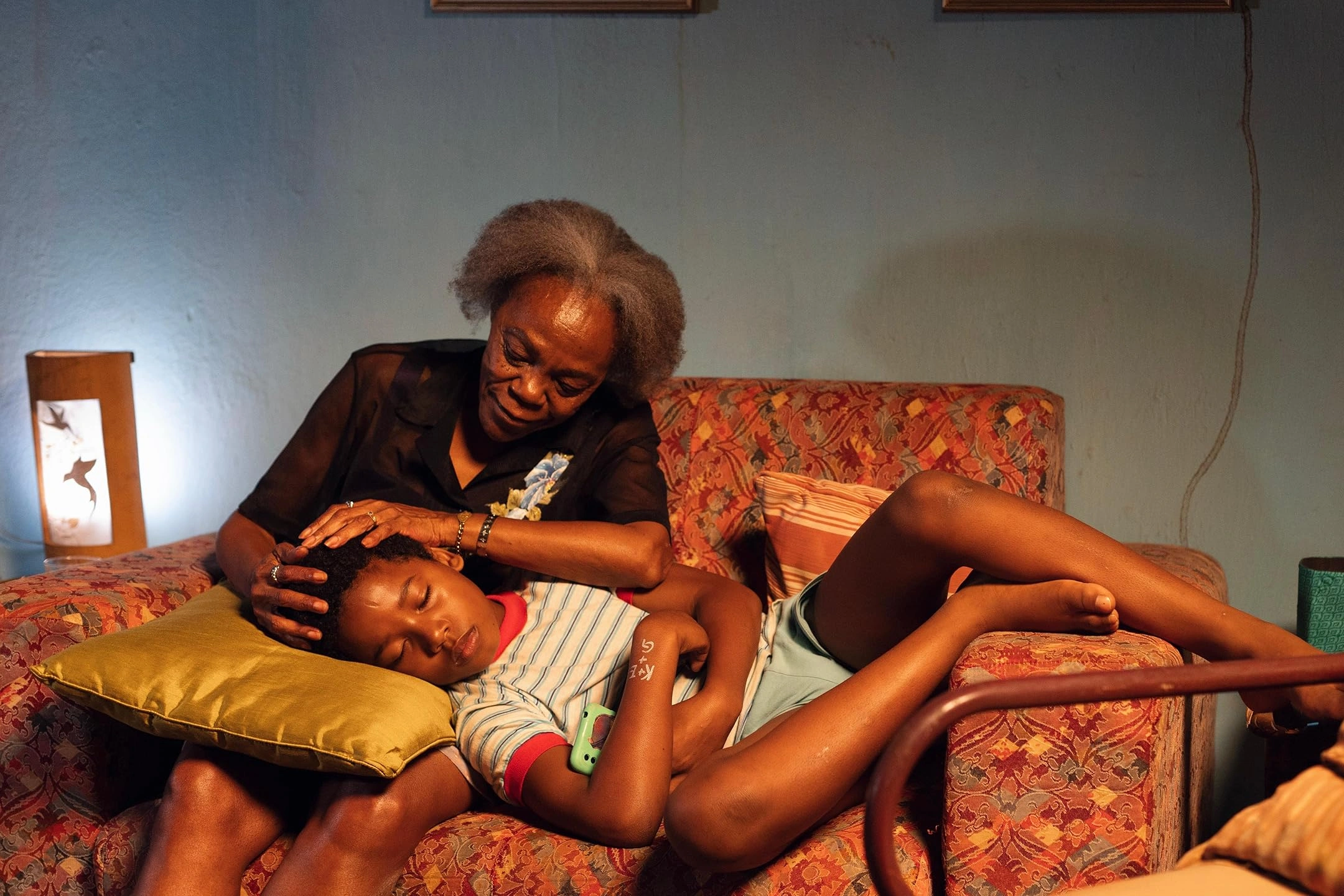
The visual design is central to that architecture. Pink, blue, purple, yellow, playful fabrics, bright surfaces, and expressive costumes do more than decorate the frame. They make Gugu’s inner freedom visible. Color becomes a kind of argument, a refusal to let the world’s duller rules define the limits of his body. Dilma’s home preserves that color. It is the place where Gugu’s selfhood can spread outward without apology.
The Ceará setting gives the film a lived physical weight. The rural community, the dry terrain, the reservoir, and the surrounding landscape do not feel like scenery placed behind the drama. They feel bound to it. The reservoir, especially, carries an eerie philosophical charge. Memory in the film is never fully gone. It sinks, waits, and returns in altered form. Dilma’s Alzheimer’s threatens erasure, while the land suggests that nothing truly disappears. The past changes shape and asks to be faced.
Some dramatic beats land on familiar ground. The bullying scenes can feel expected, and Batista’s rejection sometimes follows a recognizable coming-of-age pattern. A few turns arrive with a neatness that softens the film’s harsher existential edges. Still, Gugu’s World survives those limits through sincerity, emotional clarity, and the force of Gomes and Pereira together. Its darkness is real, but it keeps finding color inside it.
Gugu’s World, originally titled Feito Pipa, is a 2026 Brazilian drama directed by Allan Deberton. The film premiered at the Berlin International Film Festival in February 2026, where it screened in the Generation Kplus section and later won major recognition there. It runs 93 minutes and follows Gugu, an almost twelve-year-old boy living with his grandmother Dilma near the Araújo Lima Reservoir, as he tries to protect their fragile home life when her Alzheimer’s disease worsens. As of May 31, 2026, the film does not appear to have a wide streaming release listed. It has been playing through the festival circuit, with Frameline listing it for its 2026 program.
Full Credits
- Title: Gugu’s World (Feito Pipa)
- Distributor: M-Appeal, Warner Bros. Discovery
- Release date: February 14, 2026, Berlin International Film Festival world premiere
- Running time: 93 minutes
- Director: Allan Deberton
- Writers: André Araújo, Camila Agustini
- Producers and Executive Producers: Karen Castanho, Bianca Villar, Fernando Fraiha, Allan Deberton, João Macedo, Marcelo Pinheiro, Lázaro Ramos, Maurício Macêdo, Fred Burle
- Cast: Yuri Gomes, Lázaro Ramos, Teca Pereira, Carlos Francisco, Georgina Castro, Alda Pessoa, David Santos, Beatriz Carwile
- Director of Photography: Luciana Baseggio, Daniel Donato
- Editors: Mariana Nunes Gomes
- Composer: João Victor Barroso
The Review
Gugu’s World
Gugu’s World is a tender, visually rich coming-of-age drama carried by Yuri Gomes’s luminous performance and Teca Pereira’s aching warmth. Its familiar story beats occasionally soften its sharper edges, yet the film’s emotional clarity, queer self-possession, and vivid sense of place give it lasting force. It treats childhood as fragile, brave, and frighteningly exposed to adult failure.
PROS
- Yuri Gomes delivers a deeply natural lead performance
- Teca Pereira gives the film warmth and emotional weight
- Strong grandmother-grandson relationship
- Colorful, expressive visual style
- Sensitive treatment of queer childhood
- Rural Ceará setting feels specific and lived-in
CONS
- Some bullying scenes feel predictable
- Father-son conflict uses familiar coming-of-age beats
- A few plot turns feel slightly too neat