




















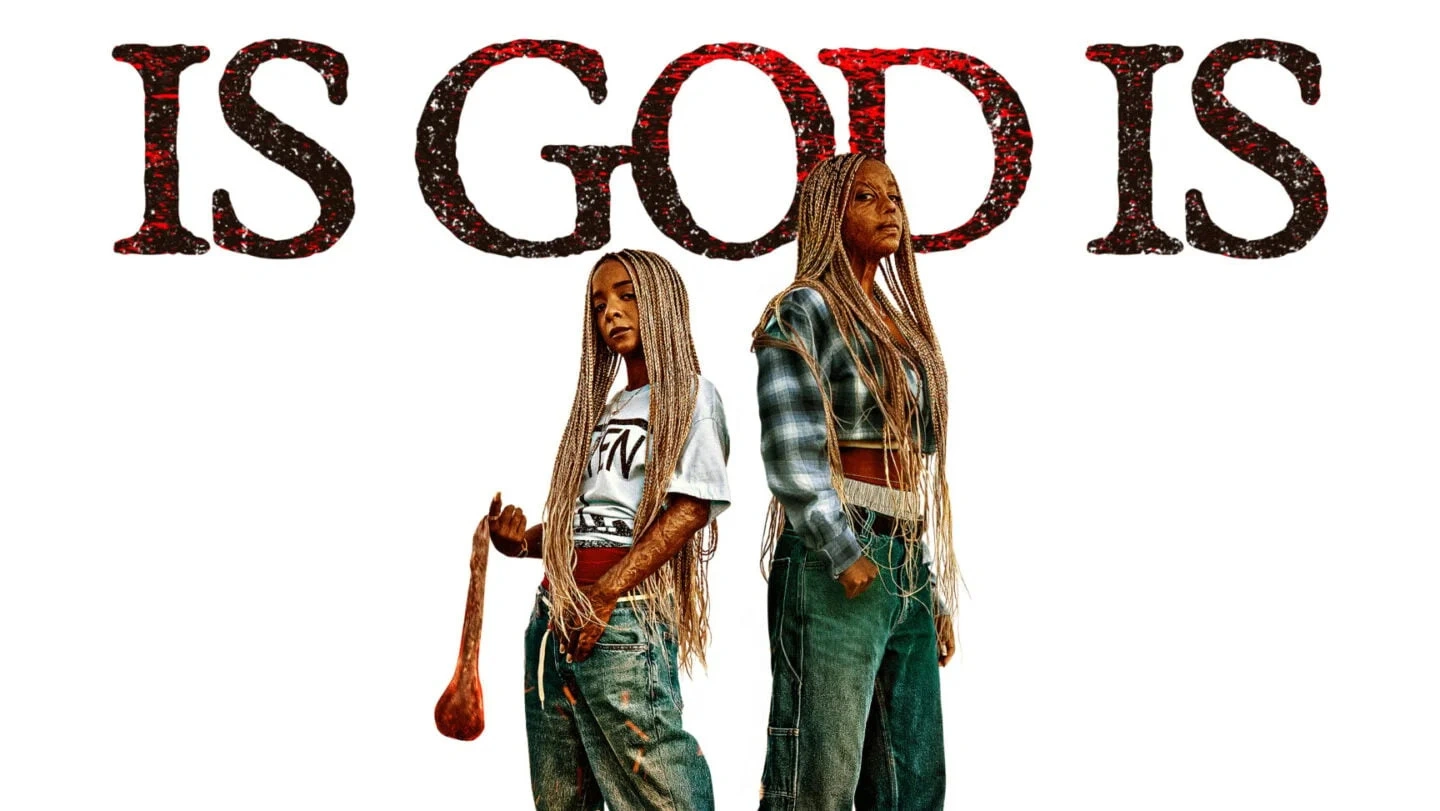

Aleshea Harris translates the theater of the absurd into a cinematic slaughterhouse with Is God Is. This story starts with a letter and ends with a reckoning. Twin sisters Racine and Anaia exist as living archives of a domestic inferno. Their bodies are maps of ancient, man-made pain.
Ruby, their mother, summons them from the Northeast to the humid Deep South. She sits in her bed like a wounded sovereign. She refers to herself as God. This choice reframes the siblings as disciples of a very specific, scorched-earth religion. Ruby reveals the identity of the Man (or the Monster) who set them on fire twenty years ago. She demands he be made “dead, real dead.”
The sisters accept this holy war. Their road quest takes them across the American landscape. They move from the Bible Belt to the clinical wealth of California. Each stop reveals a new layer of their father’s destructive history. The film presents vengeance as a form of labor. It is a grim inheritance passed down to children who have nothing else to claim.
The Cinder-Twin Calculus
The relationship between Racine and Anaia operates through a state of duo-fracture. They are two halves of a single, damaged whole. Racine adopts the role of the volatile protector. She moves with an impulsive, jagged energy that suggests a life spent waiting for a target. She is the Rough One. Her aggression feels like a necessary adaptation to a world that stares at her scars with pity or disgust.
Mallori Johnson plays Anaia as the Quiet One. She carries a tense stillness. Her hesitation provides the moral friction for the mission. She represents the parts of the sisters that still wish for a life without the weight of a baseball bat. (It is a tragedy that the world rarely allows such women the luxury of stillness).
Kara Young delivers a performance of electric volatility. She commands the frame with a physical intensity that feels dangerous even when she is silent. She makes the audience root for the “curbstomp” while simultaneously feeling the anxiety of her recklessness. Johnson matches this with a performance of simmering internal life.
She uses subtle glances to communicate with her sister. Their chemistry feels lived-in. They possess a “Sister, Sister energy” that has been dragged through a nightmare pipeline. They move in sync. Sometimes they communicate through subtitles that reflect their unspoken bond.
The prosthetic makeup acts as a primary text for the film. These scars carry genuine narrative weight. They dictate how the world reacts to the twins. The markings on Anaia’s face and Racine’s arm are permanent reminders of the father’s presence. (Harris insists we look at them in high definition, against a society that demands victims conceal their ruins). The sisters are “scabbed relics” of a crime that went unpunished for two decades.
Their physicality is a form of dermagraphia. The father wrote his hatred onto their skin. Now, they are using those same bodies to erase his existence. This is a story of two people who have been through the state care system and multiple dead-end jobs. They have nothing to lose because the world took everything from them before they could even walk. Their bond is the only thing that remains intact.
Neo-Western Grit and the Chroma-Trauma Frame
Harris utilizes a visual language that rejects the standard tropes of modern drama. She frames the Southern landscape with the scale of a Spaghetti Western. The screen radiates with a sun-soaked sepia tone. This gives the film a gritty, archival quality.

It feels like we are watching a lost grindhouse feature from the 1970s. (I would call this aesthetic pulp-classical). The influence of Blaxploitation is evident in the character title cards and the grainy texture of the film. The story holds the structural weight of a Greek tragedy. It moves with an inexorable drive toward a bloody terminus.
Alexander Dynan uses light to create a sense of exposure. The daylight feels severe. It is an “icy daylight” that offers no place to hide. During the most tense sequences, the cinematography shifts into a comic book noir style. This transition highlights the mythic nature of the violence.
Color filters separate the present from the past. Flashbacks appear in cooler or monochromatic tones. These shifts signal a change in emotional temperature. They act as a chroma-trauma (a term I use for the visual encoding of memory). The South is presented as a frontier where urban style meets rural isolation.
The sound design is a masterclass in sensory discomfort. We hear the constant, oppressive buzzing of insects. The sound of long nails clicking and the rustle of plastic couch covers create a specific domestic atmosphere. These mundane noises are set against the “out-of-frame carnage.” The film favors auditory violence. We hear what happens. We rarely see it. The roar of fire and the crackle of a match are used as a recurring motif of dread. Nothing feels more menacing than the simple sound of someone striking a match.
The editing creates a rhythmic pace. It includes on-screen typography pulled directly from the stage play. This choice honors the theatrical roots of the project and extends the language of cinematic storytelling. The soundtrack uses beats from Chaii and Beyoncé to lock in the “vibe.” These musical choices ground the story in a modern cultural identity. The film is a genre mashup that includes dark comedy and “Good for Her” horror. It refuses to stay in one lane. (It is a refreshing change of pace from the sanitized thrillers we usually see in May).
Trauma Satellites and the Soft-Spoken Sociopath
Vivica A. Fox occupies her scenes with the weight of a monument. She is the catalyst for the entire road quest. As Ruby, she represents a history of pain that has finally curdled into a command. She is a “wounded queen” sitting in a bed of pink-scrubbed nurses. Her presence provides a sense of mythic authority. She reframes the role of a mother into that of a divine architect. (Her performance is a legacy play that connects the neo-exploitation of the past to the bold voices of the present).
The father is the “Monster” at the end of the road. Sterling K. Brown delivers a performance that subverts his usual screen persona. He is a “soft-spoken sociopath.” He does not shout or posture. He possesses a calm, controlled menace. He is like a version of a sitcom character who has spent twenty years hiding bodies in the basement. The film builds anticipation for his arrival by keeping his face hidden in early flashbacks. This makes his eventual appearance feel more unsettling. He has built a new life as a family man. He treats his past crimes as a minor inconvenience.
The supporting cast creates a landscape of “trauma satellites.” Erika Alexander is Divine the Healer. She represents the women who enable violent men through spiritual justification. Her sermon is a highlight of the film. She brings a comedic edge that sharpens the social commentary. Janelle Monáe appears as the New Wife. Her role is brief. She represents a different facet of the father’s ability to manipulate women.
Even if some of these characters only appear in one scene, the actors play them with total commitment. Mykelti Williamson appears as a lawyer who regrets his past. These encounters show the reach of the father’s violence. It has touched every person on the sisters’ path. The film shows how one man can ruin multiple lives without ever breaking his polite exterior in public.
The Wages of Inherited Blood
Is God Is acts as a visceral deconstruction of misogynoir. It looks at the specific ways Black men perpetuate cycles of abuse and how society enables them. The film presents “Black female rage” as a form of survival. It is a response to decades of personal and historical erasure. Harris critiques the pillars of the community that protect the “Monster” while ignoring the “Ruby” of the story. The narrative feels like a cathartic manifesto for every woman who has been discarded by a violent man. (It is a film that refuses to be polite about the damage patriarchy causes).
There is a clear distinction between moral justice and amoral catharsis. The sisters are looking for a way to stop the pain. The film explores the burden of inherited violence. Racine and Anaia are forced to become killers to satisfy their mother’s wish. They must reconcile their desire for a normal life with their capacity for brutality. This is the cost of the mission. The act of vengeance provides a finish line, a terminus with no road beyond.
The final stretch of the road quest is both upsetting and inevitable. The ending arrives quickly. Some might find the epilogue rushed. However, it effectively conveys the message of self-discovery and the difficulty of moving forward. The final reel is a sprint toward the credits. It leaves the audience with the image of survivors who are still carrying their scars.
The act of making their “daddy dead” extinguishes one source of the fire. He cannot light another. The sisters are left to figure out who they are when the mission is over. They have reconciled with their capacity for violence. Now they must learn to live with the silence that follows. (Vengeance is a hungry deity that rarely leaves anything for the survivors to eat).
Is God Is premiered with nationwide early access screenings today, May 11, 2026, ahead of its wide theatrical debut scheduled for May 15, 2026. Directed by Aleshea Harris in her feature debut, this highly anticipated adaptation of her award-winning stage play is currently an exclusive theatrical release under the Orion Pictures banner. Audiences can experience this genre-bending revenge odyssey in cinemas across North America, where its unique blend of Southern Gothic and neo-western aesthetics is best showcased on the big screen.
Where to Watch Is God Is (2026) Online










Full Credits
Title: Is God Is
Distributor: Amazon MGM Studios, Orion Pictures
Release date: May 11, 2026 (Early Access), May 15, 2026 (Wide Release)
Rating: R
Running time: 99 minutes
Director: Aleshea Harris
Writers: Aleshea Harris
Producers: Tessa Thompson, Kishori Rajan, Riva Marker, Janicza Bravo, Aleshea Harris
Executive Producers: Stacy O’Neil, Nicole King Solaka, Kenneth Yu
Cast: Kara Young, Mallori Johnson, Sterling K. Brown, Vivica A. Fox, Janelle Monáe, Erika Alexander, Mykelti Williamson, Josiah Cross
Director of Photography (Cinematographer): Alexander Dynan
Editors: Jay Rabinowitz, Blair McClendon
Composer: Joseph Shirley, Moses Sumney
The Review
Is God Is
Aleshea Harris delivers a jagged, necessary artifact of pulp-theology. The film functions as a manual for the reclamation of agency through blood. While the final act accelerates with a frantic haste that leaves some emotional residue unaddressed, the sheer physical commitment of the leads is undeniable. It provides a stark, sun-bleached look at the cost of stopping a monster. It is a work of high-stakes sibling-labor that refuses to offer easy absolution.
PROS
- Visceral lead performances from Kara Young and Mallori Johnson.
- Masterful integration of 1970s grindhouse aesthetics and neo-western style.
- Chillingly controlled villainous turn by Sterling K. Brown.
- Sensory sound design that builds a thick atmosphere of dread.
CONS
- Rushed third act pacing that sacrifices emotional weight.
- Episodic nature of some supporting character encounters.
- Narrative finish feels somewhat abrupt for the scale of the buildup.