



























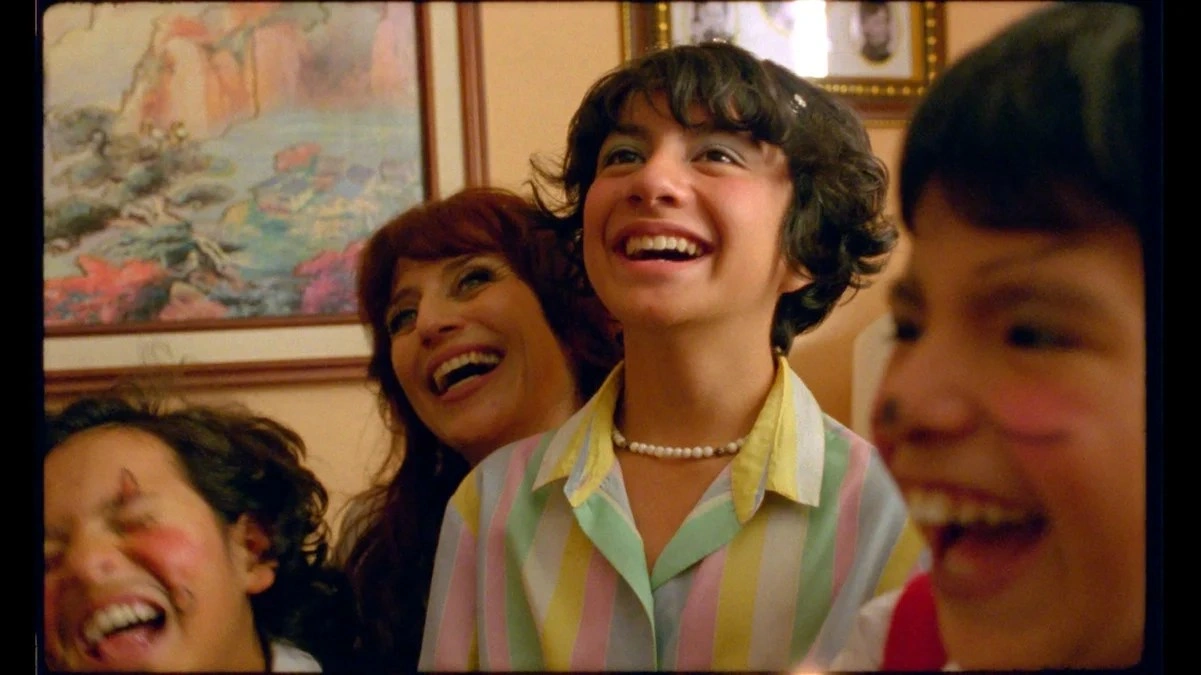

Mexican director Bruno Santamaría Razo builds a fragile historical mirror in Six Months In A Pink And Blue Building. The film sits inside Mexico City’s shifting urban fabric during the early 1990s and follows eleven-year-old Bruno, played with piercing lucidity by Jack Reyes Vazquez, as two upheavals arrive almost in sync.
His home life cracks after his illustrator father, Mundo, portrayed by Lázaro Gabino, receives an HIV diagnosis. At the same time, Bruno begins to understand his romantic attraction toward a classmate, Vladimir, played by Eduardo Ayala.
Razo grounds this double awakening in a precise cultural moment, one thick with televised alarm, classroom instruction, institutional dread, and medical falsehoods. He draws from childhood memory to shape a film that hovers between documentary realism and fictional reconstruction. Personal history becomes cinema through close, almost surgical intimacy.
The Architecture of Autofiction
The film begins with a real-life interview featuring the director’s mother, Diana, played in the fictional passages by Sofía Espinosa. That nonfiction frame cuts to black, then drops the viewer into a stylized 1990s period piece. The story unfolds through loose domestic fragments: illegal cable television gets installed, oversized papier-mâché heads take shape, and a chaotic birthday party arrives with drag-inflected theatricality.
Razo breaks the dramatic surface through talking-head interviews with his actual parents, placing documentary testimony inside the fictional world. The camera becomes a family instrument, half microscope, half confessional booth. Call it autofictional therapy, since apparently childhood can bill by the hour.
A major turn in the final third reshapes our grasp of the timeline. The real-life mother turns the camera toward Razo himself and demands creative accountability. This meta-textual interrogation transforms the film into a sharp study of memory as selection, arrangement, and defense mechanism.
Also Read





The pacing slackens across the 105-minute runtime. The urge to preserve each corner of domestic life creates moments of circular repetition. A tighter edit might have strengthened the film’s movement, yet the looseness carries its own psychological logic. Memory rarely respects clean dramatic architecture. Annoying, perhaps. Accurate, certainly.
Celluloid Ghosts and Sonic Shocks
Cinematographer Fernando Hernández García shoots this world on 16mm film. The thick, tactile grain gives nostalgia a physical texture, making the screen feel like a living artifact pulled from a drawer and handled too often.
Art director Ivonne Fuentes Mendoza fills the frame with saturated pink, orange, and blue, surrounding the family with cluttered furniture and floral wallpaper. The design carries thematic pressure. Changes in a room’s decoration become acts of physical erasure, covering secrets and wiping away traces left by former occupants.
Razo brushes against magical realism when Bruno and his father draw directly on a wall. Once they leave the room, the drawings animate, a tender visualization of shared trauma turning into art before anyone has language for it.
The sound design operates through violent shifts. Long, heavy silences give way to booming pop music. Rocío Jurado’s theatrical anthem “Ese Hombre” intensifies the emotional force of the early domestic scenes, letting melodrama speak where the family cannot.
Background noise also reminds us that Baz Luhrmann is filming Romeo + Juliet elsewhere in the city. That historical detail places this local family rupture beside a global cultural change, a small household absorbing shockwaves from illness, media, and pop mythology at once.
The Inherited Script
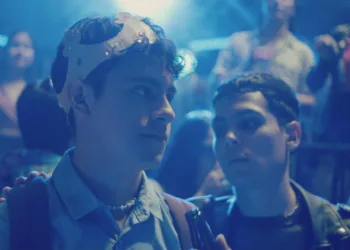
Jack Reyes Vazquez gives young Bruno an exquisite, wide-eyed vulnerability. His performance steadies the delicate bond with Vladimir. Razo traces their cooling relationship through behavioral shifts rather than grand confrontation. They trade stolen glances on a crowded metro train.
Later, during a neighborhood aerobics class, Bruno moves his hips freely, and Vladimir withdraws to the back of the room to practice stiff boxing drills. The moment becomes a quiet, bruising study of gender socialization in real time. A body learns permission. Another learns restriction. Society calls this growing up, because society has always had a talent for euphemism.
Sofía Espinosa gives Diana a stoic force. She quietly contacts her husband’s former lovers and begins to understand how little she knew about the man living beside her. Her composure has the severity of someone doing emotional arithmetic with missing numbers.
Lázaro Gabino plays Mundo with a dense, spectral isolation. His performance reaches its sharpest point in a stark conversation with his son. When Bruno asks what happens after death, Mundo answers with a flat, cyclical vision of university, marriage, and generational mortality. The scene exposes the suffocating pressure of early nineties social expectations. It also reveals how the family carries its buried truths, holding them in silence until history arrives with a diagnosis, a camera, and no polite way to leave.
Six Months In A Pink And Blue Building (originally titled Seis meses en el edificio rosa con azul) is a coming-of-age drama that premiered internationally on May 19, 2026, at the Cannes Film Festival as part of the Critics’ Week lineup. Set in the early 1990s, the international co-production between Mexico, Brazil, and Denmark chronicles an eleven-year-old boy navigating family changes and personal growth. Following its festival debut, the film’s distribution and international sales are being handled by Luxbox and Epicentre Films, making it available through select international arthouse theatrical circuits and specialized festival screenings.
Full Credits
Title: Six Months In A Pink And Blue Building
Distributor: Luxbox, Epicentre Films
Release date: May 19, 2026
Running time: 105 minutes
Director: Bruno Santamaría Razo
Writers: Bruno Santamaría Razo
Producers and Executive Producers: Carlos Quiñonez, Bruna Haddad, Bruno Santamaría Razo, Rachel Daisy Ellis, Camille Reis, Katrin Pors, Giulia Triolo
Cast: Jack Reyes Vazquez, Sofía Espinosa, Lázaro Gabino, Eduardo Ayala, Anuar Vera
Director of Photography (Cinematographer): Fernando Hernández García
Editors: Andrea Rabasa Jofré, Bruno Santamaría Razo, Marilia Moraes
Composer: Léo Chermont
The Review
Six Months In A Pink And Blue Building
Six Months In A Pink And Blue Building is a deeply moving, formally ambitious experiment that successfully bridges personal therapy and cultural history. While its pacing occasionally drags under the weight of its own memories, Bruno Santamaría Razo’s striking 16mm visuals and raw, meta-textual vulnerability make it a profound meditation on family secrets.
PROS
- Stunning, nostalgic 16mm cinematography and vibrant production design.
- An innovative hybrid structure that questions the very nature of truth and memory.
- A vulnerable, standout lead performance by Jack Reyes Vazquez.
CONS
- Pacing issues that lead to repetitive domestic scenes.
- The 105-minute runtime occasionally dilutes the narrative momentum.