














Speed Demon begins with the kind of premise that practically writes its own midnight-movie sales pitch: a troubled nun boards a train from Montreal to New York, a fellow passenger gets possessed by an ancient demon, and the whole contraption barrels toward disaster. The title promises velocity, blasphemy, cheap thrills, and maybe a few glorious lapses in taste. For a while, that promise has real charge.
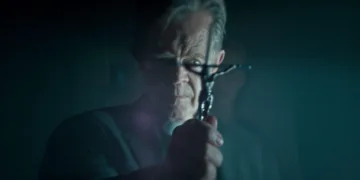
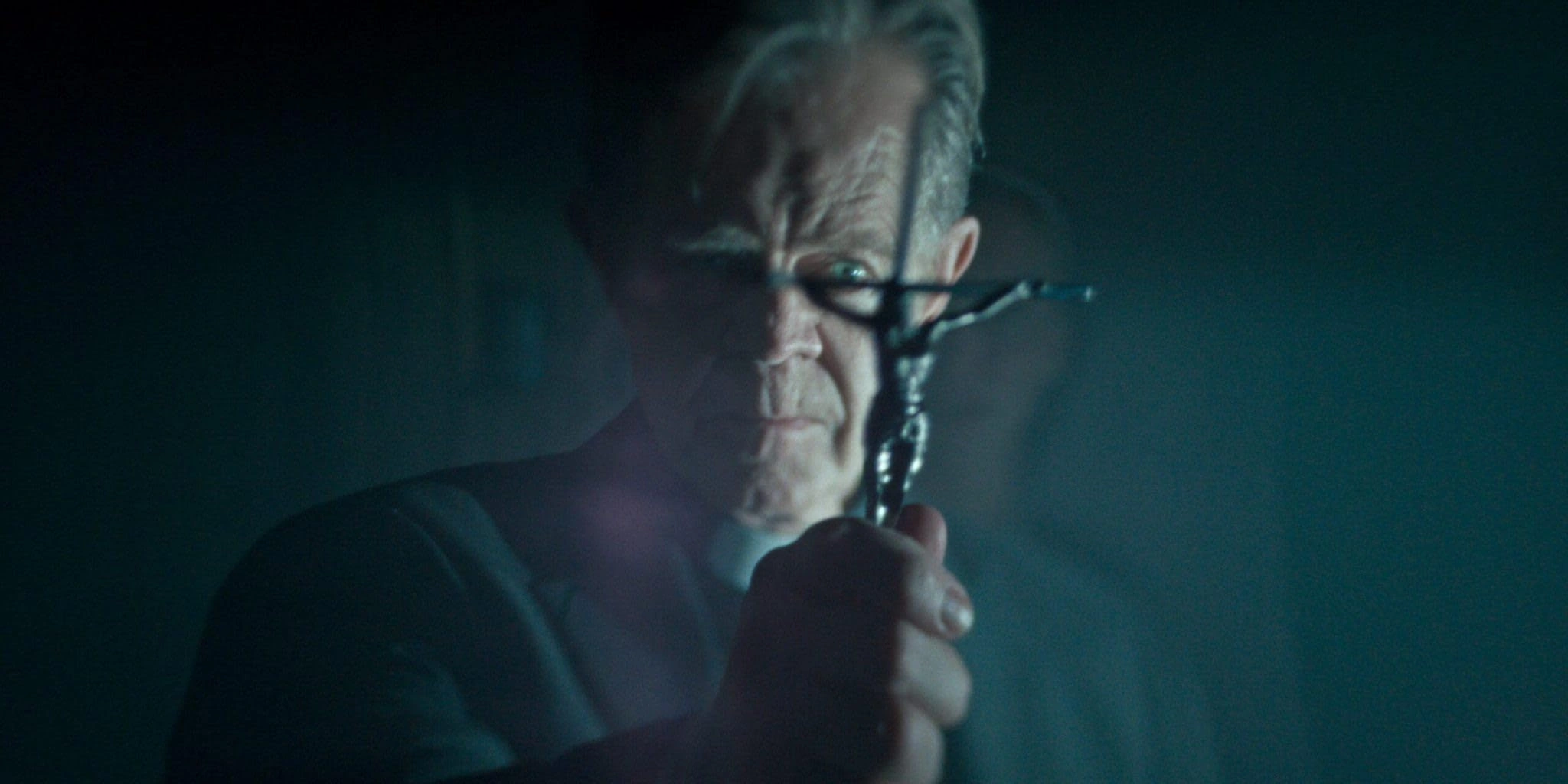
Katie Cassidy plays Sister Lu, short for Lucretia, a hard-drinking, self-destructive nun whose crisis of faith arrives with booze, sex, cocaine, and a habit waiting by the door. Her mentor, Father Novak, played by William H. Macy, carries the exhausted patience of a man who has prayed for her so long that even heaven may be screening his calls.
Then a wooden figure tied to Asmodeus enters the train, blood is drawn, possession takes hold, and Lu is forced into the exorcist role she has spent years avoiding. The film has a terrific hook. Its trouble is finding the nerve, rhythm, and visual bite to match it.
Sin, Guilt, and a Very Crowded Train Car
The narrative links Lu’s present collapse to childhood trauma involving the same demonic force now stalking the passengers. That connection gives Speed Demon its cleanest dramatic line: Lu is fighting a supernatural enemy, a religious institution that doubts her authority, and her own belief that she is already ruined.
The film reaches toward questions of free will and identity here. Is Lu choosing destruction, or has grief shaped her into someone who mistakes surrender for freedom? Can faith survive once it has been tied to shame? The script raises those ideas, then hurries past them like a commuter avoiding eye contact.
Its most pointed theme concerns authority inside the Catholic Church. Lu cannot perform an exorcism by traditional rules, a fact the film uses for both conflict and easy satire. Passengers question her, the institution limits her, and the demon treats her pain as an opening. There is moral ambiguity in that setup, since Lu’s rebellion carries real damage, yet her disobedience may be the only useful form of grace available on this particular train. That is a strong idea, perhaps stronger than the film knows what to do with.
The passengers follow a disaster-movie template: the possessed archeology-linked traveler, a pickpocket, a heart-condition boyfriend and his worried partner, a businessman with attitude, a Japanese mother, and a young girl with an oddly useful command of trains and demons. Most remain plot pieces. Father Novak and the child stand out because they give the film warmth, exposition, and small comic jolts. Sometimes that is enough. Sometimes the train feels less like a vessel of dread than a waiting room with louder wheels.
Katie Cassidy Carries the Habit, While the Tone Loses Its Ticket
Cassidy’s performance asks for grit, sarcasm, spiritual exhaustion, and action-hero resolve. She is most persuasive when Lu’s defiance feels like a defense mechanism rather than a pose. The role needs a woman who can sneer at doctrine, flinch at memory, and still step into danger with half a prayer and a full headache. Cassidy finds some of that battered confidence, mainly in scenes where Lu pushes against the men who assume she is either broken or unqualified.
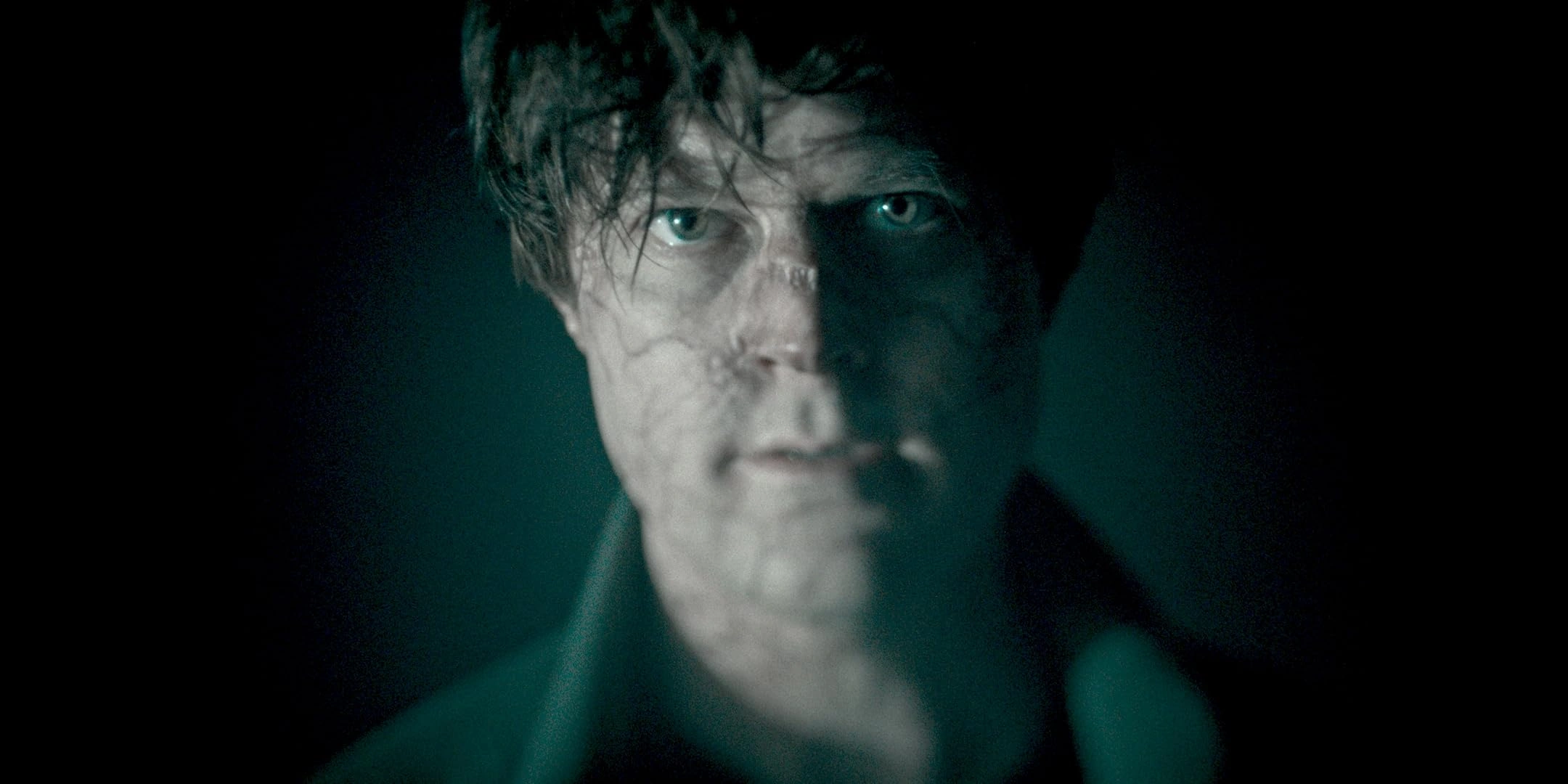
Still, some line readings land flat, and that dulls the urgency of her transformation. A character this volatile should feel dangerous even before the demon starts redecorating people’s necks. Too often, Lu seems stranded between written attitude and lived pain.
Macy gives Father Novak a brief, steady presence. His disappointment has texture, and his affection for Lu prevents their scenes from becoming pure exposition. Sky Vaux Fuller’s young passenger brings welcome oddball charm, serving as a tiny encyclopedia with survival instincts. Her train knowledge and demon lore should feel ridiculous, and they do, which is part of the fun.
The tonal problem is larger than any one performance. Speed Demon cannot decide if it wants to be severe exorcism horror, religious satire, camp action, or a train-bound thriller. It works best when it accepts the absurdity of its own design. A nun versus Asmodeus on public transport should not feel embarrassed by itself. The final scene hints at the wilder film hiding beneath the gray surfaces. By then, one suspects the better movie missed the connection.
Chiaroscuro Dreams, Digital Rails, and Horror Stuck in Neutral
Jon Keeyes builds the film around a contained ticking clock: once the demon is loose and the train becomes harder to control, the setting should tighten around the characters like a mechanical coffin. Classic noir and thriller grammar would suit this perfectly.
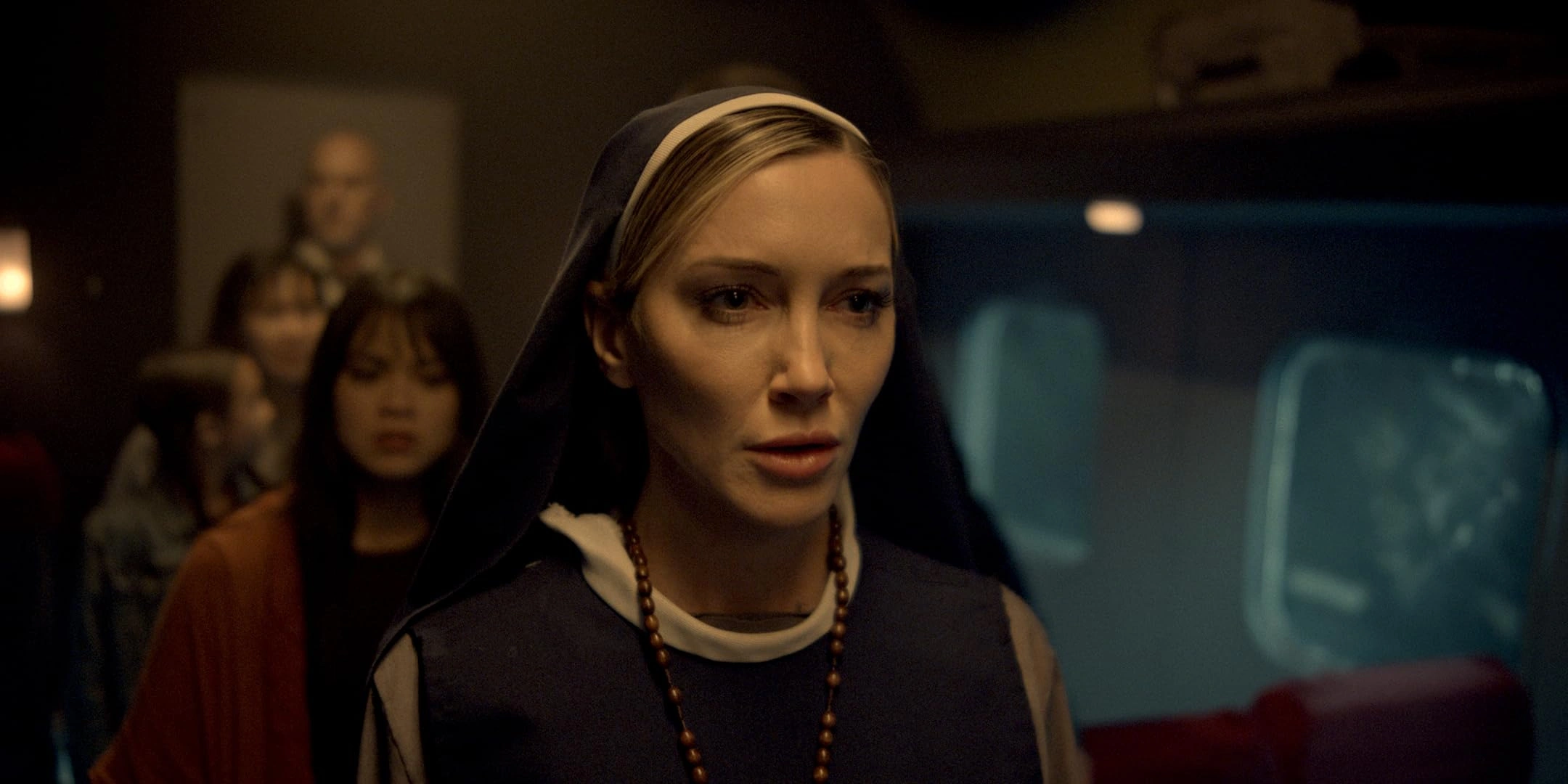
Narrow corridors, slatted shadows, faces cut by harsh light, expressionistic angles bending the train into a moral trap. There are moments where the film gestures in that direction, especially through quick cuts, sudden focus pulls, and cramped confrontations inside dim compartments.
The lighting, sadly, often settles into murky gray and brown rather than shaped darkness. Chiaroscuro depends on contrast, on the war between illumination and secrecy. Here, the visuals can look simply underlit. The train interiors feel too clean and spacious, closer to a showroom than a pressure chamber. Digital station shots and exterior effects weaken the illusion of mass and speed. The train rarely feels fast enough to frighten anyone who has experienced a mildly late regional service.
The horror craft offers flashes of personality. Birds slam into windows. Fireflies pour from a possessed body. Veins rise, necks crack, faces shift, and the demon uses psychological pressure to prod Lu’s shame. These details have pulp flavor, and the folklore reference through the Japanese mother briefly opens the film beyond standard Catholic possession imagery. The gore stays modest, which is not a flaw by itself. Suggestion can be sharper than splatter. Here, though, restraint is rarely matched by dread.
Sound and pacing should manipulate the viewer’s perception, making every rattle of the tracks feel like a countdown. Instead, the film drifts through stretches of flat dialogue and repetitive movement. The demon is called the King of Demons, then behaves like a camera-shy commuter with a grudge. Speed Demon has a catchy hook and a few B-movie sparks, yet its thin characters, modest scares, uncertain tone, and sluggish tempo keep it from becoming the wild ride its premise keeps promising.
Speed Demon is a 2026 horror film directed by Jon Keeyes and written by Domenico Salvaggio. The film stars Katie Cassidy as Sister Lu and William H. Macy as Father Novak, who board a train from Montreal to New York before a demonic force linked to Asmodeus turns the trip into a fight for survival. The movie was released in limited theaters and on VOD/digital platforms in the United States on May 29, 2026, with availability to rent or buy through digital services such as Amazon Video and Apple TV where offered.
Where to Watch Speed Demon (2026) Online






Full Credits
- Title: Speed Demon
- Distributor: Maverick Film, Complex Corp
- Release date: May 29, 2026
- Running time: 96 minutes
- Director: Jon Keeyes
- Writers: Domenico Salvaggio
- Producers and Executive Producers: Katie Cassidy, Cecil Chambers, Vanessa Coifman, Gabriela Custodio, Richard Switzer, Saleem Elmasri, Nina Kolokouri, Kevin J Nelson, Ian Niles, James Norrie, Clay Pecorin, Andy Thompson
- Cast: Katie Cassidy, William H. Macy, John Patrick Jordan, Sari Arambulo, Michael Emery, Sabrina Schlegel-Mejia, Onika Day, Allen McCullough, Jeremy Feight, Sky Vaux Fuller, Michael John Improta, Ray Faiola, George Banghart Jr., Noriko Sato
- Director of Photography: Austin F. Schmidt
- Editors: R.J. Cooper
- Composer: Aoife O’Leary, Gerry Owens
The Review
Speed Demon
Speed Demon has a killer premise, a rebellious nun, a possessed passenger, and a runaway train, yet the film rarely gathers the speed or menace its title promises. Katie Cassidy brings flashes of grit, and William H. Macy adds brief emotional weight, but thin characters, flat visuals, and uneven pacing keep the ride stuck between camp and serious horror.
PROS
- Fun B-movie premise
- Katie Cassidy has strong moments
- William H. Macy adds presence
- A few memorable supernatural images
CONS
- Sluggish pacing
- Weak scares
- Underused train setting
- Thin supporting characters
- Uneven tone