



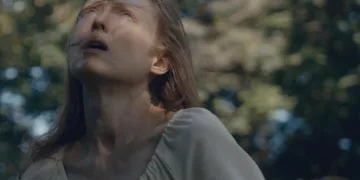
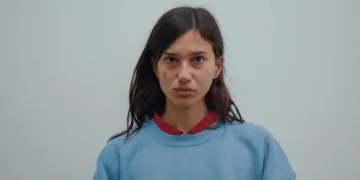






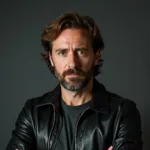
In the near future imagined by Maria Martínez Bayona’s English-language feature debut, death is a lifestyle choice. The wealthy have access to blood cleanses, pharmaceutical regimens, and bone replacement surgeries that render mortality optional, leaving a privileged class free to accumulate centuries at their leisure. The End of It opens on Claire (Rebecca Hall), a 250-year-old artist surrounded by beautiful, ageless friends, a devoted husband named Diego (Gael García Bernal), and a humanoid home assistant, Sarah (Beanie Feldstein), who manages her household with eerie competence. Claire has everything. She also wants to die.
That wish, announced at her own birthday party with the weary calm of someone who has rehearsed it for decades, sets the film in motion. What follows is a slow-burn, ideas-heavy drama about artistic identity, the tyranny of endless time, and what finitude might actually be worth. Noomi Rapace appears as Martha, Claire’s estranged daughter, adding another layer of complicated history to a story already thick with it. Bayona signals from the outset that this is a film more interested in questions than answers, and that the weight of those questions rests almost entirely on Hall’s shoulders.
The Architecture of a Dying World
Bayona builds her future with conspicuous restraint. There are no flying cars or dystopian megacities here. The science fiction infrastructure is folded into the mundane: a blood cleanse machine sits on the breakfast table like a coffee maker; bone replacement surgery is pencilled in before lunch. Production designer Lili Lea Abraham renders Claire’s Mediterranean home as aspirational and clinical, a space of great beauty that somehow communicates total emptiness. The world feels evolved rather than invented, which is precisely the point.
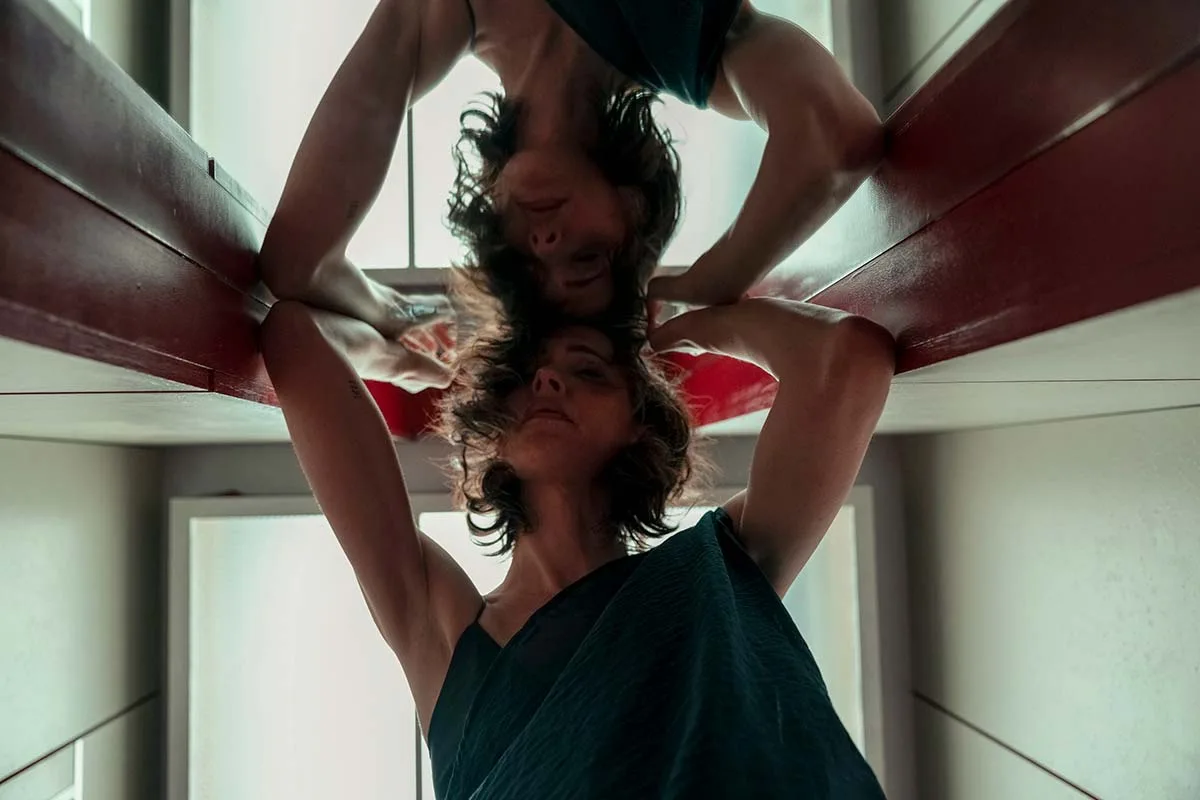
Cinematographer Andrés Arochi Tinajero opens the film with a cool, detached gaze that keeps the audience at arm’s length, appropriate for a character who has long since retreated behind the same emotional glass. As Claire begins to deteriorate physically, the camera gradually relents. Framing grows warmer, closer; the mise-en-scène shifts toward the organic as she trades her sterile interiors for rugged coastline and the sensory mess of paint and resin. It is a quietly eloquent visual progression, a film letting its walls down as its protagonist does.
Paloma Penarrubia’s string-heavy score maintains similar discipline, declining every opportunity to swell into sentiment. The film’s dark comedy is also well-calibrated in its first half: Claire’s robotic hoover repeatedly smashing into the same wall reads as the perfect emblem of a life stuck on repeat. Sarah, Feldstein’s humanoid assistant, is rendered with deliberate realism, her charging cable and encyclopedic knowledge the only tells. The casting choice carries weight: in a film about a woman whose own skeleton has been entirely replaced by synthetic material, the line between the artificial and the human has already been thoroughly blurred.
The tonal discipline frays, though. A mid-film church scene, presided over by a child preacher who places magenta gummy bears on his congregants’ tongues like communion wafers, tips from surreal into bewildering. It is a sequence that seems to belong to a different, brasher film, and it is not the only moment where Bayona strains against the measured register she has otherwise worked hard to establish.
Also Read





Forever Is the Problem
The film’s most productive question is also its simplest: if you had all the time in the world, would you spend it well? Claire’s answer, arrived at after two and a half centuries, is an unambiguous no. She was once a provocateur. Her shed holds sculptures, a skeleton assembled from her own discarded bones, flyers for past shows called “The Edge of Flesh” and “Metamorphosis.” Centuries of comfort have reduced her to designing geometric jewellery. Her decision to die is also, the film argues, a decision to make something again.
The idea that mortality is the condition of creativity has a long history in art and philosophy, and Bayona does not pretend otherwise. What she adds, and what gives the film its sharpest edges, is the privilege angle. This is a world where eternal life costs money. Entitlement runs beneath the film’s gorgeous surfaces like a slow current, never quite examined as rigorously as it deserves. The script gestures at what lies outside this gilded enclave without ever venturing there, which is a real missed opportunity.
More productive is Claire’s relationship with Martha. A grudge that has lasted over a century raises genuinely unsettling questions about whether time heals anything, or simply preserves resentments in amber. Martha wants a child, a desire shaped by this world’s rule that a new life requires a death to make room for it. It reframes mortality as something generative, a thought the film earns. When the two women occupy the same room, the screenplay briefly finds the emotional complexity it is otherwise chasing.
The second half of the film loses its way. A countdown timer, a publicity apparatus around Claire’s death, the gradual transformation of her dying into a ticketed museum event: these additions accumulate weight without adding clarity. Diego, reduced to confusion and devotion, becomes a plot mechanism. The screenplay mistakes accumulation for depth.
The Performance Holding It Together
Whatever structural problems The End of It carries, Rebecca Hall is not among them. Her Claire is a study in controlled intensity, a woman whose apparent madness follows its own precise internal logic. Hall plays her outbursts as chosen rather than impulsive, the product of centuries of suppressed judgment finally finding an exit. The dark comedy in the birthday party sequence is expertly landed: Hall’s barely concealed contempt for the room around her is funnier for being so carefully calibrated.
As the physical deterioration begins, hair whitening and skin loosening, Hall keeps the transformation rooted in psychology rather than spectacle. The body changing is the externalization of something that has been happening inside Claire for decades. Even when the film around her reaches for the grandiose in its final stretch, Hall holds her ground longer than the material deserves.
García Bernal is stranded. Diego is written as a function rather than a person, and the actor’s considerable gifts are largely wasted in a role that asks him to react and little else. Bayona at least has the confidence to frame Claire as the dominant presence in every room they share, including physically; the camera never apologises for the height differential, a small detail that communicates something true about where the authority in this relationship actually sits.
Rapace brings quiet, held-in pain to Martha, playing grief and resentment as things long since calcified rather than actively burning. The screenplay does not give her enough space to do more. Feldstein, working in a narrower register, is deadpan and precise as Sarah, her comic timing a reliable source of the film’s best dry jokes.
The End of It is a thought-provoking science fiction drama film that recently made its world premiere at the Cannes Film Festival on May 21, 2026. Set in a near-future world where the aging process can be completely cured and physical immortality is entirely optional, the narrative centers around Claire, a 250-year-old former provocative artist who has grown weary of perpetual life and wishes to finally die. As the film has just debuted on the festival circuit, it is currently seeking wider theatrical and streaming distribution, meaning it is not yet available on commercial platforms for public viewing.
Full Credits
Title: The End of It
Distributor: Bankside Films, The Mediapro Studio Distribution
Release date: May 21, 2026
Rating: Not Rated
Running time: 102 minutes
Director: Maria Martínez Bayona
Writers: Maria Martínez Bayona
Producers and Executive Producers: Emilie Jouffroy, Kamilla Kristiane Hodøl, Adrià Monés Murlans, Laura Fernández Espeso, Dyveke Bjørkly Graver, Andrea Ottmar Berentsen, JC Acosta, Erika Kennair, Claudia Yusef, Ford Corbet, Nathan Klingher, Apur Parikh
Cast: Rebecca Hall, Noomi Rapace, Gael García Bernal, Beanie Feldstein, Susan Wokoma, David Verdaguer, Pål Sverre Hagen, Kristine Kujath Thorp
Director of Photography (Cinematographer): Andrés Arochi
Editors: Tania Reddin
Composer: Paloma Peñarrubia
The Review
The End of It
The End of It is a film of genuine ideas let down by a screenplay that loses confidence in them. Bayona constructs a visually assured, thematically rich debut, and Hall delivers one of the year's most precisely controlled performances. The first half earns its ambitions. The second half buries them under spectacle and underwritten supporting roles. A promising, flawed film that asks the right questions and fumbles some of the answers.
PROS
- Rebecca Hall's masterful central performance
- Restrained, elegant visual world-building
- Sharp dark comedy in the opening act
- Thought-provoking themes around mortality and creative identity
- Strong cinematographic progression mirroring Claire's arc
CONS
- Underwritten supporting characters, especially Diego
- Second half loses narrative focus
- Tonal inconsistencies undermine the grounded register
- The immortality-as-privilege angle is underdeveloped
- Grand finale sacrifices subtlety for spectacle