































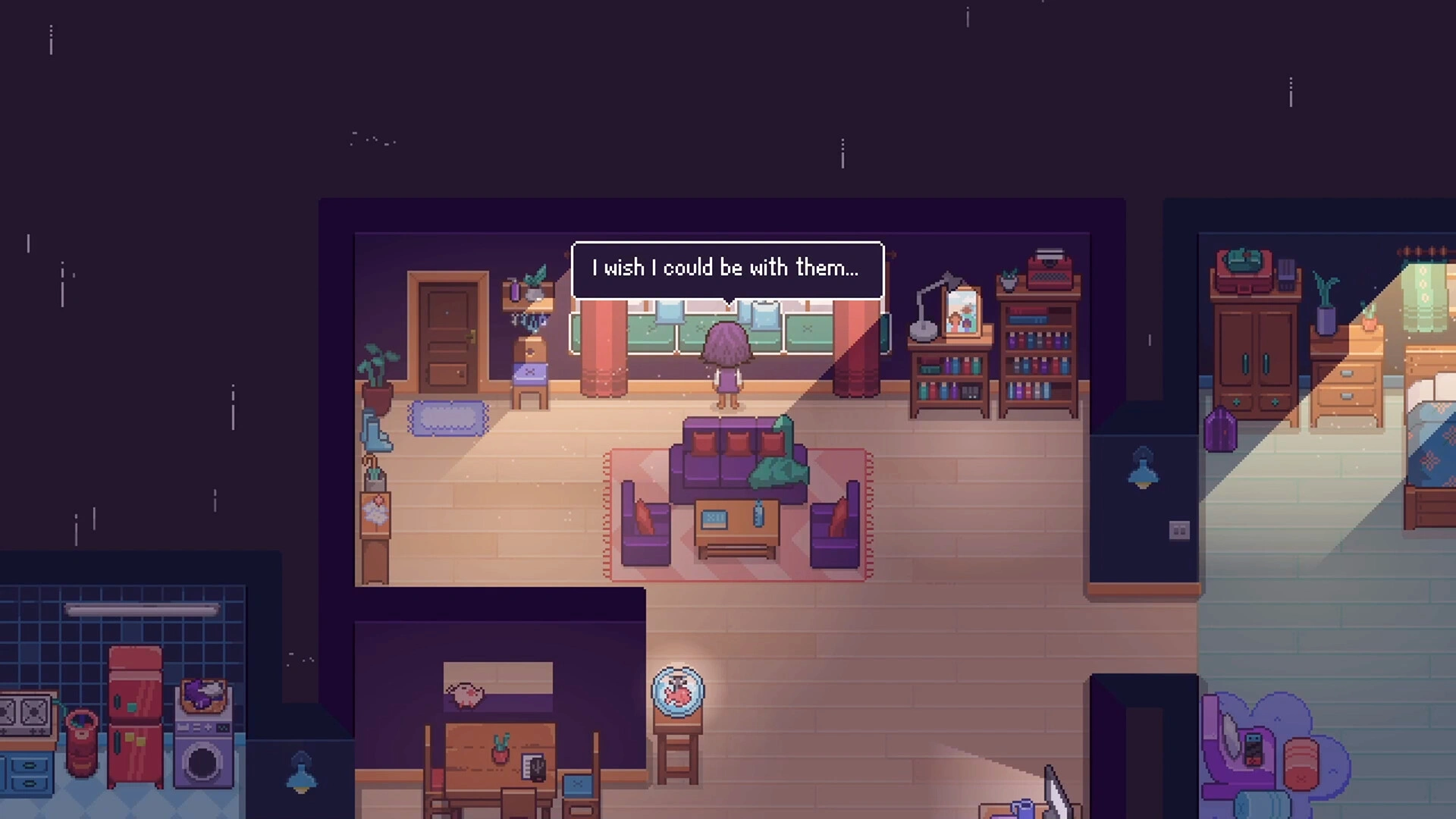
Fishbowl follows Alo, a 21-year-old recent graduate living in a new city in India. Her identity as an aspiring poet gives the premise a tender creative ache. She cannot write a single stanza, and that block reads like a direct expression of her emotional paralysis. The story takes place during the 2020 global pandemic, placing Alo inside her apartment during a month-long lockdown. That tight frame gives the game an immediate sense of physical and emotional confinement.
The narrative begins in the aftermath of her grandmother Jaja’s death. Alo tries to handle a junior video editing job while carrying that loss alone. The tension comes from the collision between professional routine and private mourning.
Her mother, Rosa, sends boxes of Jaja’s belongings that had been meant for donation. Alo accepts them to keep those pieces of the past safe, filling her small apartment with objects that carry memory, guilt, and affection. The mood stays quiet and intimate. A soft sadness hangs over each interaction, matching the stillness of a paused world.
The Weight of Daily Rituals
Fishbowl builds its play around the small rituals that keep a person moving through a day. Players guide Alo through brushing her teeth, showering, and eating regular meals. These self-care actions appear as cards on the screen, each asking for specific button inputs. Toothpaste requires a steady button hold. Brushing uses rhythmic left-to-right motion. The mechanics are simple, and their simplicity is the point. They make ordinary maintenance feel active, intentional, and sometimes exhausting.
A mood bar at the top of the interface tracks Alo’s mental health. Positive routines lift her spirits. Doomscrolling on her phone or binging empty television lowers the bar. Through these loops, the game makes depression readable through action. The challenge grows from the emotional effort behind each task. The inputs stay easy, yet the motivation behind them feels heavy.
Manually lifting a toilet lid or staying through a shower creates a quiet connection between the player and Alo’s fatigue. The routine-based design captures isolation with rare precision. A small domestic duty can become a real obstacle during intense mourning. The repeated structure mirrors the way depression can turn a plain day into a chain of conscious efforts.
Sorting Labor and Legacy
Alo’s job gives the game a second rhythm through her work as a video editor. She creates content for a popular streamer, represented through a matching mini-game. Colored blocks for audio and subtitles move across the screen. Players sort them into the correct categories on the left side. A successful streak raises a multiplier and increases the speed. This mechanic brings a sharper tempo to the experience. It reflects the pressure of a new career beginning under strange and isolating conditions.
The deepest emotional material comes from unpacking Jaja’s possessions. Each day, the player chooses a box to open, which leads into a slide puzzle. Moving the blocks uncovers items such as a chai thermos or a spectacle case. Each discovery triggers a memory sequence. These flashbacks show a younger Alo learning from her grandmother, giving their relationship texture and making the present loss sting with greater force.
One item, Paplet, is a mechanical toy fish. Paplet becomes a companion who speaks to Alo as her isolation grows. The toy carries symbolic weight, reflecting her fragile mental state and her attempts to process regret. Its presence offers odd comfort while sharpening the loneliness around her. These possessions act as anchors to a life that existed before the pandemic, tying memory to physical objects the player must handle piece by piece.
Visual Language and Digital Ties
Fishbowl uses pixel art to register emotional shifts with clarity. Alo appears in chibi form as she moves through her apartment. Video calls shift into detailed, full-screen portraits. Bright colors capture the social face Alo presents to others. When her mood falls or nightmares take over, the apartment moves toward grayscale or fills with approaching shadows. The visual design communicates her inner struggle through space, color, and scale, keeping heavy dialogue from carrying the whole burden.

Alo’s social life survives through screens. She speaks with her mother, childhood friends, and colleagues through video chat. The player selects dialogue responses during these conversations, and those choices affect the mood bar. Connection can soften her grief or make it sharper. These relationships feel grounded in the anxieties of lockdown life. The audio design supports that intimacy through a low-key, melancholic soundtrack.
The music gains rhythm during work segments, matching the pace of the editing mini-game. Small apartment sounds, including a coffee machine humming and a toilet flushing, make the space feel lived-in. These details sharpen the contrast between the cramped physical setting and the size of Alo’s grief.
Like To the Moon, Fishbowl keeps its focus on the emotional force of human experience. Its design favors atmosphere, memory, and narrative depth. The result is a portrait of a young woman trying to regain stability while the world outside has stopped moving.
The Review
Fishbowl
Fishbowl captures the heavy stillness of grief with remarkable sincerity. By turning daily self-care into deliberate acts, it makes the internal struggle of depression tangible. The pixel art provides a beautiful backdrop to a story that feels deeply personal and timely. It stands as a moving tribute to the process of living with loss.
PROS
- Sincere emotional storytelling
- Effective use of routine as a mechanic
- Beautiful character portraits
- Accurate cultural details
CONS
- Repetitive gameplay loops
- Stiff control inputs
- Slow narrative progression