



















One does not begin an episode of television expecting a queer, Spanish-language stop-motion melodrama about the political economy of guinea pigs in 1980s Ecuador. Yet, here we are. Women Wearing Shoulder Pads operates from a premise so specific it borders on the hallucinatory.
The series introduces Marioneta Negocios, a Spanish socialite whose personal crusade is to transform the local cuy from a culinary staple into a chic household pet. This is an act of cultural gentrification, a rebranding of tradition into a commodity for the elite.
Her antagonist is the formidable Doña Quispe, a former butcher who now presides over the nation’s most celebrated restaurant, El Cuchillo. Her empire is built on the very tradition Marioneta seeks to dismantle.
Their conflict is a dialectic of consumption played out in a world where cuys are the size of small horses, suitable for both dinner plates and bullfighting rings. Caught between these two matriarchs are Espada Muleta, a lovelorn matadora, and Nina, Doña Quispe’s own vegetarian daughter, a would-be revolutionary. It’s all quite a thing.
Handcrafted Verisimilitude
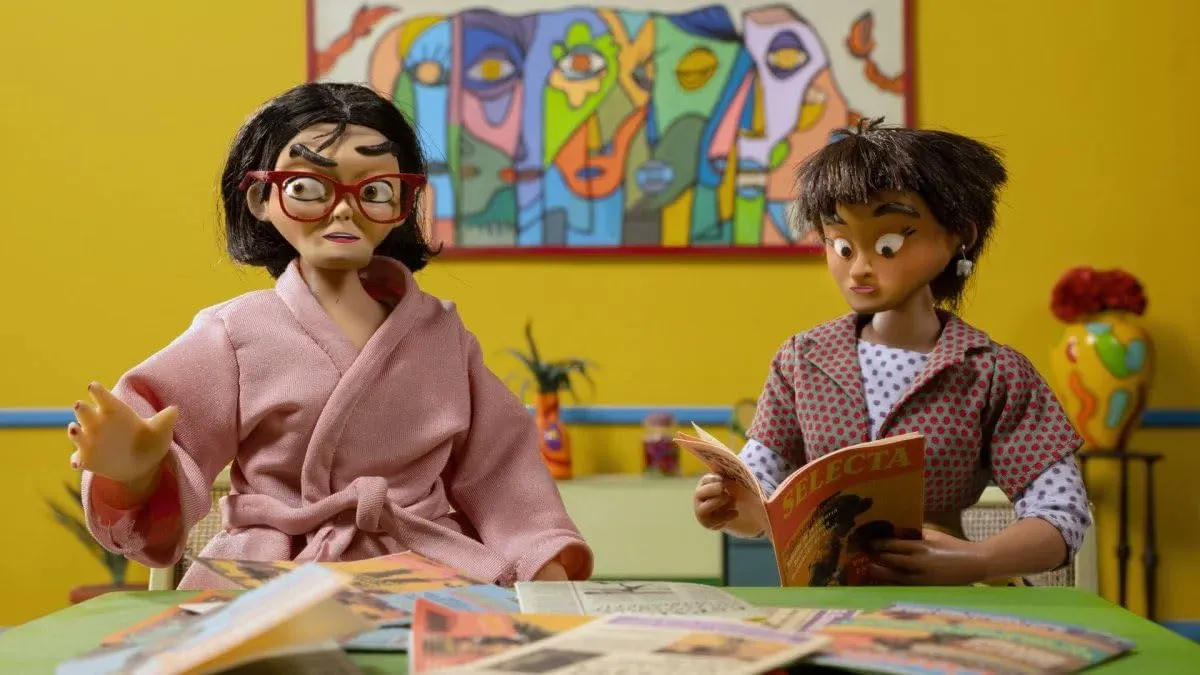
The sheer artistry of the production, credited to the animation studio Cinema Fantasma, demands immediate attention. Stop-motion animation has a unique physical presence; you can feel the imprint of the human hand on every frame, a quality that imbues the world with a tangible, almost unsettling, life. This is not the clean, digital perfection of computer-generated images.
This is a world built of clay, fabric, and paint, and its inherent imperfections are the source of its profound charm. The show’s aesthetic is a direct and loving homage to Pedro Almodóvar, saturated with a rich color palette and exquisitely detailed sets that communicate a world of high passion and higher camp.
Also Read






The passionate reds of Marioneta’s wardrobe are a clear signifier of her dramatic inner life, while the cold, metallic sheen of Doña Quispe’s restaurant speaks to her ruthless pragmatism. The puppets themselves, with their expressive faces and period-appropriate costumes, are small marvels of design, capable of conveying subtle emotional shifts with a mere tilt of the head.
There is a technical mastery here that produces moments of startling beauty. A scene set in the rain, for instance, transcends its medium. The way the light catches the manufactured water droplets, the slight tremor in a character’s pose, the entire atmospheric composition—it creates a feeling of manufactured authenticity that is somehow more emotionally potent than reality.
It is a reminder that cinema at its best does not replicate life but interprets it. The creators even occasionally insert a live-action human hand into the frame, a delightful collapse of the diegesis that reminds us of the beautiful artifice we are watching, a Brechtian nod to the labor behind the fantasy.
The Gravity of the Ridiculous
The show’s narrative tone is a delicate balancing act. It fully commits to the high-stakes emotionality of the telenovela, complete with masked stalkers, unrequited love, corporate espionage, and long-buried secrets.

These plot points are not treated as jokes; they are the sincere engine of the story, and the characters’ passions are presented without a shred of condescension. The genius of the series is in placing this genuine emotional core within a universe governed by a logic of profound absurdity.
The humor arises from the deadpan presentation of the surreal. The world’s strangeness is the established norm. A duck might willingly throw itself into a paper shredder, and the event is met with the same casual indifference as a passing car.
The comedy stems from the characters’ earnestness within their surreal context. Marioneta’s profound self-absorption, her genuine belief that she is the central figure in a grand drama, makes the bizarre world bend around her.
Her acceptance of multiple admirers and stalkers is not vanity; it is simply her perception of the natural order. The series understands that our own internal melodramas, when viewed from the outside, often contain a measure of the ridiculous. It operates in a state of sincere irony, where the emotions are real, but the circumstances are preposterous.
The Tyranny of the 11-Minute Hour
The primary point of friction in the series is its structure. The show’s grand, sprawling narrative ambitions are packed into eight episodes, each barely eleven minutes long. This format, common for animated comedy, creates a sense of perpetual narrative interruption.
Just as a scene accumulates dramatic weight or a character relationship begins to deepen, the credits appear. This is a story with the soul of a novel forced into the body of a collection of short poems.
This compression has consequences. The total runtime of the season is less than a feature film, which is simply not enough space to properly develop its large cast. Many figures, especially the supporting players like the matadora Espada, are left as compelling sketches rather than fully realized characters. Her tragic love remains a motif rather than a fully developed arc.
Traditional telenovelas build their empires over hundreds of episodes, allowing intricate plots to breathe. Women Wearing Shoulder Pads attempts to perform the same feat in miniature.
The effect is that of a brilliant, frantic fragment, a story that gestures toward an epic scope but is ultimately constrained by its own temporal boundaries. It leaves one admiring the vision while lamenting the unrealized depth, a testament to an ambition the format cannot fully contain.
The animated series “Mujeres con hombreras” (Women Wearing Shoulder Pads) premiered on August 17, 2025, and is a production by Cinema Fantasma for Adult Swim. It is also available to stream on HBO Max.
Full Credits
Director: Gonzalo Cordova
Writers: Gonzalo Cordova, Pancho Viñachi
Producers: Cinema Fantasma
Cast (voice actors): River L. Ramirez, Norma Maldonado, Pepa Pallarès, Gabriela Cartol, Kerygma Flores, Nina Torres, Karla Falcón, Cony Madera, Regina Carrillo, Laura Torres
The Review
Women Wearing Shoulder Pads
Women Wearing Shoulder Pads is a triumph of artistic vision and conceptual daring. Its stop-motion world is a sublime, handcrafted marvel, and its blend of sincere telenovela passion with deadpan absurdity is masterful. The show is a visual feast and a tonal miracle. Its profound weakness is a runtime that suffocates its own narrative ambition, leaving a brilliant story gasping for air. It is a gorgeous, unforgettable, and frustrating fragment of a masterpiece.
PROS
- Exquisite and highly detailed stop-motion animation.
- A unique and effective blend of high melodrama and surreal humor.
- A gorgeous, fully realized visual aesthetic inspired by Pedro Almodóvar.
- A completely original and inventive central concept.
CONS
- The extremely short episode length undermines the narrative's depth.
- The story's pacing often feels rushed and abrupt.
- Character arcs, particularly for the supporting cast, feel underdeveloped.