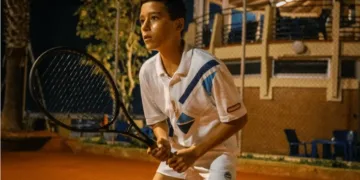










The sports film often follows a dependable blueprint, but My Tennis Maestro seems less interested in the final score than in the messy mechanics of the game itself. Set in 1980s Italy, the story introduces Felice, a 13-year-old tennis talent meticulously engineered by his father.
His game is a reflection of his upbringing: a rigid, defensive baseline style modeled on the machine-like consistency of Ivan Lendl. When Felice earns a spot on the national circuit, his father makes a significant sacrifice, investing the family savings in a professional coach.
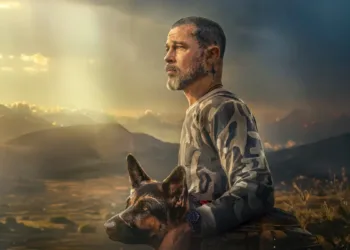
This brings Raul “the Cat” Gatti into the picture, a former pro whose charisma is matched only by his unreliability. Raul champions a philosophy of instinct and pleasure, both on the court and off, idolizing the flamboyant Guillermo Vilas. With their conflicting ideologies packed into a small car, the two begin a tour of Italy’s junior tournaments, setting the stage for a collision of character.
The Psychological Rally
The narrative engine of the film is the relationship between its two leads, a dynamic built on fundamental opposition. The story finds its rhythm in the friction between Felice’s severe discipline and Raul’s almost pathological need for freedom. Where Felice sees a rule, Raul sees a suggestion to be ignored.

Their early interactions are a series of small battles over training schedules, meals, and curfew, each one a test of wills. The structure works because the performances are so precisely calibrated. Pierfrancesco Favino gives Raul a captivating, almost predatory charm, yet he allows glimpses of the profound vulnerability beneath the surface. It shows in the moments when his bravado cracks, revealing a flicker of desperation, or when he observes Felice with an expression that is part pity, part envy.
Across the net is Tiziano Menichelli as Felice, who provides a performance of astonishing maturity. He conveys the immense weight of expectation on his young shoulders with minimal dialogue, using a tensed posture and watchful eyes to show a boy constantly calculating risk.
Their initial coach-student arrangement slowly dissolves, re-forming into a fragile, surrogate father-son bond that neither seems equipped to handle. The film cleverly constructs a dual coming-of-age story. As Felice is carefully introduced to a world beyond rigorous training, Raul is awkwardly forced to confront a life of deferred responsibility.
The Texture of the Game
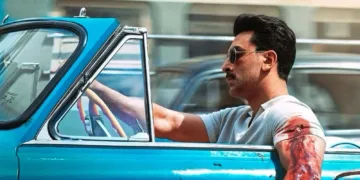
Director Andrea Di Stefano builds a world that feels authentic in its particulars. The film’s visual language employs a saturated, almost Technicolor palette, giving the 1980s setting a warm, nostalgic sheen that feels closer to the Italian cinema of the 1960s. This choice creates a subtle tension, contrasting the vibrant, sun-baked visuals with the often melancholy inner lives of the characters.
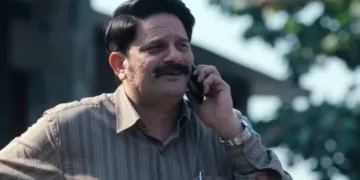
The aesthetic is supported by period details that are present without being distracting, from the clunky mechanics of a pay phone to the designs of the cars that ferry the pair from one tournament to the next. The soundtrack, filled with classic Italian pop songs, further grounds the story in a specific cultural moment.
These songs often provide an ironic counterpoint, with upbeat melodies playing over scenes of quiet disappointment or contemplation. What is most effective is the depiction of the junior tennis circuit itself.
The story finds life in the mundane details: the quiet sadness of out-of-season seaside hotels, the dusty trophy cases filled with forgotten victories, and the endless hours spent waiting for a match to begin. This focus on the unglamorous reality of the sport, the sheer logistical grind of it all, gives the film a tangible atmosphere of fatigue and fleeting hope.
Deconstructing the Final Set
At its core, the film examines the space between ambition and self-worth. It explores themes of mentorship and the heavy burden of parental expectation, contrasting Felice’s biological father, who coaches for results, with Raul, who coaches for life experience.
The story’s primary deviation from the genre is its deep interest in the narrative of failure. This is not a film about a triumphant comeback; it is a film about learning to live with imperfection and finding value outside the win-loss column. As the story progresses, it deliberately shifts its focus from a conventional sports plot to a more nuanced character study, using the tennis matches as a backdrop for Raul’s personal reckoning.
This structural choice is ambitious, though the execution in the third act is debatable. The story seems uncertain how to resolve its central conflicts, resisting the neat bow of a championship victory but also struggling to find an equally resonant emotional climax.
It leaves certain character arcs feeling incomplete, which may be a deliberate reflection of life’s untidiness or a simple fumble in the script. The final shot, a direct wink to the camera, is a curious decision. It could be read as a self-aware nod to the story’s autobiographical roots, a playful gesture that feels slightly at odds with the poignant emotional journey that preceded it.
My Tennis Maestro (Italian title: Il maestro) premiered at the Venice Film Festival on August 31, 2025. It is scheduled for a theatrical release in Italy on January 15, 2026. The film is 125 minutes long. It is a collaborative production involving Indiana Production, Indigo Film, Vision Distribution, Memo Film, Sky, and Playtime.
Full Credits
Director: Andrea Di Stefano
Writers: Andrea Di Stefano, Ludovica Rampoldi
Producers and Executive Producers: Nicola Giuliano, Francesca Cima, Carlotta Calori, Viola Prestieri, Marco Cohen, Benedetto Habib, Fabrizio Donvito, Daniel Campos Pavoncelli
Cast: Pierfrancesco Favino, Tiziano Menichelli, Giovanni Ludeno, Dora Romano, Valentina Bellè, Astrid Meloni, Chiara Bassermann, Paolo Briguglia, Roberto Zibetti, Fabrizio Careddu, Edwige Fenech
Director of Photography (Cinematographer): Matteo Cocco
Editors: Giogiò Franchini
Composer: Bartosz Szpak
The Review
My Tennis Maestro
My Tennis Maestro is a thoughtful and engaging character study, carried by the superb performances of its two leads. It smartly subverts the sports genre to tell a poignant story about mentorship, failure, and the messy business of growing up. While the narrative stumbles in its final act and lacks a fully satisfying resolution, the film’s authentic atmosphere and the depth of its central relationship make it a compelling watch. It is a heartfelt film that values emotional truth over a simple victory.
PROS
- Pierfrancesco Favino and Tiziano Menichelli deliver nuanced performances with exceptional on-screen chemistry.
- The film excels as a dual coming-of-age story, focusing on the complex bond between coach and student.
- The nostalgic 1980s Italian setting is beautifully realized through saturated visuals and an effective soundtrack.
- It thoughtfully explores themes of failure and personal growth, avoiding typical sports movie clichés.
CONS
- The narrative loses momentum and struggles to bring its central character arcs to a conclusive end.
- The story leaves several threads unresolved, which may frustrate some viewers.
- The film's final playful gesture feels somewhat disconnected from the poignant drama that precedes it.