
























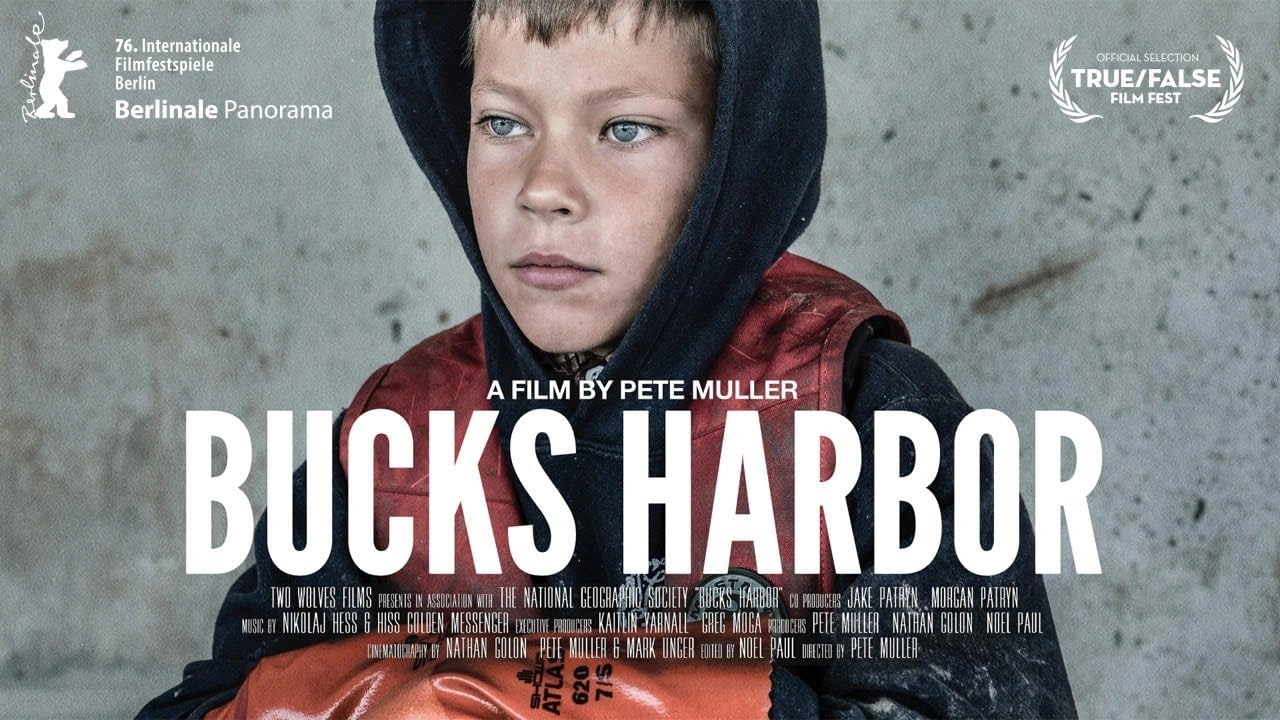

Pete Muller’s Bucks Harbor enters a remote lobster-fishing community in Downeast Maine with the patience of someone who knows a place can’t be understood by staring at its postcard version. The Atlantic is beautiful here, yes, but it is the sort of beauty that could kill you before breakfast. Forests press in from one side, gray water from the other, and winter seems less like a season than a local government.
Muller’s 98-minute documentary studies men whose lives are bound to lobster fishing, clam digging, tackle shops, family obligation, poverty, addiction, and private grief. There is no conventional plot. No grand explanatory voice arrives to make everything tidy. The film gathers meaning from routines, glances, jokes, pauses, and labor.
This is working-class masculinity viewed without easy condemnation. The men of Bucks Harbor live inside traditions that have given them purpose and damaged them in equal measure. They carry their hurt like equipment: heavy, practical, rarely discussed.
Fathers, Sons, and the Old Machinery of Manhood
Dave becomes the film’s most immediately magnetic presence, partly because he seems to know the tragic joke of his own life and tells it well. A fisherman, recovering drug addict, gifted artist, and devoted dog owner, he is funny, bruised, patriotic, proud, and painfully aware of the smallness of the choices once offered to him. His father’s death still hangs over him. So does the life he might have lived had his artistic talent found support beyond local admiration and practical resignation.
His visits to food banks never feel like sociological punctuation. Muller lets them sit there, plain and uncomfortable. Poverty in Bucks Harbor is not decorative misery. It is the arithmetic of a hard trade, a remote economy, and a culture that teaches men to equate usefulness with dignity.
Mark offers the film’s most surprising act of self-definition. At first, he appears to fit the town’s familiar mold: quiet, work-worn, lodged inside a masculine trade. Then the film reveals his pleasure in wearing women’s clothing and sharing that expressive side online. The detail could have been played for cheap surprise. Muller avoids that. Mark’s story becomes a small rebellion against what might be called dockside orthodoxy, the belief that manhood must arrive in one shape, one voice, one uniform.
Mike, teaching his young sons the lobster trade, gives the film one of its sharpest moral tensions. He wants them to remain children, yet he also knows the sea has a way of recruiting early. Their competence on the boat is impressive and slightly terrifying. Wayne, scarred by abuse, alcohol, failed relationships, and isolation, carries a different historical record in his body. He is less a cautionary tale than a weathered archive. The film respects them all. That respect matters.
The Tide as Editor, the Camera as Witness
Muller and editor Noel Paul shape Bucks Harbor as a mosaic rather than a march. The film moves from one life to another with little concern for chronological signposting. There are no onscreen names, no tidy chapter cards, no lecture from above. We learn people through behavior: how they work, how they talk, how they dodge tenderness, how they laugh when pain gets too close.

That choice gives the documentary a certain rough grace. It can feel loose, perhaps too loose at times, as if a few scenes have been kept because the world was too rich to trim. Yet that looseness also mirrors the harbor’s own rhythm. Life here does not arrange itself into clean dramatic beats. It drifts, freezes, thaws, repeats.
The cinematography by Muller, Nathan Golon, and Mark Unger is central to the film’s power. Wide shots turn the coast into a stern, gorgeous presence: gray water, red autumn leaves, snow fields, working docks, bruised skies, boats small against the Atlantic’s indifference. The images have painterly control, but the film never confuses beauty with comfort. Mud, cold, fatigue, and danger remain visible. Nature is no spiritual spa. Nature is the boss, and it does not offer paid leave.
This observational restraint gives Bucks Harbor its ethical texture. Muller watches without embalming his subjects in nobility. He lets them be funny, stubborn, wounded, contradictory, and occasionally ridiculous. That last part helps. Any documentary about masculinity that lacks absurdity is probably lying.
Lobsters, Molting, and the Fragile Hard Shell
The underwater lobster sequences provide the film’s governing symbol, and yes, it is obvious. Men with hard shells, lobsters with hard shells. Men trying to change, lobsters shedding their old armor. One can almost hear a classroom discussion forming in real time.

Yet the metaphor works because Muller handles it with calm visual intelligence. Beneath the water, the lobsters move with eerie composure. Their world is quiet, ancient, almost indifferent to the human drama above. They survive through vulnerability, shedding what once protected them. For the men on land, change is less graceful. It arrives through sobriety, grief, parenthood, gender expression, aging, memory, and the slow recognition that inherited toughness can become a prison with a nice view.
The film’s treatment of masculinity is philosophical without becoming abstract. It understands manhood as a transmitted system: fathers pass down trade skills, emotional silence, pride, fear, and sometimes violence. Sons absorb these codes before they can name them. Some repeat the pattern. Some resist it. Some do both before lunch.
This gives Bucks Harbor a cultural charge beyond its small setting. In an age still arguing over masculinity through slogans, podcasts, politics, and panic, Muller offers something rarer: a close look at men who are neither monsters nor saints. They are products of class, geography, family, labor, and loss. They are trying, which is less glamorous than transformation and often harder to film.
The humor keeps the film from sinking into solemnity. Roadkill stories, blunt local one-liners, Dave’s laugh, Wayne’s battered candor, and the salty poetry of everyday speech all give the documentary warmth. Bucks Harbor becomes a tender, visually rich, unsentimental study of survival and self-reinvention, finding fragile lives inside a place built on hardness.
The American independent documentary Bucks Harbor made its official world premiere at the 76th Berlin International Film Festival in the Panorama Documentary program on February 14, 2026, before going on to screen at regional US events like the True/False Film Fest and the Margaret Mead Film Festival. Directed by photojournalist Pete Muller, the film presents an immersive, vignette-style look at a handful of generations-deep lobster fishermen navigating the unforgiving winter elements and rigid masculine expectations of a coastal Downeast Maine village. Since the title is currently playing on the international and domestic film festival circuits, interested viewers can keep an eye out for upcoming independent cinema showcases and local non-fiction screening schedules.
Full Credits
Title: Bucks Harbor
Distributor: 2 Wolves Films, Indox
Release date: February 14, 2026
Running time: 98 minutes
Director: Pete Muller
Writers: Pete Muller
Producers and Executive Producers: Pete Muller, Nathan Golon, Noel Paul, Kaitlin Yarnall
Cast: David Cale, Mark, Local Machias and Bucks Harbor Residents
Director of Photography (Cinematographer): Nathan Golon, Pete Muller, Mark Unger
Editors: Noel Paul
Composer: Nikolaj Hess
The Review
Bucks Harbor
Bucks Harbor is a tender, visually arresting documentary about labor, masculinity, trauma, and quiet self-reinvention. Pete Muller observes his subjects with patience and moral clarity, finding poetry in rough speech, cold water, hard work, and lives shaped by fathers who left deep marks. Its loose structure may test some viewers, yet its human portraits are rich enough to carry the film.
PROS
- Beautiful coastal cinematography
- Strong human portraits
- Thoughtful study of masculinity
- Warm humor amid heavy themes
- Patient observational style
CONS
- Loose structure may feel drifting
- Lobster metaphor is somewhat obvious
- Some subjects could use deeper focus