
























![Kingdom Hearts Collection [I-III] Review](https://gazettely.com/wp-content/uploads/2026/10/Kingdom-Hearts-Collection-I-III-1-360x180.webp "Kingdom Hearts Collection [I-III] Review: KHII Holds Steady as Newer Entries Fluctuate 37")




The Berlin Apartment steps into interactive historical fiction as a narrative-first game that plays close to a walking simulator. Everything happens inside one Berlin apartment, and that fixed setting lets the game trace the history of the city and Germany through the people who pass through it. A framing story set in 2020 puts players in the role of Dilara, a child helping her father, Malik, renovate the apartment. As they work, they uncover objects left behind by earlier tenants, and each discovery opens a separate interactive story.
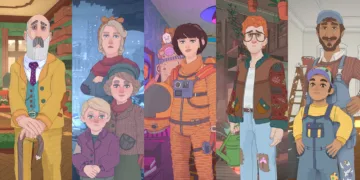
The game’s key idea is to move through the last century of German history by following the personal lives of four former residents. Big events like the rise of Nazism, World War II, the Cold War split of Berlin, and daily life under communism appear through private moments, small routines, and the weight those eras place on ordinary people. The tone is intimate and emotional from the start, helped along by an art style that feels both distinctive and beautiful.
The Historical Anthology
The Berlin Apartment uses an anthology structure, presenting four self-contained vignettes. Each vignette follows a tenant from a different period, spread across roughly 100 years. Together, they touch major points of modern German history, focusing on the impact of fascism and World War II, dated here at 1933 and 1945, then shifting to the pressures of life inside the German Democratic Republic and a city divided by the Berlin Wall, dated at 1967 and 1989.
The stories vary a lot in tone and dramatic focus. The 1989 vignette follows Kolja and carries a lighter, more hopeful mood. It builds an unlikely pen-pal friendship across the Wall, with paper airplanes serving as their method of contact. The 1933 vignette moves into harsher territory through Mr. Liebermann, an elderly Jewish man. Players help him pack a suitcase with essential belongings as he prepares to flee Nazism. That simple task triggers quiet, silent-film-styled memories of his earlier life, giving the scene its punch without leaning on long speeches.
The 1945 postwar vignette follows a family trying to celebrate Christmas inside a bombed-out ruin. Compared with the others, it feels brief and thin on interaction, so its emotional beats pass faster than they should. The 1967 vignette, focused on the author Antonia facing state censorship over her novel, is the most elaborate and feature-rich of the four. Its structure plays with perception, sliding between the physical apartment and the world Antonia is writing, so the player keeps shifting between reality and fiction.
Each vignette shows care and empathy on its own, and the historical detail often lands well. The larger structure is shakier. Interconnected anthology games like What Remains of Edith Finch set up links that help separate stories build toward a shared arc. The Berlin Apartment’s vignettes sit alongside each other with little narrative or thematic pull tying them together, which can make the full experience feel chopped into pieces. Pacing adds to that drift. The 1945 story ends quickly and feels underbuilt, while the 1967 story sometimes stretches longer than its core ideas need.
Visual Design and Aural Detail
Presentation is one of the game’s biggest strengths. The Berlin Apartment uses a clean cel-shaded look, then fills it with strong color choices and rich environmental detail. Sticking to one apartment could have made exploration feel repetitive, yet each era remakes the flat completely. Decor, color palette, and mood change from vignette to vignette, reflecting both the resident’s personality and the interior style of the time. That constant reinvention keeps the space interesting to search, and every historical layer brings a different visual flavor.

Technical problems sit under that surface polish. Some players run into performance issues, including frame-rate drops in certain moments, plus minor texture glitches and occasional asset overlap. Character animation is also a weak spot. Movement can look choppy and a bit lifeless, drawing attention away from the otherwise strong visual work.
Sound design stays spare, leaning on ambient noise and soft musical cues. Full voice acting across all characters is a major part of the game’s emotional pull. The English track can feel flat at times, with lines delivered in a way that turns too explanatory. The German track is far more convincing and carries a stronger sense of place. Erich the goldfish is the standout, speaking with a distinct Berlin accent that sells the authenticity of the original language option.
Interactivity and Mechanical Limitations
Mechanics are intentionally minimal. There’s little challenge, and almost every input exists to serve the narrative. Play works as point-and-click exploration inside the compact apartment space. The typical loop has players click through dozens of objects until they find the specific trigger that pushes the plot forward or unlocks a memory. Actions stay grounded and simple: watering plants, carefully packing a suitcase, folding paper airplanes.

This light interactivity often feels like a restraint on storytelling. In several sequences, especially the World War II vignettes, the game slips into slow scavenger-hunt routines. Character movement is sluggish, dialogue can pile up, and the hunt for the next required object turns into busywork. That mechanical drag creates tension between the powerful historical themes and the tedious effort needed to reach the next beat.
The 1967 author story is the clear exception. It gives the player more agency and folds interaction into the plot, so actions feel motivated by Antonia’s fight with censorship rather than by a checklist. The way it merges fictional spaces with the apartment works best here because the mechanics are designed around that shifting perspective. Outside the four historical stories, the 2020 framing section offers lighter activities for Dilara, like drawing on the walls or playing a tile-based Minesweeper variant.
The larger weakness of the game is the lack of synergy between its parts. The emotional writing and striking art often push hard, yet the simple mechanics and occasional flat line delivery keep rubbing against that momentum. The Berlin Apartment shines brightest in moments where its minimal gameplay lines up cleanly with a specific narrative beat and lets the story breathe.
The Review
The Berlin Apartment
The Berlin Apartment is a visually stunning historical anthology that succeeds in telling powerful, human-scale stories within a single setting. Its gorgeous, transformative art style and intimate voice acting effectively carry the weight of Germany’s complex past. However, the experience is hampered by disjointed narrative coherence, technical rough edges, and minimalist gameplay that often feels repetitive and tedious. It is a worthwhile experience for fans of narrative history, though it struggles to compete with the genre's best due to its mechanical limitations.
PROS
- Visually stunning and transformative art style
- Powerful, intimate historical storytelling
- Strong German voice acting and atmosphere
- Creative exploration in the 1967 story
CONS
- Gameplay is repetitive and often tedious
- Narrative structure is sometimes disjointed
- Choppy animations and technical glitches
- Pacing issues in some vignettes