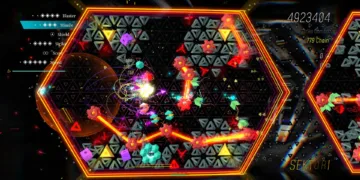

























Sektori is an adrenaline-fueled twin-stick shooter that distills classic arcade action into pure, high-skill play. Its audiovisual identity sets the tone in seconds. A pulsating techno score pushes every encounter forward, while kaleidoscopic, eye-melting backdrops keep the screen in a constant sensory surge that can slip into euphoria. Headphones feel close to mandatory, because the sound design carries an insistent, urgent pulse that shapes how you time movement and fire.
Created by solo developer Kimmo Lahtinen, a veteran from Housemarque, Sektori wears that lineage openly. You can feel it in the finely tuned controls and relentless pacing, and in the way the game draws a straight line to the golden age of modern arcade shooters. The central loop is clean and fierce: pilot a polygonal ship, shred waves of geometric enemies, and stay alive inside an arena that refuses to sit still.
Flow State and Mechanical Discourse
Sektori speaks the familiar grammar of the genre: left stick movement, right stick aiming and shooting. The ship begins with a deliberately restrained base speed that the player develops through upgrades, so early runs play like a battle to earn full mobility under pressure. That shape of progression nods to arcade tradition, where improvement comes from performance and repetition.
Strike is the mechanic where the design turns into kinetic expression. This dash attack triggers an Area of Effect explosion that clears nearby threats. Its real hook is the reset rule: Strike into any token and the cooldown snaps back instantly. That single twist creates a sharp risk-reward rhythm. You are pushed to dash into danger to keep momentum alive, and every successful reset feels like threading a needle through a storm.
When the screen reaches maximum chaos, Mirage arrives as a brief, radiant counter-tempo. Built by collecting specific letter tokens, Mirage grants a temporary burst of high damage with limited invulnerability, and the visuals tilt into pure, trippy power. It reads like a reward for staying in sync with the game’s internal beat.
Enemy design stays rooted in function. Polygons, squares, and triangles each carry distinct movement and attack habits. Some chase in time with the music, turning rhythm into a tactical cue. Others fire projectiles that carve lanes through the arena. Certain types add layered defenses, such as a shielded head paired with a weak serpentine body that invites careful targeting. Across the dozen-plus enemy roster, recognition becomes a learned skill. You read tells, anticipate patterns, and set priorities fast, because hesitation costs space, and space is your real currency.
Also Read





The Economy of Risk and Reward
Progression is woven directly into the firefight, so upgrades never feel like a guaranteed escape hatch. Defeated enemies drop Glimmer, small experience pips that fill a meter and then spawn an Upgrade Token. Tokens feed an in-run hierarchy tied to Speed, Strike, Shield, Missiles, and Blasters. The daring part of this design sits in how it makes you gamble on your own consistency.

Big payoffs like Blasters require banking multiple tokens without taking damage. One hit sends you back to the bottom of the tree. So each wave forces a mid-combat choice: take a quick, low-tier boost such as Speed to stabilize, or hold your tokens for a heavier upgrade while the arena keeps trying to kill you. The system revives an arcade ethic that values precision over convenience.
Alongside that ladder is the Deck/Evolver system. Selector/Evolver Tokens offer a pick from one of your equipped upgrade decks. Before a run, you choose a limited set of decks, for example eight, each containing specialized passive buffs like utility drones or proximity shields.
These additions do not replace your base kit. They sit on top of it, layering extra texture and finesse into the same core shooting language. After a run, the climb resets. Each attempt begins from the same baseline, and your progress lives inside execution rather than a permanent power curve. The design keeps skill front and center, asking you to earn every advantage in real time.
The Global Language of Challenge
Campaign Mode lays out a brutal route: five levels or worlds, each ending in a randomized boss fight. The standout feature is the arena itself. The playable space grows, shrinks, and changes shape every few seconds, turning the ground into a shifting agreement that you have to renegotiate constantly. That instability feels in conversation with abstract visual art traditions where solid form dissolves into movement and perception.

Here, the player’s sense of place becomes temporary, and adaptation turns into a kind of cultural literacy for the game’s world. Red flashing floor sections signal parts about to fall away. Step into one at the wrong moment and the run ends instantly. This layer of spatial threat stacks on top of enemy pressure, so the arena becomes an active participant in every fight.
Difficulty sits high even on the standard “Experience” setting. Sektori is unforgiving, demanding reflexes that stay sharp and awareness that never drifts. Losses rarely register as cheap. They land as lessons, showing exactly where your timing slipped or your angle went soft. That teaching quality feeds replayability. You come back to correct small errors, keep pace with the rhythm, and chase a cleaner mastery.
For players who want twists on that same challenge, Sektori includes six additional modes unlocked through challenges. Classic locks the arena into a static layout, letting you focus on enemy patterns without the shifting floor. Surge adds brief power-up bursts that change the tempo of runs. Crash turns Strike into the primary tool for kills, remaking the dash loop into the heart of combat. Each mode supports online global leaderboards, linking your performance to a worldwide arcade language of score-chasing and self-comparison.
Through all of this, the techno pulse and visual overload remain half the experience. Music, motion, and geometry sync into a trance-like state that pulls attention tight and keeps the body moving on instinct. Sektori’s heritage in modern arcade shooters is clear, yet its appeal travels easily across borders. Anyone fluent in the global dialect of high-pressure action can step in, feel the beat, and start learning the game’s grammar through play.
The Review
Sektori
Sektori is an essential contemporary entry in the arcade twin-stick genre. Its relentless action is perfectly calibrated, demanding high skill while rewarding players with a deeply satisfying mechanical loop. The synthesis of its punishing, yet fair, difficulty curve, kinetic upgrade systems, and euphoric audiovisual design creates a trance-like state of focused mastery. It is a stunning realization of pure arcade intensity that successfully translates a classic aesthetic into a demanding modern experience.
PROS
- Exquisite, highly-tuned twin-stick gameplay
- Addictive, skill-based risk-reward progression
- Pulsating techno soundtrack and stunning visuals
- Dynamic, constantly evolving level architecture
CONS
- High difficulty may deter casual players
- Occasional legibility issues due to visual chaos
- Boss designs can interrupt flow/pacing
- Minimal guidance on some mechanics