


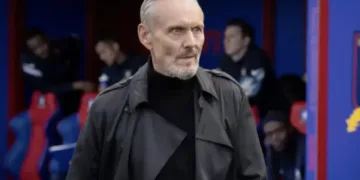





















The Great Escaper takes a small modern legend and treats it with quiet care. The film retells the true story of Bernard “Bernie” Jordan, an 89-year-old World War Two veteran who, in 2014, slipped out of his Hove care home so he could travel on his own to Normandy for the 70th anniversary of the D-Day landings. Director Oliver Parker approaches this tabloid-ready incident as a restrained character drama, sidestepping simple patriotic rhetoric.
With Michael Caine as Bernie and the late Glenda Jackson, in her final screen role, as his wife Rene, the film draws its strength from close observation. It tracks the physical trip of an ageing veteran searching for a sense of closure and sets it alongside an emotional process of memory and marriage that shapes the couple’s last years. The story looks at the act of saying farewell, to a violent past and to a beloved partner.
The Weight of Caine and the Road to Normandy
Michael Caine’s turn as Bernie carries the film. His presence has authority, yet he relies on fine shadings to express Bernie’s inner life. Caine conveys the character’s buried sorrow, survivor’s guilt and brief flashes of fear as he stands once again in the landscape of his youth. The performance makes it easy to understand why he was reportedly drawn out of retirement to play this part.
Bernie’s trip to Normandy becomes a kind of pilgrimage shaped by his wish to honour a fallen comrade. The concrete details of trains, ferries and arrival are observed with quiet respect. Brief flashbacks to the brutal 1944 crossing and its bleak aftermath supply context and root Bernie’s present-day urgency in that earlier trauma.
Here the film works as a cultural object that speaks to shifts between generations. One striking sequence shows Bernie meeting German veterans in a café. The scene refuses a tidy sense of reconciliation and lingers on a shared, wordless moment between men who once tried to kill each other.
The result feels like a clear statement that steps outside everyday political talk. Bernie’s plain remark at a grave, “What a waste,” captures the film’s limited use of patriotic fervour and its preference for the sober sadness of an old soldier, with grand claims of glory left to one side. The film places the real cost of war inside these hushed scenes of private thought.
An Anchor in Rene: Jackson’s Poignant Farewell
Across the Channel, the emotional grounding of the film rests with Glenda Jackson’s radiant work as Rene. In this final performance, she carries the same mischief and grit that marked so much of her career. She suggests an intimate process of remembrance while her husband is away. The scenes between Bernie and Rene in their care home feel piercingly truthful, especially in their open conversations about approaching death and the lingering weight of survivor’s guilt.

The film cuts to flashbacks of their wartime romance, with a first encounter and first kiss filtered through Rene’s memory and old photographs. These fragments make Rene feel like the guardian of their shared story, the person who protects what they have lived together.
As someone who has always responded to performances that communicate emotion with the smallest shift of expression, I found Jackson’s ability to glow at a private recollection remarkable. A confident supporting cast strengthens the material, with John Standing as a gentle RAF veteran and strong work from Victor Oshin and Danielle Vitalis. The partnership between Caine and Jackson forms the emotional core of the film, with attention fixed on a relationship that outlasted some of the century’s worst violence.
Direction, Sentiment, and Cinematic Honesty
Oliver Parker’s direction stands out for its clean, unfussy style. He avoids easy World War II nostalgia of the sort that often leans on familiar images and speeches. The film functions as a focused character portrait that gives primary weight to the human price and personal memory of war, with any simple patriotic salute kept firmly in the background.
Parker and writer William Ivory handle the line between sentiment and honesty with care. The script draws on the “pat, patriotic sentimentalism” that surrounded Bernie’s real-life media coverage, yet Parker consistently prunes that tone in the most charged scenes. The filmmaking gives priority to truthfulness and care and keeps spectacle at a distance. I felt drawn to that sense of integrity. The film’s emphasis on the personal story is strengthened by its economical use of place.
The production shoots entirely in the UK and relies on small touches, such as red wine on a table, to suggest France, which keeps attention on the actors. One technical reservation stands out for me. The score can feel heavy-handed, leaning hard on emotional cues at moments when Caine and Jackson’s expressions already communicate everything that is needed. The film’s real strength lies in its craft as a quiet piece of cinema about a life marked by extraordinary noise and consequence.
The Great Escaper is a 2023 British biographical film inspired by the true story of 89-year-old World War II veteran Bernard Jordan, who “escaped” his care home to attend the D-Day 70th anniversary in Normandy, France, in 2014. Starring Michael Caine and the late Glenda Jackson in her final screen role, the film premiered in the United Kingdom on October 6, 2023. For viewers in the United States, the film made its American television debut on the PBS Masterpiece channel on Sunday, November 23, 2025. It is also available to stream or rent on various digital platforms, including BFI Player and Amazon Prime Video.
Full Credits
Title: The Great Escaper
Distributor: Warner Bros. Entertainment UK
Release date: October 6, 2023 (United Kingdom)
Rating: 12A
Running time: 96 minutes (1 hour 36 minutes)
Director: Oliver Parker
Writers: William Ivory
Producers and Executive Producers: Robert Bernstein, Douglas Rae (Producers)
Cast: Michael Caine, Glenda Jackson, John Standing, Will Fletcher, Laura Marcus, Danielle Vitalis, Victor Oshin, Jackie Clune
Director of Photography (Cinematographer): Christopher Ross
Editors: Paul Tothill
Composer: Craig Armstrong
The Review
The Great Escaper
The Great Escaper is a moving and deeply affecting character study, elevated by the extraordinary final partnership between Michael Caine and Glenda Jackson. Director Oliver Parker successfully avoids easy patriotism, favoring an intimate exploration of aging, memory, and the enduring bond of marriage. While the film's structure is conventional, its emotional power is profound, making it a quiet tribute to a generation and their sacrifices. It serves as a beautiful, poignant farewell for two cinematic legends.
PROS
- Michael Caine's nuanced, emotionally rich final lead performance.
- Glenda Jackson's luminous, deeply felt final performance.
- The film successfully handles themes of survivor's guilt and aging with maturity and grace.
- The powerful, understated scene involving the German veterans, which favors silent communion over melodrama.
- The focus remains a character study of a marriage, not a generic war tribute.
CONS
- The musical score is occasionally unsubtle and overly sentimental, undercutting the performers' subtlety.
- The reliance on external media sentimentality, though mostly undercut by the direction, occasionally surfaces.
- The film’s structure is straightforward and conventional, offering little in the way of narrative innovation.