


















In 1983, a blue Georgetown jacket set off a long blackout of justice in West Baltimore. Fourteen-year-old DeWitt Duckett was killed in the hallways of Harlem Park Junior High. The state moved fast, landing life sentences on sixteen-year-olds Alfred Chestnut, Andrew Stewart, and Ransom Watkins.
The Harlem Park Three entered the system and stayed there for thirty-six years, present in paperwork and absent from the life they were meant to have. Director Dawn Porter adapts the story from Jennifer Gonnerman’s reporting and frames the film like an autopsy of a civic wound. Producer Ta-Nehisi Coates supplies a local angle shaped by proximity. He grew up with this case as part of the neighborhood weather.
The documentary studies the way a single act of violence can become an instrument for the state, clearing space for a conviction while erasing three lives. What remains is a grim record of trauma that clings to a city. The film holds itself to an unsentimental discipline, keeping its gaze clinical as it measures what a conviction costs.
The Chiaroscuro of Memory
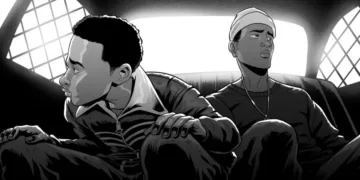
Porter builds her reconstruction through a severe visual grammar that treats memory as something you light, frame, and interrogate. Live-action reenactments are absent. The film turns instead to Dawud Anyabwile’s black-and-white motion comics, all sharp angles and hard shadows, like panels torn from a noir storyboard.

The drawings lean into chiaroscuro, pushing the city’s backstreets into inky planes where faces emerge, recede, then return with a different weight. The compositions press the boys against the architecture around them, making the law feel like a physical structure that crowds the frame. It is stylization with teeth.
Also Read





Archival news reports from the 1980s arrive with grain and anxiety, a rough texture that anchors the film in the fearful air of that era. The shift from illustrated shadow to noisy footage changes the viewer’s footing. It also sharpens the film’s argument about perception: what the camera captures can harden into public certainty long before the facts settle.
Coates appears on screen in airy, well-lit rooms, staged with a clarity that reads as ethical aspiration, a clean plane of light set against the murk of the original investigation. The 2022 deposition videos bring a cold digital surface, and Porter lets that chill do its own work. Time shows on the faces of the accusers and the accused, in pauses, in posture, in the way an answer lands and then stalls.
Porter favors frames that hold longer than comfort recommends. The camera lingers on empty chairs and still rooms until absence becomes a character. Silence turns into a narrative device with pressure behind it, forcing the viewer to sit inside the missing years rather than skating past them. Framing often isolates a single figure, turning space into a form of confinement. The visual strategy feels meticulous, like evidence arranged on a table under a bright lamp, each piece placed so the viewer can see what was taken and what was left behind.
The Architecture of Iniquity
The state’s machinery moves with a frightening, mindless efficiency, and Porter films it like a system that prefers momentum to meaning. Detective Donald Kincaid surfaces as a portrait of certainty, the kind that reads as virtue in a courtroom and menace everywhere else. In recent depositions, he sustains a tactical amnesia that would be funny if it did not carry such consequences.
The ailment is selective, and the timing is perfect. He shrugs, and the posture plays like a costume, while records of misconduct remain in view. Porter’s structure keeps returning to that gap between gesture and documentation, making the viewer feel the way institutions can treat memory as optional and still call it procedure.
The prosecution’s case depended on the coerced statements of Ron Bishop, a fourteen-year-old facing threats of violence from police. The film treats him as a child pulled into an adult mechanism, used as a tool in a game he could not read. Judge Robert Bell presided over proceedings that the film frames as absurd in their brazenness, and his failure to check manipulation becomes part of the documentary’s moral geography. The law functions here as a blunt instrument, heavy and indifferent, with little interest in precision.
Justice arrives later, delivered through the Conviction Integrity Unit in 2019. The correction comes thirty-six years after the damage, a date stamped on a life already spent. A $48 million settlement follows the exoneration, and the number lands with the dead weight of accounting. Money registers as poor compensation for time in sunlight and air, for ordinary years that cannot be repurchased.
Porter’s film refuses any comforting fantasy about a system that malfunctioned. The system operates as built. It produces a conviction that satisfies fear, then moves on. The true subject is the moral vacuum left by investigators, a landscape where truth becomes secondary to closing a folder and calling it order.
The Weight of Stolen Time
Survival after that kind of theft becomes existential labor, and the film watches the work up close. Chestnut, Stewart, and Watkins speak about their missing decades with quiet precision that cuts deeper than a raised voice. They describe the rhythms they lost: the accumulation of ordinary days, the slow building of a life. Family markers vanish from the timeline. Careers never get a chance to form. Porter’s pacing lets these absences register as more than background information, because she gives the words room and she gives the silences a shape.
Watkins describes how simple choices can trigger anxiety, even something as small as picking dinner from a menu. The detail lands as a psychological afterimage of incarceration, a mind trained by a world where minutes were scheduled by a guard’s whistle. Porter ties that feeling to the film’s own timing. Scenes breathe, then tighten. The documentary creates tension through duration as much as content, using the viewer’s impatience as a mirror for the men’s long endurance.
The film reaches a peak of strain during the meeting with Ron Bishop. The setting is neutral and sterile, a place stripped of comfort. Porter’s cameras capture a collision of mutual trauma, and the scene plays with the rawness of an unscripted encounter. Bishop offers explanations. The men seek an apology that can be felt in the body, something that acknowledges harm without hiding behind process.
The exchange stays jagged, uncomfortable, unresolved. Porter keeps the edges sharp and refuses to sand them down for narrative ease. The men ask for a kind of backbone that Bishop, as a child under threat, could not produce. The moment becomes a study in the limits of forgiveness and the limits of what truth can repair.
For these men, the search for truth reads as a condition of continued existence, not a thematic bonus. They are learning how to speak in a world that let their names fade. The documentary gives their voices a platform and keeps its promises narrow. It records. It witnesses. It leaves the missing decades where they belong: gone, and still shaping every frame that follows.
When a Witness Recants premiered at the Sundance Film Festival on January 26, 2026, where it received significant acclaim for its rigorous investigative depth. As an HBO Documentary Films project, the film is primarily available for streaming on Max and broadcast on HBO. The documentary serves as a profound exploration of systemic failure, following the 36-year journey of three men wrongfully convicted of a 1983 Baltimore murder, brought to life through a collaboration between acclaimed filmmaker Dawn Porter and author Ta-Nehisi Coates.
Where to Watch When a Witness Recants (2026) Online
Full Credits
Title: When a Witness Recants
Distributor: HBO Documentary Films, Max
Release date: January 26, 2026
Rating: TV-MA
Running time: 112 minutes
Director: Dawn Porter
Writers: Dawn Porter
Producers and Executive Producers: Dawn Porter, Miriam Weintraub, Jennifer Oko, Nancy Abraham, Ta-Nehisi Coates, Kamilah Forbes, Jennifer Gonnerman, Lisa Heller, Kenyatta Matthews, Sara Rodriguez
Cast: Alfred Chestnut, Andrew Stewart, Ransom Watkins, Ron Bishop, Ta-Nehisi Coates, Jennifer Gonnerman, Donald Kincaid
Director of Photography (Cinematographer): Bryan Gentry
Editors: Jessica Congdon
Composer: Osei Essed
The Review
When a Witness Recants
When a Witness Recants is a searing autopsy of a judicial system that failed three boys. It is a work that gains power through its refusal to offer easy closure or forced reconciliation. By transforming a true-crime narrative into a haunting meditation on lost time, the film forces a confrontation with the fragility of truth. It is essential viewing for those seeking an unvarnished look at the cost of state-sponsored error.
PROS
- Dawud Anyabwile’s evocative motion comics provide a necessary visual depth to the childhood memories.
- The unvarnished vulnerability of the Harlem Park Three creates an immediate emotional connection.
- The climactic meeting between the victims and the witness offers a rare, jagged realism.
- The focus on the specific textures of 1980s Baltimore grounds the tragedy in a physical reality.
CONS
- The early acts follow a traditional pacing that occasionally feels familiar for the genre.
- Certain details are withheld to create dramatic tension.
- The reliance on legal transcripts during specific segments can feel static compared to the animated sequences.