























Manila in 1979 feels like a sealed room with no air, a place where history presses against the skin with the force of matter. Under Ferdinand Marcos and the suffocation of his regime, the city becomes the setting for a muted act of revolt that reflects the state’s decomposition. Dahlia, a police officer who moves with the eerie stillness of a shadow, carries out a heist against Chief Bernal, the superior she serves.
She steals to build financial refuge for people whose lives were burned away in a state sponsored arson. The film draws its tension from the silence that surrounds her deception. Bernal does not see the betrayal and assigns Dahlia to investigate the crime she carried out herself.
Charlie enters this terrain of guilt as a lawyer returning from the United States to care for his dying father. He comes back after twelve years and steps into a world where old ghosts meet fresh corruption. The film gives us a portrait of a woman living between duty and rebellion, with the city’s heat smearing the edges of who she is.
The Architecture of Irony and Silence
The film is built on deep irony, with hunter and hunted housed in the same body. That cycle reflects a society in which authority feels emptied out, a shell covering rot that has spread through public life. Dahlia looks for a place to hide the stolen cargo inside a convent, drawing her aunt, Sister Therese, into a conspiracy of silence that strains the sanctity of the church.

The decision points to a world where moral life survives in dim religious corners, far from the eyes of the law. Beyond the immediate drama, martial law arrives through radio static. Those broadcasts carry reports of unrest and decrees, tying private struggle to a harsh historical ground. The arson that erased the slums for luxury real estate starts Dahlia’s quiet war. It exposes a system that treats human lives as obstacles standing in the path of profit.
Also Read






The story moves at an intentionally slow pace, giving the weight of a single breath priority over the engineered motion of a standard thriller. That lethargy reads as an artistic decision, a reflection of collective exhaustion inside a society trapped in endless waiting. The narrative withholds quick resolution and remains in the discomfort of crimes that stay unresolved. A thriller usually promises release. This film lets pressure accumulate and keeps it there, which gives the silence a moral shape. The waiting becomes part of the violence.
Vessels of Longing and Moral Contradiction
Dahlia stands at a measured distance, an anti-femme fatale shaped through refusal of familiar genre traps. Her presence carries a cold and elusive quality, often seen through gray cigarette smoke that serves as her lone confidant.
The characterization recalls a lineage of difficult women, including the persona of Bree Daniels, a figure who holds power inside contradiction. Dahlia does not stage femininity for a male audience. She wears it like a shield in a world that asks for her submission. The performance of self, in this setting, feels like survival.
Charlie meets her from another emotional register. He appears worn by family obligation and by the grief attached to his father’s decline. Their connection becomes a study of what remains unsaid between two people who once shared a life. Flashbacks to a gala in 1967 reveal versions of them that have vanished, younger figures untouched by the cynicism of 1979.
These glimpses sharpen the tragedy of the present. Each look carries the knowledge of lost time. Their chemistry feels like dormant coal, a low glow in darkness that never rises into flame. The actors speak with flat, quiet intensity, stripping melodrama from the dialogue. That choice carries its own historical force. Under martial law, intimacy itself seems to require a whisper.
There is uncertainty in the space between them, and the film does not rush to name it. Desire lingers beside guilt. Memory sits beside fear. The silence between lines gains as much meaning as speech, perhaps more, and the characters seem aware that speech can become evidence in a world built on surveillance and force.
The Velvety Texture of a Dying Era
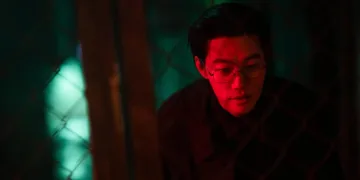
The film’s visual identity studies atmospheric density, shaped by Isaac Banks. The cinematography uses soft dusk tones and neon light to create a Manila that feels like a beautiful, humid prison. Night scenes carry a velvety depth, suggesting a world where secrets function as currency.
The title card appears forty nine minutes into the film, a bold structural decision that asks the audience to reconsider what kind of narrative they have been watching. It marks a turn toward existential realization that arrives much later than expected. Time in this film does strange work. It withholds orientation, then hands it back in altered form.
The production design captures the tactile reality of the era with striking accuracy. Clunky wired telephones and the floral patterns in Dahlia’s apartment build a dense sense of historical immersion. Sound design, paired with Keegan DeWitt’s jazz score, creates a muffled sonic field that cuts the characters off from the city’s chaos. The camera moves with voyeuristic intent, creeping toward faces until the frame fills with silent anxiety.
Slow crane shots and lingering focus shape a rhythm that is hypnotic and unsettling. The film turns into a sensory experience in which the smell of tobacco and the pressure of the air matter as much as dialogue. It values the texture of a moment and gives that texture dramatic force, while plot clarity recedes into the background like a radio signal dissolving in static.
Moonglow is a neo-noir romantic thriller that recently had its world premiere at the 55th International Film Festival Rotterdam on February 4, 2026. Directed by and starring Isabel Sandoval, the film is set against the backdrop of late 1970s Manila during the martial law era. It follows a jaded police officer who orchestrates a heist to help those displaced by government-led arson, only to be tasked with investigating her own crime alongside a former lover. As of February 2026, the film is primarily screening within the international film festival circuit and has not yet secured a wide theatrical or streaming release date for the general public.
Full Credits
Title: Moonglow
Distributor: Daluyong Studios
Release date: February 4, 2026
Running time: 108 minutes
Director: Isabel Sandoval
Writers: Isabel Sandoval
Producers and Executive Producers: Alemberg Ang, Ria Atayde, Isabel Sandoval, Tan Si En, Takahiro Yamashita
Cast: Isabel Sandoval, Arjo Atayde, Janina Lorelei, Jhoanna San Juan, Morny de Guzman, Rocco Nacino, Agot Isidro, Dennis Marasigan
Director of Photography (Cinematographer): Isaac Banks
Editors: Daniel Garber, Isabel Sandoval
Composer: Keegan DeWitt
The Review
Moonglow
While its deliberate lethargy may test those seeking a traditional thriller, this is a profound meditation on the shadows of the human heart. It succeeds as an atmospheric triumph, capturing a specific historical malaise through a lens of smoky, noir-inflected longing. The narrative gaps and muted performances contribute to an elusive beauty that lingers far longer than a more conventional plot. It is a work of quiet rebellion and sensory density, offering a haunting glimpse into a past that refuses to stay buried.
PROS
- The visual and auditory world-building creates a uniquely immersive tropical noir experience.
- Isaac Banks uses soft, dusk-drenched tones to turn Manila into a character of its own.
- The protagonist avoids genre clichés, offering a complex, elusive anti-heroine.
- The subtle use of radio and setting provides a chilling sense of life under martial law.
CONS
- The narrative occasionally stalls, prioritizing mood to the detriment of suspense.
- Certain secondary characters feel like sketches rather than fully realized people.
- The uninflected, flat delivery of lines may distance viewers seeking emotional warmth.