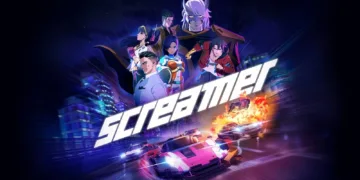

























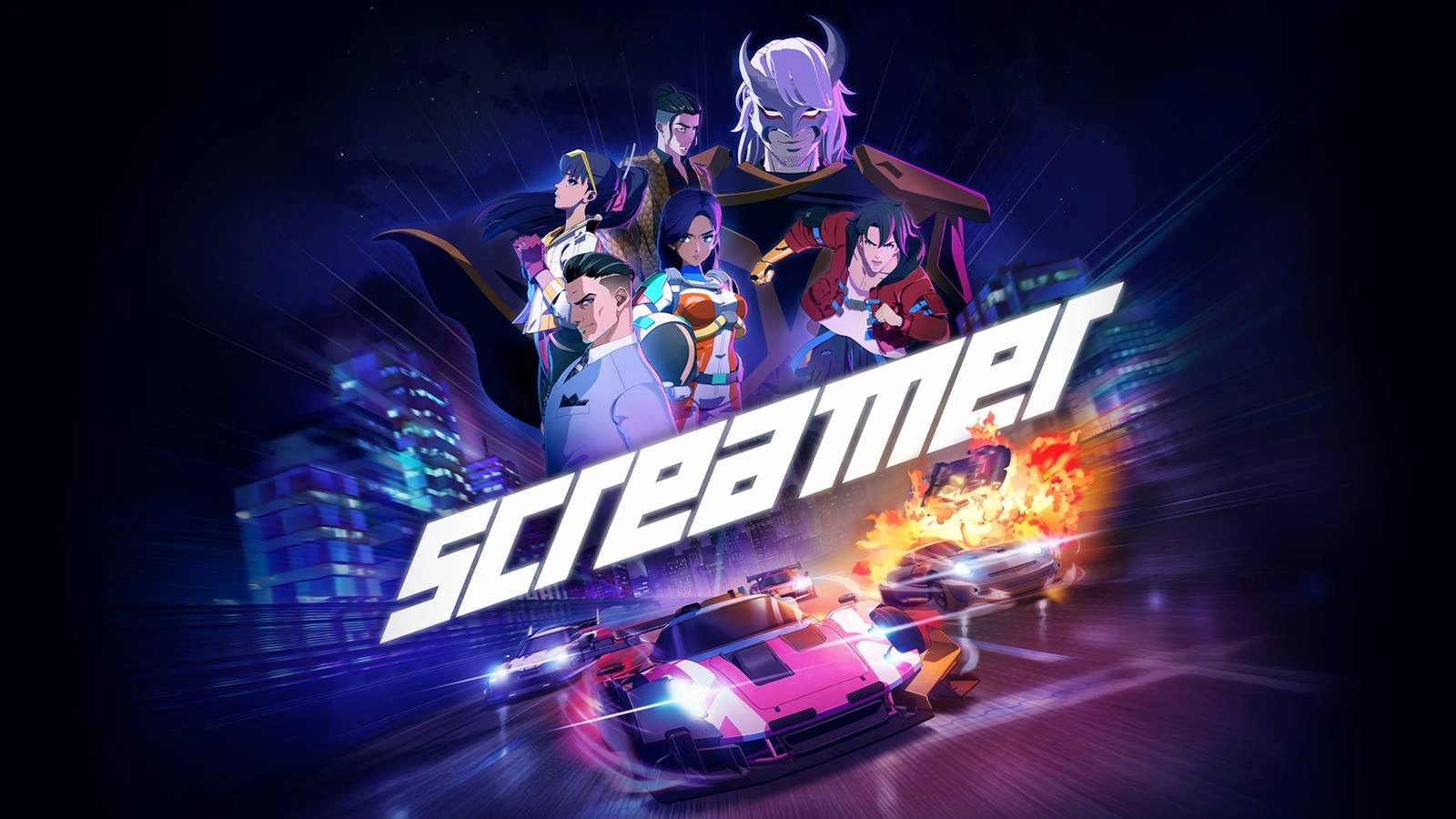

Screamer opens with a blast of color that feels bigger than the usual spectrum, and that first impression shapes everything that follows. Milestone’s revival treats visual intensity as a statement of purpose, giving the game a jagged, aggressive style that makes many current racers feel clinically polished by comparison. The setting trades hyper-realistic Monza replicas for a near-future tournament built on danger and spectacle, with a masked figure named Mr.
A offering 100 billion dollars to fifteen racers desperate enough to chase it. Working with Polygon Pictures, the game pulls from the visual language of Akira and Redline, then channels that influence into a world where car culture, faction rivalry, and theatrical drama all share the same track. You choose from five factions, from the rough, welded-together cars of the Green Reapers to the sleek corporate machines of the Anaconda Corps.
That framing gives Screamer a clear identity. It is a resource-heavy driving game wrapped in loud neon style, carrying the attitude of a 90s arcade racer while aiming for something far stranger and larger. The illegal tournament premise gives the speed, violence, and excess a strong narrative excuse, and the whole project feels designed to argue for personality in a genre that often chases technical simulation.
The Twin-Stick Learning Curve and Echo Economy
The biggest adjustment comes from the controls. Screamer asks players to throw out years of racing-game habits and learn a system built around both analog sticks, much like Inertial Drift. The left stick covers your basic steering input through gentler turns. The right stick controls drift angle by kicking the back of the car outward. That division of labor changes the way every corner is approached. Sharp turns punish anyone who relies only on the left stick, with the car plowing forward and understeering so badly that the game can feel absurd during the opening hours.
Learning the setup has the awkwardness of trying to perform two precise actions at once, and the camera deepens that instability by sliding laterally in exaggerated fashion each time a drift begins. Traditional weight transfer barely registers here. What the player actually manages is a pendulum rhythm, with constant corrections needed to keep the car pointed where it should go.
That unusual steering model feeds directly into the Echo System, which becomes the real engine behind Screamer’s race design. Two connected meters control much of what happens on the track. The blue Sync meter fills through active upshifts and slipstreaming behind opponents, and that meter fuels speed boosts. The pink Entropy meter rises as Sync is spent, and it powers offensive Strikes and defensive Shields.
Also Read






Once that loop clicks, the game starts to look less like a pure racer and more like a tightly wound resource-management challenge played at extreme speed. Timing plays a huge role in that system. Hitting the boost button at the exact moment during an upshift produces a stronger burst, so even a basic acceleration sequence carries a layer of execution.
The AI handles this economy with unnerving precision, which means wins often come from exploiting the boost cycle effectively instead of tracing the cleanest line through a corner. That choice defines Screamer’s personality. The race is still there, but the main skill check sits in meter control, split-second input timing, and the ability to keep that whole loop running under pressure. It turns each event into a combat puzzle built out of speed, rhythm, and opportunism.
Factional Warfare and the Episode Structure
Tournament mode stretches that foundation across a narrative campaign of more than 100 episodes, using a visual novel format between races to build its cast and its faction politics. The story follows five teams with different reasons for entering Mr. A’s competition, and those teams give the campaign a steady stream of new voices and shifting priorities.
The Green Reapers arrive with Roisin at the front, carrying rage, revenge, and a temperament that gives her scenes a lot of bite. Strike Force Romanda brings a very different energy through its J-Pop identity, which lightens parts of the campaign without reducing the sense of risk hanging over the tournament. Across the wider cast, Screamer leans into an eccentric mix of personalities that includes pop stars, astronauts, and private contractors.
The Universal Language Translator ties that ensemble together through an in-universe explanation that lets characters speak Japanese, Flemish, or Irish while everyone still understands each other. It is a logic similar to the language handling in Tekken, and it suits the game’s heightened tone.
The campaign keeps moving because its mission design refuses to settle into one pattern for long. Some events send you after a sentient dog driving with impossible precision. Others ask you to eliminate specific rivals while still protecting your position in the race. That setup creates some of Screamer’s strangest tactical tensions.
Since you cannot attack while holding first place, certain missions require you to let opponents pass on purpose, build Entropy, and then strike at the right moment. Those objectives turn every placement shift into a decision instead of a simple mistake, and they also expose how much the game depends on AI behavior to keep events tense. Rubberbanding is aggressive, with rivals capable of erasing huge gaps in a matter of seconds, so final laps often feel unstable and frantic.
Character selection matters through all of this. Leader cars hit harder and carry more raw strength, though they demand greater effort to keep under control. Team-member vehicles offer steadier handling for players who value precision. Since the campaign rotates through all fifteen racers, adaptation becomes part of progression. You are constantly learning new acceleration patterns, new handling quirks, and new ways each vehicle fits the broader system.
Aesthetic Fidelity and Accessibility Features
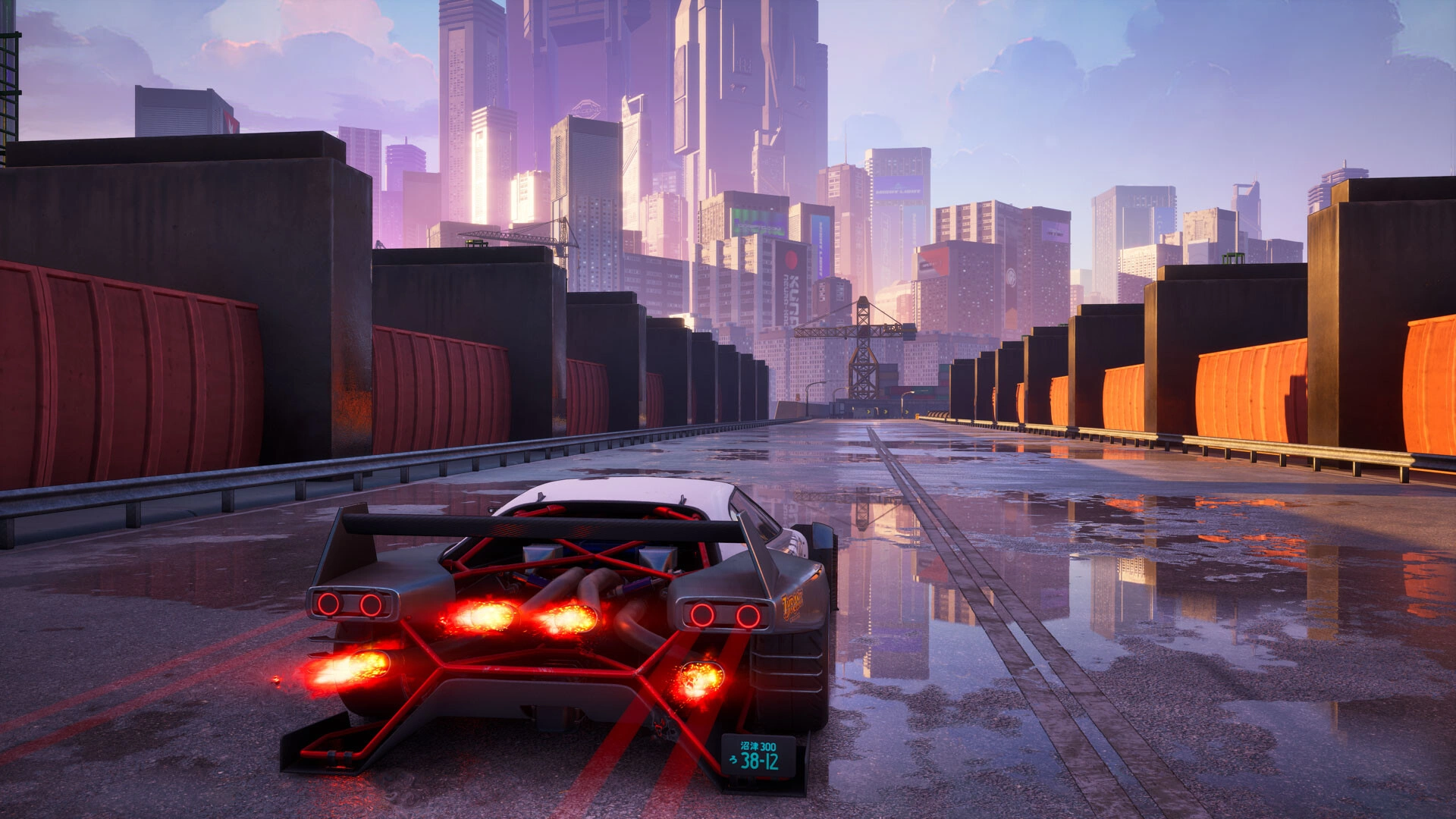
Screamer’s presentation gives all of those ideas a strong visual home. The races take place on rain-slick neon city circuits where cel-shaded cars look as if they drove out of a 90s anime frame. Polygon Pictures’ involvement helps the game keep a consistent identity from the opening cinematic through the character portraits, and that continuity matters because the project depends so heavily on style. Track design has a direct effect on how successful the handling feels. Wider tracks with sweeping corners let the twin-stick drifting settle into a satisfying rhythm, giving the cars room to swing and recover.

Tight switchback-heavy routes expose the system’s weaknesses, since low-speed sections drain momentum and leave the cars feeling bogged down. Gage’s Garage offers vehicle customization, though its focus stays on paint jobs, liveries, and aero parts. The system gives players room to personalize the look of a car, while mechanical tuning remains much lighter than the kind of setup work found in Japanese Drift Master.
Outside the main campaign, Screamer has enough side content to keep the core mechanics active in different forms. Arcade mode brings in Time Attack and a Score Challenge centered on stylish driving. Overdrive mode reshapes the experience into a survival-focused sprint by locking cars into a constant lightspeed state.
Local multiplayer stands out as well, with four-player split-screen included in 2026, which gives the game a feature many racers have left behind. The sound design supports the same high-energy tone that defines the visuals. Songs such as “Survive” by Wagamama Rakia keep races surging forward, and crash impacts land with heavy force. Accessibility support is one of the game’s strongest practical choices.
The one-handed control option simplifies a demanding system by automating acceleration and folding steering and drifting onto one stick. That adjustment opens the game up to players who struggle with the standard twin-stick layout while keeping the action fast and readable. Colorblind filters and game-speed sliders add even more flexibility, making Screamer’s demanding design easier to approach without stripping away its identity.
The Review
Screamer
Screamer is a bold racer that prioritizes technical resource management over traditional driving mechanics. Its striking 90s anime aesthetic and deep story mode provide a specific identity. While the twin-stick controls and aggressive AI create a steep learning curve, the depth and presentation make it a rewarding experience for those willing to adapt. It is a confident revival that values style and system mastery. It stands as a refreshing alternative to mainstream racing titles.
PROS
- Striking 90s anime aesthetic
- Deep, technical resource management system
- Lengthy, fully voiced story campaign
- Excellent accessibility options
- Four-player local split-screen support
CONS
- Steep learning curve for twin-stick controls
- Aggressive AI rubberbanding
- Victory relies on boosting over driving skill
- Narrow tracks feel sluggish