
















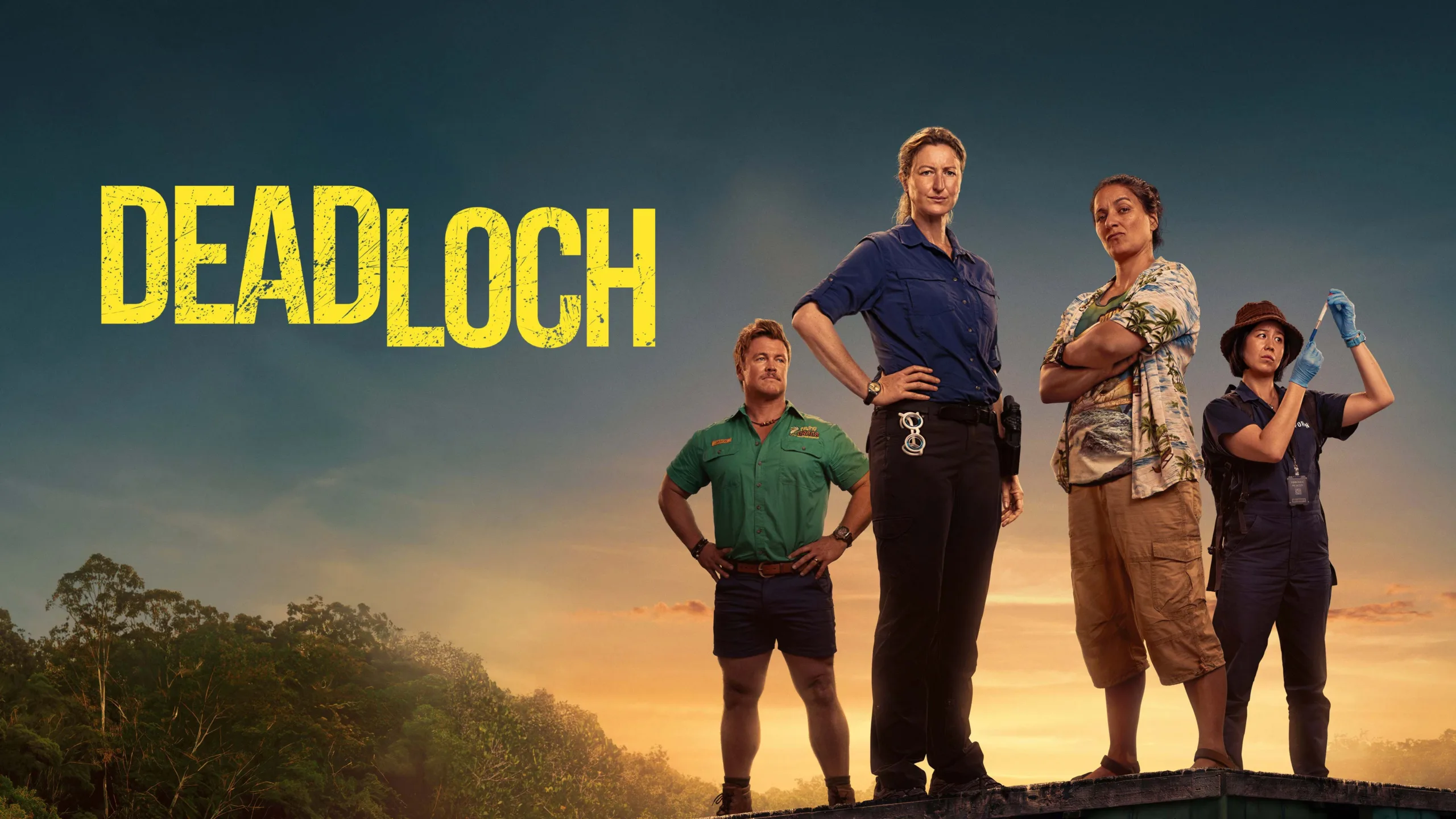

Deadloch returns for a second season and relocates from the cold Tasmanian coast to the humid Northern Territory. Detectives Dulcie Collins and Eddie Redcliffe arrive in Darwin to look into the suspicious death of Eddie’s former partner, Bushy. The case soon carries them to the rural town of Barra Creek, Eddie’s childhood home, which she describes with very little affection.
The season’s main investigation begins with a dead crocodile that contains a severed human arm. That discovery connects to two missing Swedish backpackers and to a town shaped by hard-sell crocodile tourism. Dulcie struggles with the heat and with the local ocker culture.
Eddie drops back into a social world that speaks her language in every sense. Across six episodes, the season keeps the first installment’s dark comic register and gives greater weight to questions of policing and identity. Rival tour operators, local journalists, and an assortment of eccentric residents fill out the investigation. The move to the Top End gives the central partnership a fresh setting and a different kind of pressure.
Atmospheric Transition: From Cold Tasmania to the Top End
The move from Tasmanian noir to the sweltering Top End works as a major reset for the series. Red earth and eucalyptus trees take the place of southern damp and shadow, and the show’s visual language changes with them. Heat becomes a constant physical pressure on Dulcie. Her description of the air as thicker than Clag captures the humidity in one sharp line and sets the tone for how punishing this place feels. The environment pushes everyone into a rawer, more bodily version of daily life.
The Barra Creek Tavern becomes the organizing center of this world. It is a richly detailed piece of production design and a strong anchor for local culture. Barra Creek itself is defined by a hyper-masculine ocker sensibility, where profanity serves as the default language and crocodile tourism keeps the town’s rivalries simmering. Don Darrell’s Best Best Jumping Croc Tour battles for attention with Land of Crocs, run by the preening wildlife presenter Jason Wade.
Wade is drawn as a media-hungry performer whose shorts signal his vanity long before the script has to explain it. Small details keep the town specific and funny. Agadoo turns up, king python lollies turn up, and both details help fix the place in memory.
Barra Creek is a one-pub town with a semi-lawless mood, the kind of place where secrets stay visible and still remain protected. The Darrell family looms over the town’s social order. Everyone knows everyone else’s past, yet the police are left scrambling for basic truths. The region’s beauty sits beside a network of old resentments that never fully went away.
Character Evolution: Identity, Backstory, and the New Outsider
Season two flips the detectives’ dynamic in a smart and productive way. Dulcie Collins becomes the outsider here. Her reserved temperament and procedural instincts rub awkwardly against the Northern Territory’s blunt social codes. Eddie Redcliffe, by contrast, returns to familiar ground. In Tasmania she often felt like a chaotic disruption. In Barra Creek she is surrounded by people who match her brash, foul-mouthed energy.

That shift gives the season a useful structural hinge. Eddie has to face the world that made her, and Dulcie has to work from a position of discomfort. Their partnership still works because each detective supplies what the other lacks, and the writing understands how much mileage that contrast can generate without flattening either of them.
The season also gives Eddie substantial backstory. It moves past her abrasive surface and spends real time on family, history, and identity. During a heated argument, the script introduces she/they pronouns for Eddie. The scene lands because the change is folded into the dialogue with ease, without turning the moment into a sermon or a detour.
Eddie also starts to explore her attraction to women, and the show mines comedy from her blunt questions to Dulcie about queer life. The humor comes from character, which is usually where Deadloch is at its strongest. Returning supporting players are used with clearer purpose. Cath York, living in a campervan, stays a calm and amusing presence, even as the town’s slow pace leaves her restless. Forensic investigator Abby Matsuda arrives with her own peculiar expertise and adds another offbeat texture to the ensemble.
New characters sharpen the season’s interpersonal conflicts. Leo Lee, a non-binary journalist, becomes a useful ally in the investigation. Their deadpan delivery and air of professional fatigue cut neatly against the police force’s chaos. Amber Darrell works as a pointed foil for Eddie, and their scenes draw energy from rivalry and open hostility.
Miki Evans, a no-nonsense ranger, brings a steadier reading of the land and its dangers. Kate Box and Madeleine Sami continue to ground the series. They move from broad physical comedy to genuine emotional strain without losing control of either register. Luke Hemsworth has fun with Jason Wade, playing him as a celebrity wildlife expert whose ego fills every available space. The performances keep the characters credible even as the series leans into a heightened comic reality.
The Mystery: Crocodiles, Missing Persons, and Social Subtext
The central case begins with a gruesome hook. A severed arm found inside a crocodile sets the forensic problem in motion and gives the season an image sturdy enough to carry several episodes of suspicion and misdirection. The case links back to two missing Swedish backpackers, and the local tour guides repeatedly invoke Wolf Creek, folding Australian survival-horror imagery into the series’ comic vocabulary. At the same time, Eddie pursues answers about Bushy’s death. That private investigation runs alongside the larger case until the history of Barra Creek starts to bring those threads together.
Deadloch keeps playing with the grammar of the small-town murder mystery. The plot relies on twists that change the meaning of earlier scenes, and the final explanation sits a long way from the season’s opening clues. That gap is part of the design. The series wants the audience to keep revising its assumptions as the town’s history becomes harder to ignore.
The Darwin detectives who obstruct Dulcie and Eddie are sexist, arrogant, and deeply dodgy, and their presence gives the season a clear line of criticism aimed at institutional incompetence. The script also brings land ownership and racial politics into the case.
It addresses racism toward Aboriginal people in the region and looks at how power works in remote communities where distance can harden local control. Dulcie and Eddie are pushed into a crisis of conscience about policing itself. The season asks whether people inside a corrupt institution can do meaningful good. That is a serious question for a comedy to carry, and the show treats it with enough care to keep it from feeling decorative.
These political and social threads matter because they are built into the mystery’s machinery. They give the case weight and help balance the show’s steady run of jokes. The investigation also stresses the lack of resources available outside major metropolitan areas.
Dulcie and Eddie end up relying on instinct and on civilians who are willing to help. The Darrell family deepens the case’s social tension. Their status in town makes people wary of speaking freely, and that reluctance becomes part of the mystery’s structure. Again and again, the season returns to a simple idea: a small community can protect itself with impressive efficiency, especially when outsiders start asking the wrong questions.
Technical Execution: Visuals, Design, and Comedic Style
On a technical level, the series is impressively assured. Director of photography Rob Marsh captures the stark beauty of Larrakia country in wide shots that give the season a strong sense of scale. The red earth and heavy vegetation establish a visual identity clearly separate from season one.
The Barra Creek Tavern is equally effective on the design side. Every detail, from the coasters to the storage rooms packed with dry snakeskins, helps define a place that feels lived in and faintly threatening. The setting holds two sensations at once: the Northern Territory’s natural appeal and the claustrophobia of a town that can trap people in its own social logic.
Kate McCartney and Kate McLennan’s script keeps a fierce tempo. The dialogue still thrives on florid profanity, and the insults carry their own rhythm, shaping the sound of the town as much as the scenery does. Comedy often arrives through cross-talk and overlapping shouting, which suits lives lived in a state of near-constant agitation. The humor survives the season’s darker material because the show understands timing.
It knows when to let a scene breathe and when to let someone detonate it with one rude line. The reduction from eight episodes to six produces a tighter, denser structure. The first episode carries a heavy load, setting up numerous threads and introducing a large ensemble, so it can feel overcrowded. There is a lot to process, and the series knows it is asking the audience to keep up.
Once the central mystery locks into place, the season settles into a stronger rhythm. Some stretches of dialogue serve an expository function, laying out rivalries, histories, and secrets with enough clarity to keep the plot legible. Those passages do their job, even if they occasionally sound like the show arranging its paperwork in public.
The finale pays off the season’s questions with confidence and with a tone that fits the show’s appetite for boldness. What lingers most is the coordination between setting, character, and plot. Deadloch builds a world that feels grounded in local detail and gleefully absurd in the way it lets that detail curdle into comedy, menace, and suspicion.
Deadloch Season 2 premiered on March 20, 2026, and is available for streaming exclusively on Prime Video. This season moves away from the chilly landscape of Tasmania and into the sweltering heat of the Northern Territory, specifically the town of Barra Creek. Following the success of its debut, the series continues to explore its Tropical Gothic theme through a complex murder mystery involving crocodile tourism and the personal history of Detective Eddie Redcliffe.
Where to Watch Deadloch Season 2 Online


Full Credits
Title: Deadloch
Distributor: Prime Video
Release date: March 20, 2026
Rating: TV-MA
Running time: 60 minutes
Director: Beck Cole, Gracie Otto
Writers: Kate McCartney, Kate McLennan
Producers and Executive Producers: Andy Walker, Kate McCartney, Kate McLennan, Kevin Whyte, Tanya Phegan, Ben Grogan
Cast: Kate Box, Madeleine Sami, Nina Oyama, Alicia Gardiner, Luke Hemsworth, Steve Bisley, Shari Sebbens, Jean Tong, Genevieve Morris, Byron Coll, Nikki Britton, Anthony J. Sharpe, Blake Pavey, Damien Garvey, Ngali Shaw, Bev Killick, Ling Cooper Tang, Ursula Yovich, Syd Brisbane, Ines English, Lennox Monaghan
Director of Photography (Cinematographer): Rob Marsh, Drew English
Editors: Angie Higgins, Julie-Anne De Ruvo
Composer: Amanda Brown
The Review
Deadloch Season 2
Deadloch Season 2 trades Tasmanian fog for Northern Territory heat. The shift in setting forces a sharp role reversal for its leads. The narrative matures by grounding Eddie’s abrasive nature in a meaningful history. The mystery remains effective within a tighter six-episode structure. The script balances foul-mouthed comedy with a pointed examination of institutional power. The initial pacing feels frantic. The series remains a rare example of a genre parody that functions as a genuine whodunit. It is a confident evolution that retains a sharp Australian bite.
PROS
- Seamless transition to the Northern Territory setting.
- Effective character expansion for Eddie Redcliffe.
- Natural chemistry between Kate Box and Madeleine Sami.
- Direct social commentary on policing and land ownership.
- Successful parody of crime drama tropes.
CONS
- Condensed six-episode count feels slightly rushed.
- Occasional reliance on descriptive dialogue to explain the plot.
- The first episode feels crowded with new characters.