




























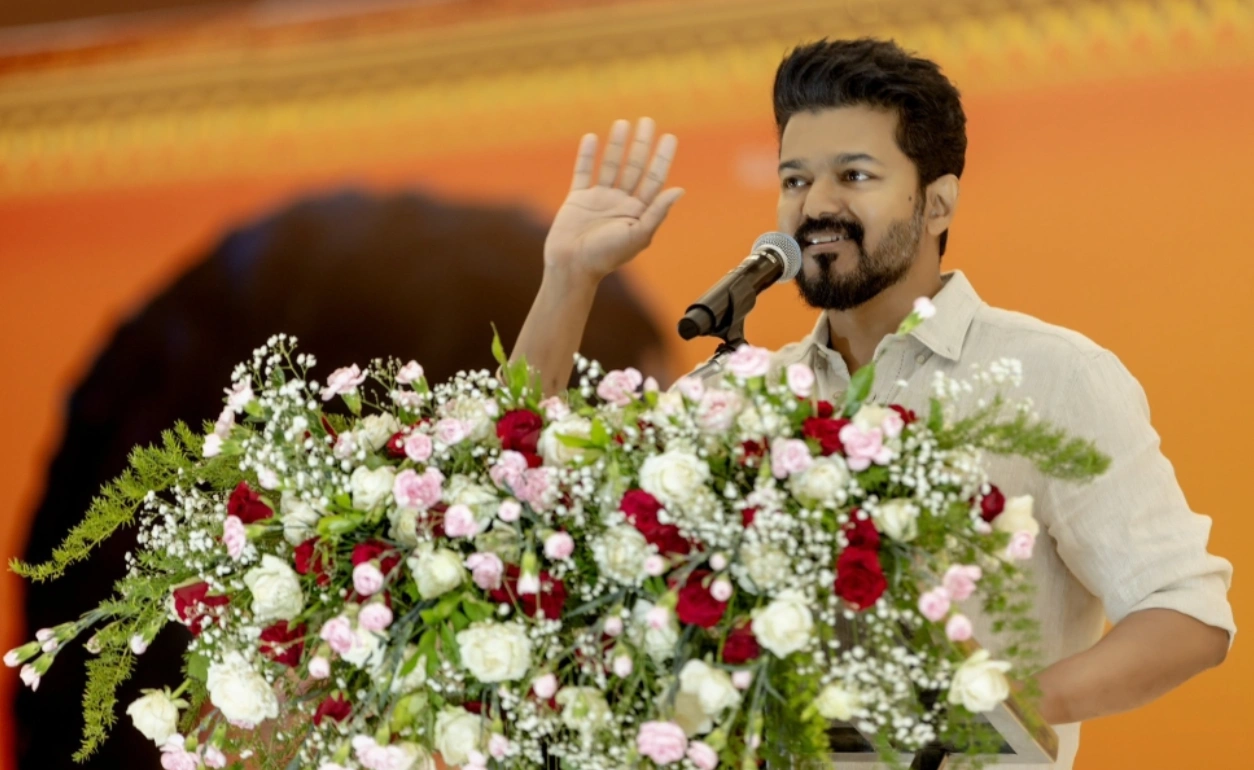

Joseph Vijay Chandrasekhar was sworn in as Chief Minister of Tamil Nadu on Sunday, May 10, ending 59 consecutive years of Dravidian-party rule in one of India’s most politically entrenched states — an outcome that, just two years ago, most political analysts would have dismissed as fantasy.
Tamil Nadu Governor Rajendra Vishwanath Arlekar administered the oath at Chennai’s Jawaharlal Nehru Indoor Stadium at 10 a.m. local time before a crowd of roaring supporters. Nine ministers took the oath alongside Vijay, including TVK General Secretary N. Anand, Aadhav Arjuna, K.A. Sengottaiyan and Selvi S. Keerthana — the only woman in the inaugural cabinet. Vijay kept the portfolios of public administration, police and home for himself.
Exactly 1.72 crore voters backed TVK, propelling the party to 108 seats in its very first election and placing it within striking distance of forming government. That total surpassed the vote share M.G. Ramachandran managed in his own landmark 1977 electoral debut as an actor stepping into government. TVK attracted youth, women, urban and first-time voters across caste and religious lines — analysts attributing the surge less to a defined ideology than to a promise of change.
The road to the ceremony was torturous. With 108 seats, TVK fell 10 short of the 118-seat majority threshold. Congress broke from its longstanding DMK alliance to back Vijay, triggering rebellion within sections of its own state unit; party leaders defended the move by arguing the shift was necessary to uphold the “secular mandate” and keep the BJP out of Tamil Nadu. Reports then circulated that bitter 60-year rivals DMK and AIADMK were exploring a joint post-poll arrangement to shut TVK out entirely. AIADMK general secretary Edappadi K.
Palaniswami held his 47 newly-elected MLAs in Chennai on standby for something “new and unprecedented,” while the VCK, Left parties and the Indian Union Muslim League withheld their support for days. The VCK and the Left parties eventually backed Vijay, arguing that the people’s mandate should be respected. Combined with Congress’s five seats and two each from CPI, CPI(M), VCK and IUML, TVK crossed the majority mark with 120 votes.
The swearing-in makes Vijay only the third film star to serve as Tamil Nadu Chief Minister, after MGR and J. Jayalalithaa — a distinction that eluded both Rajinikanth, who withdrew before contesting, and Kamal Haasan, whose party never broke through electorally. Among the dignitaries in attendance were Rahul Gandhi — whose Congress party now holds a share of power in four southern states — and actor Trisha Krishnan. In a particularly symbolic blow to the outgoing government, CM M.K. Stalin lost his own Kolathur constituency, a seat he had held since 2011.
TVK was founded in February 2024 and built its grassroots structure around Vijay’s 85,000-strong fan club network. The party contested all 233 constituencies alone, ruled out alliances with both the DMK and BJP throughout, and ran a campaign heavy on personal charisma and emotional rallies. Critics questioned whether celebrity appeal could outlast first contact with governance in a state long shaped by cadre-based, ideologically rooted politics.
Vijay must answer that question by May 13, when his government faces a constitutionally-mandated vote of confidence. Separately, his unreleased film Jana Nayagan — still entangled in certification disputes and a damaging pre-release piracy incident — remains the industry’s most unusual postscript to a political career: a farewell movie whose star became head of state before audiences ever saw it.