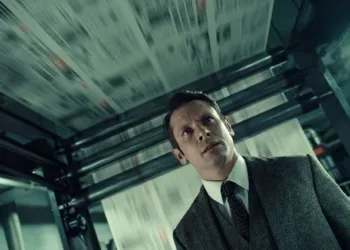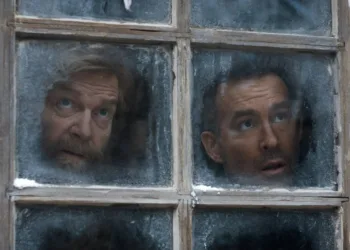






























Alexandre Rockwell situates his story inside Film Noir Cinema in Greenpoint, Brooklyn, and the choice immediately gives the drama its governing shape. The theater stands as a relic from a fading era, a physical echo of Sully’s own condition after twelve years in prison for a manslaughter charge he barely understands.
Sully has built a life out of quiet habits. His sparse apartment, the empty seats, and the daily rhythm of projection and retreat all point to a man who has learned survival through absence. For a while, the story honors that stillness. Then the past arrives with a collector’s patience. Old associates return with demands. Ramona, his former boss, wants a debt settled.
The noir engine starts in familiar fashion, yet Rockwell slows the machinery until every step feels like a moral negotiation. The conflict is plain: Sully wants a life beyond his old crimes, and that life keeps being claimed by people who still speak the language of debt.
The mood stays somber, almost devotional. Inside the theater, screen images feel firmer than the streets outside. Rockwell uses a traditional noir premise, then strips away the easy charge of genre mechanics. What remains is atmosphere, guilt, and a man trying to read the story he has apparently been living.
Faces of the Past
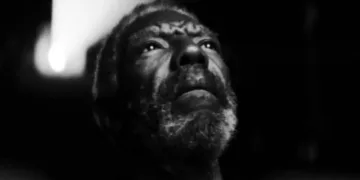
Vondie Curtis-Hall builds Sully from restraint. His performance depends on posture, pauses, and a face that seems to have stored every year spent behind bars. He gives the character a quiet intensity, shaped by a fading hold on the present. The role needs gravity, and Curtis-Hall supplies it with controlled ease. Kevin Corrigan’s Duck, a corrupt detective, brings a serrated energy to the film.
His cynicism cuts through the gloom and gives the danger a practical texture. He feels dangerous because he feels plausible, which is often scarier than theatrical menace. David Proval’s Aaron brings the story into a more domestic register. As Sully’s brother, a man whose mind is slipping away, he turns the possibility of a rebuilt life into something painfully fragile. Their scenes suggest that peace, for Sully, would require care, patience, and luck, three items rarely found in noir inventory.
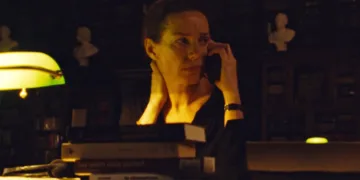
Kasi Lemmons gives Ramona the authority of someone who never has to raise her voice to control a room. Her scenes with the ensemble carry the suggestion of old arrangements, old injuries, and old debts. Karyn Parsons, appearing as Rosa, carries a haunting presence tied to Sully’s deepest wound. The cast gives the film its lived-in weight. These people seem to have known one another long before the camera arrived, and that shared past does much of the storytelling.
The Geometry of the Frame
Sam Motamedi’s black-and-white photography gives the film its moral architecture. High contrast shapes the rooms Sully occupies, turning each space into a pressure chamber of light and shadow. Dialogue matters, yet the frame often tells the story first. One of Rockwell’s bolder formal choices comes through frequent aspect-ratio shifts. The image widens and narrows as if responding to Sully’s fractured state of mind.
The device suggests a man whose sense of reality has been trained by the cinema he operates, a life processed through projection, framing, and flicker. It is a technical flourish with a narrative purpose, which is the kind of flourish noir can actually use. Richard Edson’s score follows a similar discipline. It works beneath the surface, tracking the film’s movement from tentative hope to sudden menace with restraint.
The music helps organize the mood changes quietly. Rockwell also threads classic cinema through Sully’s inner life. Clips of Buster Keaton and Fellini appear like messages from another artistic age. They create a conversation between Sully’s grief and the history of moving images. The effect gives the film a self-aware quality and keeps the focus on Sully’s experience. Shadow, light, music, and screen memory all serve the character study, giving the familiar noir grammar a more reflective shape.
The Persistence of the Image
The film treats memory as a faulty storyteller. Sully is haunted by a past that remains vivid in feeling and broken in sequence. His recollections arrive as fragments, and the story asks him to assemble them before any peace can be possible. The movie theater becomes his shelter, a dark room where grief can be processed at a safer distance. It also lets him hide from the city’s harsher glare, which makes the place both sanctuary and trap.
The plot remains clear about the difficulty of breaking a violent cycle. Old mistakes return with names, faces, and claims. Sully’s path requires a confrontation with history, and the film earns its emotional charge by making that confrontation feel exhausting. The tone moves between crime-thriller grit and a softer sentimentality. That combination could have collapsed into awkwardness, yet the performances keep the material steady.
The resolution offers closure through fatigue, with triumph kept at a distance. A sliver of light appears in the monochrome world because Sully has endured enough to recognize it. The past remains fixed, yet the future can still be shaped by how he carries its images forward. Rockwell’s film becomes a character study about guilt, memory, and the strange power of cinema to tell us what we have lived through before we fully understand it.
The Projectionist arrived as a highlighted selection during the 2026 Slamdance Film Festival. It premiered in February of this year at the DGA Theater in Los Angeles. Currently, the film appears in select independent theaters across North America following its acquisition by the distributor Utopia. Audiences seeking to view the work can find it at boutique cinemas and through specialized festival circuits. Plans for a digital rollout are expected for later this summer as the theatrical run concludes.
Full Credits
Title: The Projectionist
Distributor: Utopia
Release date: February 19, 2026
Running time: 94 minutes
Director: Alexandre Rockwell
Writers: Alexandre Rockwell
Producers and Executive Producers: Quentin Tarantino, Jack Auen, Alexandre Rockwell, Elaine Walsh
Cast: Vondie Curtis-Hall, Karyn Parsons, Kasi Lemmons, David Proval, Kevin Corrigan, Michael Buscemi
Director of Photography (Cinematographer): Sam Motamedi
Editors: Alexandre Rockwell
Composer: Richard Edson
The Review
The Projectionist
The Projectionist succeeds as a melancholic study of a man tethered to his past by the very reels he spins. Alexandre Rockwell trades traditional thriller pacing for a slow, textural immersion into memory and noir tradition. The experimental aspect ratio shifts might feel arbitrary to some. However, the strength of the ensemble, particularly Vondie Curtis-Hall, provides a necessary emotional anchor. It is a film for those who appreciate the texture of cinema and the weight of a life lived in shadows. It demands patience and rewards it with a haunting, quiet clarity.
PROS
- Vondie Curtis-Hall anchors the film with a deeply physical and still portrayal of a broken man.
- Sam Motamedi utilizes high-contrast black-and-white photography to create a rich neo-noir atmosphere.
- The score by Richard Edson effectively mirrors the internal emotional shifts of the protagonist.
- The supporting ensemble of seasoned actors brings a lived-in history to the criminal underworld.
CONS
- The narrative momentum often stutters when shifting between meditative drama and thriller elements.
- The frequent changes in aspect ratio lack a clear or consistent narrative purpose.
- Violent outbursts occasionally disrupt the established somber mood in a way that feels jarring.