


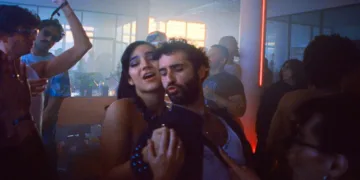

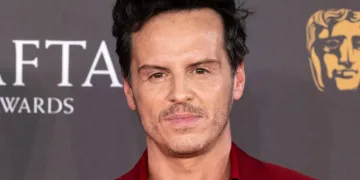
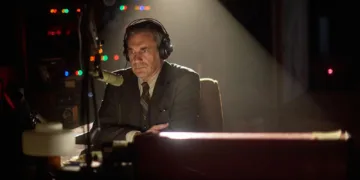

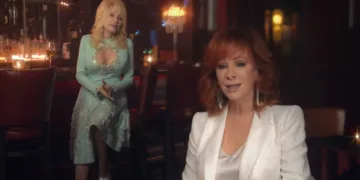


















Television crime has a protagonist problem. For every detective slouching through the rain, there are dozens of ordinary people whose proximity to crime could fuel a far richer story. Maximum Pleasure Guaranteed, Apple TV+’s new 10-episode series from creator David J. Rosen, makes a pointed choice: its hero is a fact-checker. Newly divorced, financially precarious, mid-custody-battle Paula (Tatiana Maslany) lives in an unglamorous corner of Queens that the show refuses to romanticize. She pays for online sessions with a camboy named Trevor (Brandon Flynn) — for sex, yes, but also for someone to talk to. When she witnesses him being violently attacked mid-session, the police shrug. So Paula does what fact-checkers do: she investigates.
Billed as a dark comedy, the series functions more honestly as a propulsive mystery thriller with comedy woven through it. The title is an audacious promise, and Rosen’s show earns much of it through sharp pacing, a genuinely surprising plot, and an ensemble built around what is arguably the year’s best lead performance on television.
How to Keep Ten Episodes Moving
The show establishes Paula’s double life quickly and without hand-holding. There is the custody battle with ex-husband Karl (Jake Johnson), the career frustration at the magazine, and the paid virtual relationship with Trevor that functions as both sexual outlet and emotional lifeline. The series trusts the audience to read this world on the fly.
The inciting incident arrives fast: during a session, a masked assailant bursts into Trevor’s apartment and attacks him while Paula watches, films, and screams. She is in her cheetah-print bra. She films instinctively. NYPD Detective Sofia Gonzalez (Dolly De Leon) is entirely unmoved, categorizing the whole thing as a scam. Then the blackmail calls begin, threatening to expose Paula’s cam sessions and torch her custody case.
Paula, armed with her fact-checking instincts and a reckless determination, goes looking for Trevor herself. What she finds is considerably worse than a scam, and from that discovery onward, the series delivers a new shock or reversal with each episode. The conspiracy eventually reaches what one character describes as having “Epstein-file” scale, though the villains operating at its top remain frustratingly vague.
Rosen positions the show in a tonal middle ground: serious enough to carry real stakes, light enough to cut away to a cat video or a pizza-making party without the tonal whiplash feeling terminal. Premiere director David Gordon Green shoots Paula’s paranoia with kinetic ferocity, tight close-ups and rapid cuts colliding with a cacophony of phone notifications and overlapping voices. Composer Wynne Bennett’s score, pulsating with club-inflected bass, makes it hard to tell whether to feel thrilled or terrified. Mostly, you feel both.
The pacing is the show’s great structural achievement. Episodes fly, arriving at their end points before you have decided you want to stop. The custody scenes can drag when they repeat themselves, but they pay dividends in the season’s final emotional accounting.
Tatiana Maslany and the Art of the Contradiction
Paula is a rarity: a loving, funny, messy, sexual mother whose flaws the show refuses to pathologize. Her cam sessions with Trevor are framed from the first episode as practical survival, a woman managing loneliness and desire on her own terms. The show never stages a scene in which Paula is made to feel ashamed of this, and its refusal to apply that particular kind of moral judgment to a mother’s private life is one of the most quietly radical things about it.
The custody battle gives her disorder genuine consequence. Karl and his partner Mallory (Jessy Hodges) represent a stable, polished future for their daughter Hazel (Nola Wallace) that Paula’s psychological and financial precarity cannot currently match. Paula knows this. The series knows this too, and resists the easy comfort of letting her off the hook.
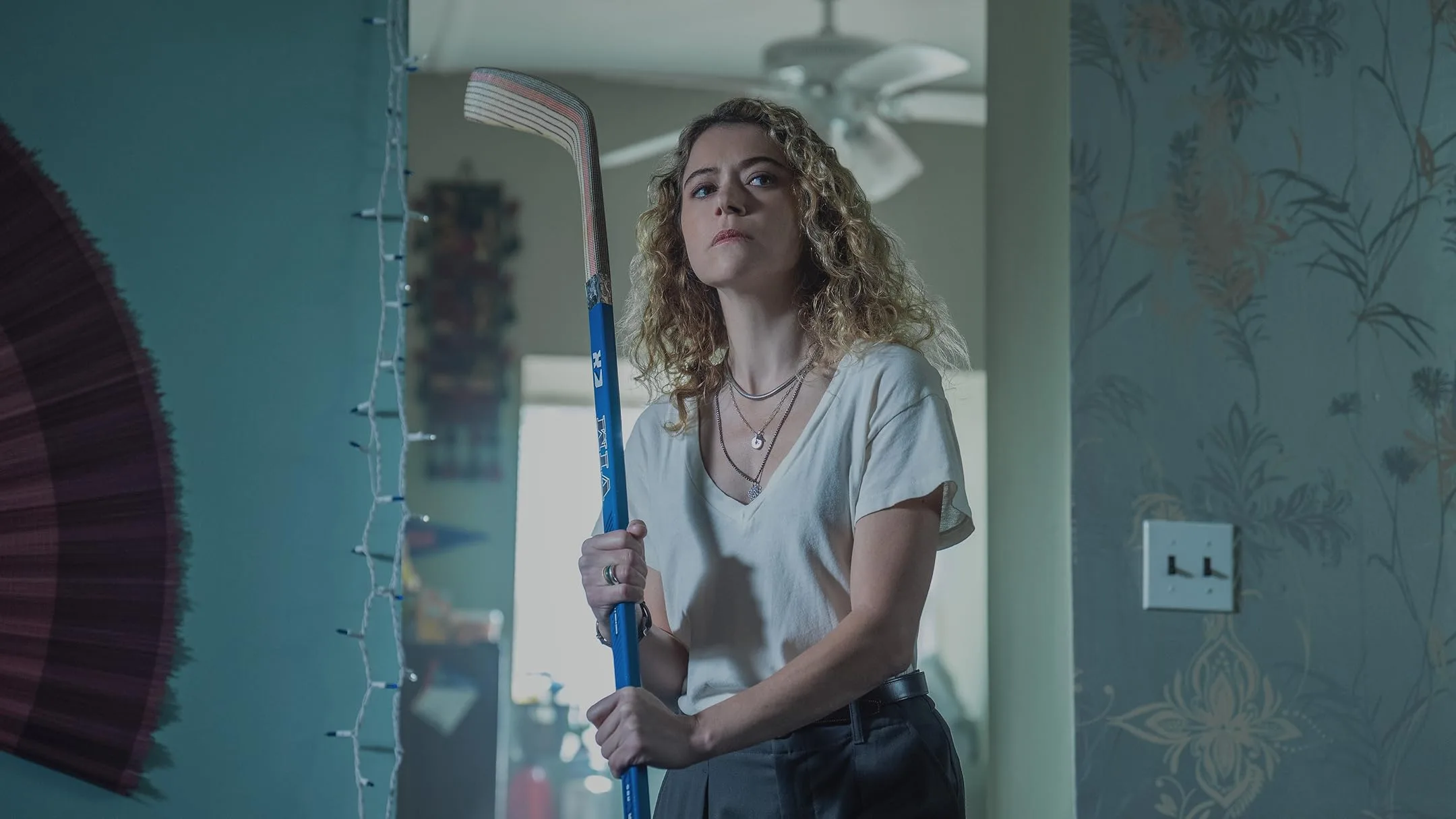
What makes Paula hold together across ten episodes of escalating absurdity is that she is both formidably intelligent and spectacularly bad at staying out of trouble. She uses her fact-checking toolkit to track down a murder suspect, then leaves her laptop open at work with her Google search history fully visible. She grabs a hockey stick to confront a potential kidnapper, then leaves it at the crime scene. Her naivety is character-consistent, which keeps it charming rather than infuriating, most of the time.
This is Maslany’s best work since Orphan Black, a performance that channels volatility and warmth into a single coherent person. A throwaway joke about bathing with a toaster reads as wickedly charming because of the precision she brings to it. The scenes between Paula and Hazel, ice cream for dinner and jumping on beds, are where the series’ emotional logic lives.
The Company She Keeps
Murray Bartlett’s Dennis is the kind of role that should not be described in detail. What can be said is that Bartlett moves from warm and disarming to calculating and cold with a fluidity that erases any prior associations with his earlier high-profile work. He and Maslany construct the season’s central antagonism across scenes that manage to be both genuinely menacing and darkly funny. He is the right kind of threat for a show like this: personable enough to make you doubt yourself.
Brandon Flynn’s Trevor is sweeter and layered beyond what the camboy premise might suggest. The emotional intimacy Paula and Trevor have constructed over their virtual sessions is believable enough to make the subsequent betrayal, and its complications, land with real force.
The detective pairing works because De Leon and Jon Michael Hill play against each other’s textures. Gonzalez’s salty deadpan masks a sincere interest in finding the truth. Baxter is brasher, greener. The partnership has potential the show only partially exploits.
Jake Johnson plays Karl stripped of every trace of his signature gruff likability, which is a quiet act of transformation. Karl is a good father making decisions that are devastating for Paula. The show gradually reveals that the custody fight costs him something too, which prevents the character from becoming a simple obstacle.
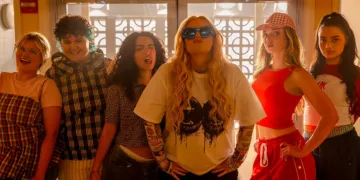
The season’s most satisfying supporting arc belongs to Kiarra Hamagami Goldberg and Charlie Hall as Geri and Rudy, Paula’s younger colleagues. They start as snarky comic relief, two people clearly planning their escape from the dead end of magazine fact-checking. They end up driving to remote locations and barely escaping violence. Their loyalty runs primarily to each other, which the show uses to say something true and a little sad about Paula’s isolation. Their chemistry is sharp throughout.
What It Gets Right, and Where It Stops Short
The show’s commitment to specificity pays off in ways that glossier productions cannot manage. Residential Queens is a choice, a refusal to make Paula’s world look like a streaming brochure. The small magazine staff, the granular detail of the custody process, the texture of Paula’s financial anxiety all ground the show in something plausible enough to absorb the wilder developments without the whole thing floating away.
The series’ handling of sex work and Paula’s sexuality is consistently non-judgmental, which still counts as a political act on a streaming landscape that tends to punish women for their appetites. There is no scene in which Paula repents. There is no lesson learned about paying for intimacy online. The show treats it as a fact of her life, which is the correct treatment.
Where Maximum Pleasure Guaranteed strains is at its conspiratorial center. The villains occupying the upper levels of the scheme are psychologically thin, their menace more asserted than earned. A gambling subplot surfaces and then disappears without doing the thematic work it gestures toward. Characters with survival instincts honed by multiple near-death experiences still open doors without checking who is on the other side.
The show raises questions it never quite answers. Why are mothers held to a higher standard than fathers in custody disputes? Why does private sexual behavior become public currency so easily? These are the right questions for this particular story, raised clearly, then left to sit. Some of this may be a calculation about future seasons. Some of it is a missed opportunity. The framework for something sharper is visible throughout, which makes the gap between what Maximum Pleasure Guaranteed is and what it could become the most interesting thing about it.
Maximum Pleasure Guaranteed is a darkly comedic thriller series that premiered on Apple TV+ on May 20, 2026. The 10-episode series stars Tatiana Maslany as Paula, a newly divorced magazine fact-checker who becomes entangled in a dangerous web of blackmail and murder after witnessing a crime during an online interaction. As she navigates a complex custody battle for her daughter, Paula begins an independent investigation that threatens to unravel a larger conspiracy. The series, which can be watched on Apple TV+, blends elements of crime drama, dark comedy, and psychological thriller, and features an ensemble cast including Jake Johnson, Dolly de Leon, Brandon Flynn, and Murray Bartlett.
Where to Watch Maximum Pleasure Guaranteed Online


Full Credits
Title: Maximum Pleasure Guaranteed
Distributor: Apple TV+
Release date: May 20, 2026
Rating: Not explicitly specified (generally considered TV-MA based on genre and content descriptions)
Running time: Half-hour episodes (approx. 30 minutes)
Director: David Gordon Green
Writers: David J. Rosen
Producers and Executive Producers: David J. Rosen, David Gordon Green, Simon Kinberg, Audrey Chon, Bard Dorros, Tony Hernandez, Lilly Burns, Elise Henderson
Cast: Tatiana Maslany, Jake Johnson, Jessy Hodges, Jon Michael Hill, Charlie Hall, Kiarra Hamagami Goldberg, Nola Wallace, Dolly de Leon, Brandon Flynn, Murray Bartlett, Raymond Lee, Tara Summers, Daniel Dale
Editors: Skip Macdonald, Jeff Seibenick
Composer: Wynne Bennett
The Review
Maximum Pleasure Guaranteed
Maximum Pleasure Guaranteed is a sharp, propulsive thriller held together by Tatiana Maslany's finest television work in years. Creator David J. Rosen builds a world specific enough to absorb its wilder turns, and the ensemble around Maslany is consistently strong. The show stumbles at its conspiratorial core, where thin villains and underdeveloped subplots cost it real depth. What it gets right, it gets very right. What it leaves unfinished makes a second season feel necessary.
PROS
- Tatiana Maslany delivers a career-best performance
- Propulsive pacing across all ten episodes
- Non-judgmental treatment of female sexuality and sex work
- Strong, vivid ensemble with standout work from Dolly De Leon, Murray Bartlett, and the Geri/Rudy pairing
- Specific, grounded setting that keeps the plot's wilder swings credible
CONS
- The central conspiracy's villains are psychologically thin
- Key subplots are introduced and abandoned
- Tonal shifts between comedy and violence occasionally misfire
- Big thematic questions are raised but left largely unexamined