














![Kingdom Hearts Collection [I-III] Review](https://gazettely.com/wp-content/uploads/2026/10/Kingdom-Hearts-Collection-I-III-1-360x180.webp "Kingdom Hearts Collection [I-III] Review: KHII Holds Steady as Newer Entries Fluctuate 33")






Jack Thorne has made his name writing about society’s fault lines. Adolescence, Toxic Town, Help, these are dramas that apply pressure to institutions, systems, and the people ground beneath them. Falling, his six-part Channel 4 drama, is a departure: a love story, slow and philosophical, set between a West Country convent and the streets of Bristol.
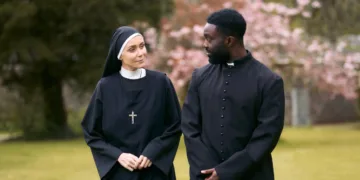
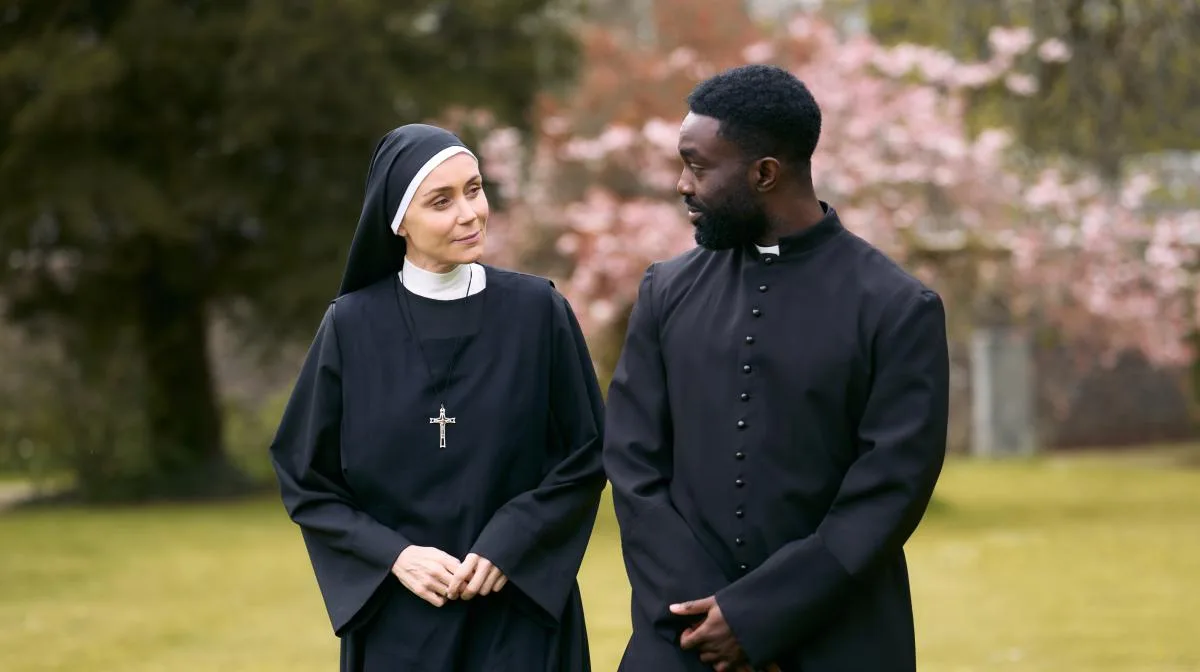
Sister Anna (Keeley Hawes) has spent over two decades behind convent walls, tending her kitchen garden and her faith. Father David (Paapa Essiedu) works a very different vocation in Easton, a deprived Bristol parish, pushing for needle exchanges and basketball hoops where others might settle for underfloor heating. These two people, bound by celibacy and calling, meet by chance, and the encounter changes everything.
The show signals its intentions early: this will be quiet, unhurried, and occasionally stagey. Thorne writes like a playwright, and Falling often feels like one, its characters trading carefully constructed exchanges against the hum of daily devotion. Patience is required. What the series reaches for is a question about what it costs to choose one life over another. Does love, arriving late and uninvited, carry any right to dismantle what has already been built?
A Burn, a Tap, and Six Hours of Consequences
The inciting incident is almost absurdly tender. Father David visits the convent kitchen, Anna burns her hand on a pan, and he runs it under cold water. Seconds of contact. The rest of the series exists in the aftershock of that moment.
Anna acts on it with startling speed. She leaves the convent, finds lodgings with a parishioner named Muriel, and turns up at David’s church to declare her feelings. Her transition from nun to secular woman is handled with suspicious efficiency: a new haircut, flattering clothes, shaved legs. The abbess references deconsecration as a formal process, but the drama is far less interested in institutional procedure than in emotional momentum.
The problem is that the momentum is largely one-sided. Anna’s feelings are direct and refreshingly unromantic in their expression. She tells David plainly that the idea of sex terrifies her, that this is something other than physical desire. David, for much of the series, looks less like a man wrestling with impossible longing than one caught in a situation he cannot exit gracefully. His eventual declaration of love arrives without sufficient preparation, a shift in weather with no gathering clouds.
Thorne draws out David’s backstory in fragments: alcoholism, a traumatic past, an arrangement where he lodges with his sister rather than at the church. These accumulate into a portrait of a man with reasons for caution. The series is careful throughout to treat faith with genuine respect. Neither character is secretly longing to escape religion. Their vocations are real, and the Church is allowed to be sustaining and obstructive in roughly equal measure.
A subplot involving Tina, a teenager under David’s pastoral care whose home life is fractured by a violent father, gives the series its most grounded emotional material, even if it never fully integrates with the central story.
Two Excellent Actors, One Missing Spark
Keeley Hawes brings a watchful elegance to Anna. Her performance is carefully calibrated, and she finds real warmth in a character who can veer toward the implausible. The writing occasionally tips Anna into near-childlike behaviour that sits oddly with a woman who has spent 20 years interacting with the outside world through food banks and market stalls. Hawes makes it work far more often than the script deserves, but the inconsistency accumulates.
Paapa Essiedu is magnetic, and the role largely wastes that magnetism for the first half of the series. David is written as persistently bewildered, and Essiedu plays bewilderment with real craft, but it is hard to locate genuine internal conflict in a character whose primary expression is polite paralysis.
What the series does exceptionally well is its supporting cast. Sophie Stone as David’s deaf sister Susan is the show’s quiet revelation. Her scenes with Essiedu, conducted in British Sign Language, carry an intimacy and honesty the central romance consistently reaches for but rarely finds. Adrian Scarborough as fellow priest Francis brings wit and grounded humanity to the margins. Niamh Cusack’s Abbess Francesca is controlled and quietly formidable. Jason Watkins makes convincing ecclesiastical friction as the conservative Bishop Peter, whose disagreements with David over church spending give the series some of its more conventional dramatic tension.
The fault here lies with architecture, not talent. Both Hawes and Essiedu are operating at a high level. What the central relationship lacks is built into the script, not the performances.
Faith, Freefall, and the Weight of Starting Over
Thorne writes for the stage as well as the screen, and Falling wears that dual citizenship openly. The dialogue is formal, considered, and at its best genuinely beautiful. At its worst, it lands with an awkward deliberateness that feels closer to a read-through than a performance. The show approaches emotional confrontation slowly, circling it, pulling back repeatedly. For a viewer prepared to sit inside that rhythm, there are real rewards. For others, the accumulating hesitation may feel like the drama refusing to commit to itself.
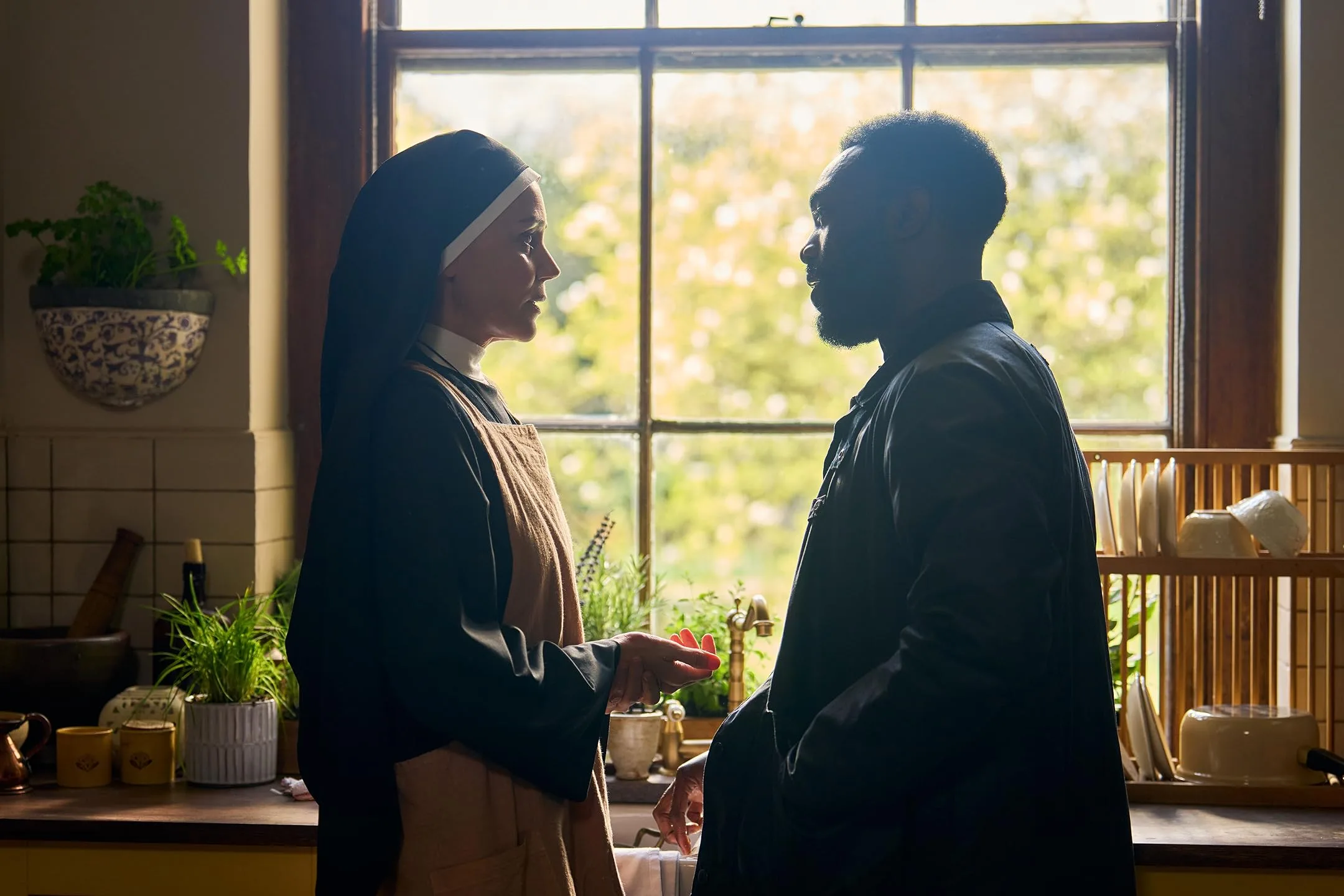
What redeems the pacing is the seriousness of the philosophical stakes. To be together, David and Anna would have to dismantle entire identities and begin again in middle age. That is an unusual proposition for British television, and Thorne is right to treat it with weight. The question of reimagining a future once your entire framework has quietly collapsed carries a universality that more conventional romance rarely reaches.
The treatment of faith is one of the series’s genuine achievements. British drama tends to hold religion at a sceptical distance, viewing it as a quirk or an obstacle. Falling allows faith to be sustaining, communal, and real. Both characters draw genuine meaning from their vocations, and the Church as lived experience is handled with care, even as its institutional face is occasionally found wanting.
Where Thorne loses his footing is in the granular texture of religious life. The convent and its rhythms never feel deeply inhabited. The title, meanwhile, is doing considerable thematic work: gesturing at the biblical fall, at the freefall of sudden love, at the terrifying open space of an unscripted future. It is a title with real ambition, and the series earns it only in parts.
Falling is a British romantic drama series that premiered on May 19, 2026, on Channel 4. The six-part story follows the lives of Anna, a devoted nun who has spent most of her adult life in a convent, and David, a Catholic priest with radical ideas, as their paths unexpectedly intertwine. As they grapple with forbidden feelings, they must wrestle with their personal desires, their vows, and their relationship with faith. You can watch Falling on Channel 4 and stream the full series on the channel’s on-demand platform.
Where to Watch Falling Online
Full Credits
Title: Falling
Distributor: Channel 4
Release date: May 19, 2026
Rating: Not specified
Running time: Approximately 60 minutes per episode
Director: Peter Hoar
Writers: Jack Thorne
Producers and Executive Producers: Joe Donaldson (Producer); George Ormond, George Faber, Jack Thorne (Executive Producers)
Cast: Keeley Hawes, Paapa Essiedu, Rakie Ayola, Jason Watkins, Niamh Cusack, Adrian Scarborough, David Dawson, Susan Brown, Sophie Stone
Director of Photography (Cinematographer): James Swift
Editors: Sofie Alonzi, Mark Keady, Malcolm Crowe
Composer: Adiescar Chase
The Review
Falling
Falling is a drama with genuine ambition that only partially delivers on it. Thorne's instinct to write about faith with seriousness and care is admirable, and both leads bring considerable skill to their roles. The supporting cast, particularly Sophie Stone, frequently outshines the central romance. The problem is structural: a love story that asks for belief it has not fully earned, paced with a restraint that occasionally tips into inertia. Worth watching for what it attempts.
PROS
- Faith treated with rare intelligence and respect
- Strong supporting performances, especially Sophie Stone
- Philosophically serious about the cost of reinvention
- Thorne's dialogue, at its best, is genuinely beautiful
CONS
- Central romance lacks chemistry and conviction
- Convent life feels under-researched
- David's emotional arc resolves too abruptly
- Pacing tests patience without always justifying it