





























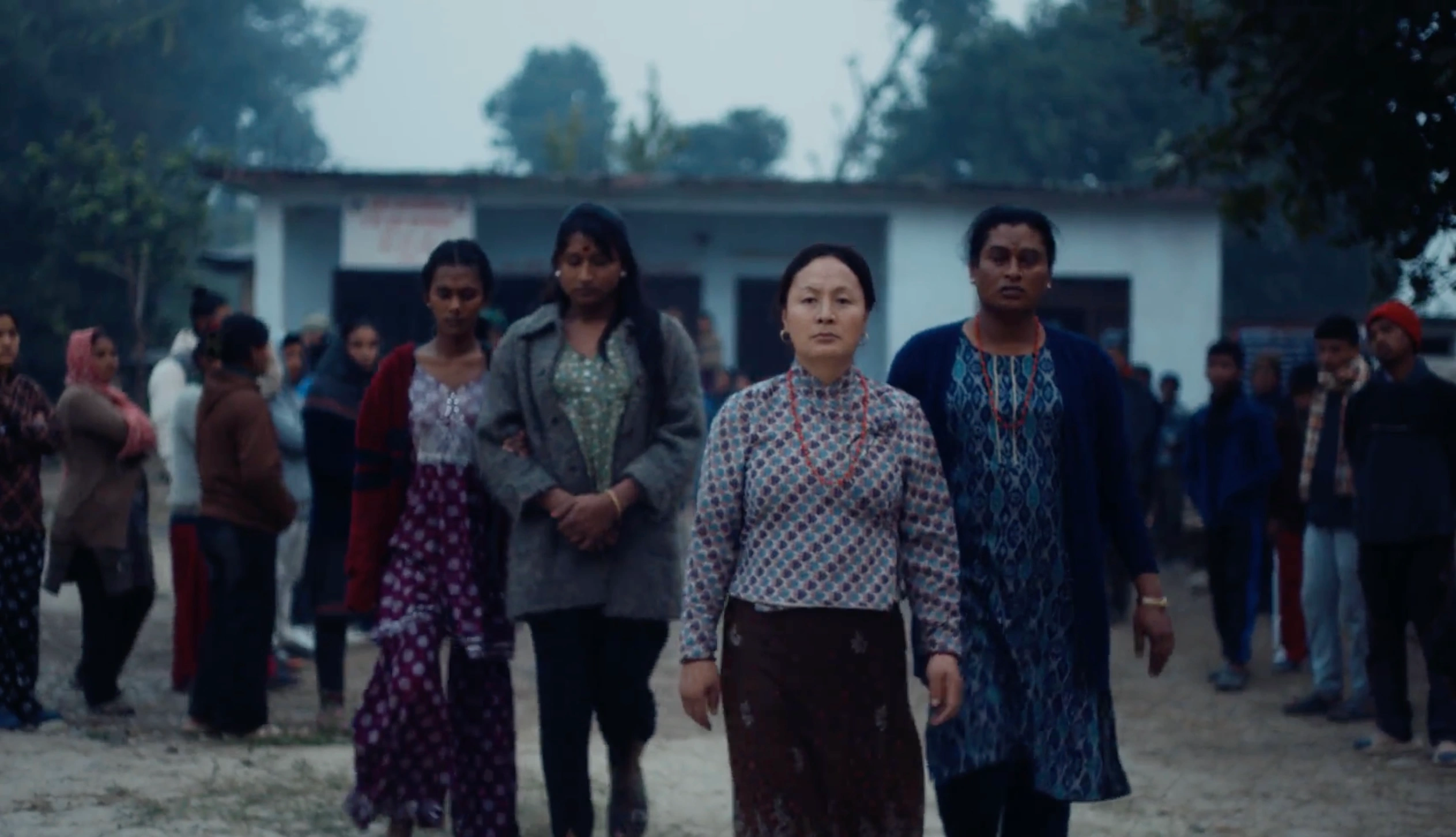

The southern belt of Nepal holds terrain where a mapped border hardens into a spiritual line. In Elephants in the Fog, the feature directorial debut of Abinash Bikram Shah, the remote rural village of Thori becomes a chamber of existential pressure.
Premiering in the Un Certain Regard section at the Cannes Film Festival, this quiet, severe drama places itself near an ancient, breathing forest inhabited by wild elephants. Pirati, a middle aged transgender woman, presides over a household of refugees from the Kinnar community, a legally recognized third gender socio-cultural group in South Asia.
Their survival depends on fragile, transactional tolerance from neighboring villagers. That brittle arrangement breaks when one of Pirati’s adoptive daughters vanishes during a nightly jungle patrol designed to keep the encroaching animals away. Abandoned by local authorities, Pirati enters a desperate, solitary search through dense mist and institutional apathy, seeking proof of a life that society has already consigned to oblivion.
The Sacred Scapegoat and Chosen Blood
Society keeps inventing vessels for its hunger for blessing and its buried fear. The Kinnar community inhabits that paradox with terrible precision, taking on the old role of the pharmakos, the sacred scapegoat. Ancient Hindu traditions revere them as bearers of blessings for weddings and births, then daily life pushes them toward physical and social exile.
Shah studies this wound through the structure of Pirati’s household. Kinship here becomes an act of will, a shelter built from survival, mutual protection, and care, with no reliance on biological inheritance. The refuge carries its own severity. Rigid hierarchies and strict vows of celibacy govern the house, watched over by an alluring local Guru Mata whose whispers ask for total submission.
Care and control share the same roof. Pirati lives inside this fracture. Her secret, forbidden romance with the local male drum master expresses a hunger for private freedom that violates the community’s codes of endurance. After her favorite daughter disappears, the film moves from intimate cultural portrait into dark, murky mystery. The search yields little comfort. It reveals the cold indifference of village residents and state bureaucracy, showing how swiftly protection evaporates once usefulness has passed.
The True Gravity of an Unguarded Face
Once a film strips away cinematic ornament, the human face becomes scripture. Pushpa Thing Lama gives Pirati an immense, heavy stillness, a presence plainly shaped by her own real life history as a veteran Nepali social activist. Lama refuses outward display. She lets the camera find emotion where it has been buried.

Her inscrutable, stoic face becomes a rough surface marked by decades of historical trauma, tangled vulnerabilities, and stubborn inner force. Shah films her with unsparing closeness, revealing Pirati as a flawed human being of fierce protection and private contradiction.
The supporting ensemble carries the same lived-in truth, joining professional actors and non-professionals to create a tangible world. Apsara burns with restless, ungovernable energy, a daughter whose modern fever collides with the domestic rules of the house.
The drum master gives the film warmth and makes the impossibility of Pirati’s desire feel almost physical. The local police official remains cold, bureaucratic, and detached, the mechanical face authority wears when it has emptied itself of conscience.
Rhythms in the Mist
Thori’s visual and sonic atmosphere becomes a moral argument about visibility and isolation. Cinematographer Noé Bach works with fluid, on-location compositions, and Marina Starke shapes a palette that sets the lush, menacing beauty of the Nepalese jungle against the harsh concrete pressure of Birgunj, the border city where Pirati meets her lover. Wide images of the vast, frightening nightly elephant vigils move beside delicate close-ups that feel almost trespassing.
Inside this space, the film reclaims the rhythmic claps used by the Kinnar women. Mainstream media has long turned that gesture into mockery; here it becomes a living language of solidarity, anger, and self-assertion. Editors Andrew Bird and Paris J. Ludwig hold communal ritual and private interiority in tense suspension, keeping social realist drama and crime thriller elements in a shared, uneasy pulse.
Frédéric Alvarez’s score begins as a murmur drawn from traditional roots, then breaks into raw, exposed sonic strain that echoes Pirati’s inner undoing. In the final sequence, the image of wild elephants and thick fog reaches full force. These ancient, venerated, systematically excluded creatures reflect the social position of the trans women. The closing movement turns toward abstraction, where the natural world seems to recognize the marginalized and grants them a majestic, unsettling grace.
The Nepalese feature film Elephants in the Fog made its historic world premiere on May 20, 2026, at the 79th Cannes Film Festival, screening in the prestigious Un Certain Regard section. Written and directed by Abinash Bikram Shah, this poignant drama marks a major milestone as the first Nepali feature film ever selected for this competition category. Following its festival run, the movie is planning a domestic theatrical release in Nepal around November 2026 through the distributor Tea Folks, while global distribution is being handled by international partners including Best Friend Forever. Because it is currently hitting the international festival circuit, it is not yet widely available on mainstream digital streaming platforms or commercial networks.
Where to Watch Elephants in the Fog (2026) Online
Full Credits
Title: Elephants in the Fog
Distributor: Les Valseurs Distribution, Arizona Distribution, Best Friend Forever
Release date: May 20, 2026
Running time: 108 minutes
Director: Abinash Bikram Shah
Writers: Abinash Bikram Shah
Producers and Executive Producers: Anup Poudel, Justin Pechberty, Damien Megherbi, Michael Henrichs, Kumudini Gurung Shrestha, Soham Dhakal, Prachandman Shrestha, Min Bahadur Bham, Pravesh Gurung, Keki Adhikari, Prateek Subedi
Cast: Pushpa Thing Lama, Aliz Ghimire, Jasmin Bishwokarma, Aashant Sharma, Sanjay Gupta, Joel Gurung, Drishti Gauri Malla, Shanti Giri, Maotse Gurung, Mahima Nawabag, Akanksha Karki, Deepika Yadav, Dol Bahadur Sharma, Umesha Pandey
Director of Photography (Cinematographer): Noé Bach, Cyril
Editors: Andrew Bird, Paris J. Ludwig
Composer: Frédéric Alvarez
The Review
Elephants in the Fog
Elephants in the Fog is a devastatingly beautiful, philosophically heavy debut that transcends conventional social realism. By rejecting melodrama in favor of a haunting, existential atmosphere and an unforgettable lead performance, Abinash Bikram Shah creates an uncompromising portrait of queer kinship and marginalized survival.
PROS
- A commanding, deeply authentic lead performance by activist Pushpa Thing Lama.
- Stunning, atmospheric cinematography that transforms the Nepalese jungle into a living character.
- A powerful reclamation of cultural motifs, specifically the symbolic use of rhythmic clapping.
CONS
- The deliberate, slow pacing may challenge viewers looking for a conventional thriller.
- The narrative shift into a crime mystery leaves certain structural threads intentionally unresolved.