



















The standard screen biography often turns an artist’s life into neat arithmetic, with genius made legible through cause, effect, and a dutiful march through dates. Thor Klein and Lena Vurma take a more splintered path in Leonora in the Morning Light, their dense psychological portrait adapted from Elena Poniatowska’s biographical novel. The film follows Anglo-Irish painter Leonora Carrington, played by Olivia Vinall with a serrated intensity that cuts cleanly through the period trappings.
Carrington enters the damaged cultural atmosphere of 1930s Europe, moves through the chauvinistic salons of Paris, then forms an ardent creative alliance with German painter Max Ernst, played by Alexander Scheer. The Second World War destroys that fragile refuge.
Ernst’s world is torn from hers, a severe mental health crisis follows, and Carrington’s path leads to Mexico City. Klein and Vurma treat art as an existential pressure point, where private trauma meets inner vision and the canvas becomes a zone of self-command. Their frame often feels like a locked room with better wallpaper: beautiful, airless, and quietly combative.
Chronology Disrupted and the Intellectual Mood Board
The screenplay refuses the usual cradle-to-grave procession and builds a fractured, non-linear design, arranging eras out of sequence. It moves from Carrington’s early Lancashire origins to pre-war bohemian France, then to her later decades of exile in Mexico. That temporal fracture echoes Surrealist logic, with memory shaped as a fluid, non-Euclidean field where old wounds and present creation occupy the same psychic chamber.
The design gives the film its most persuasive intellectual texture, then extracts a cost. The quick leaps across decades leave large absences in Carrington’s historical record. Political specificity thins as psychological atmosphere thickens. Major milestones arrive as brief, passing vignettes.
Her foundational involvement in the Mexican women’s liberation movement receives little space beyond a single act of resistance against the Parisian avant-garde, leaving her later growth as a political organizer faintly sketched. Biopics often resemble overfilled suitcases, stuffed with historical detail until the hinges beg for mercy. Klein and Vurma leave theirs open, and several significant facts fall out along the road.
The script alternates between spare dialogue and extended stretches of atmospheric stillness. The dialogue can grow heavy, using historical markers to keep the viewer aware of shifting geopolitical conditions. Passing references to the rise of fascism land with blunt force, cutting into the subtler dream state the film builds elsewhere. Its quiet passages carry greater force.
There, the directors assemble an intellectual mood board of Carrington’s mind: Celtic folklore, Mesoamerican indigenous traditions, animism, and a childhood belief that she could speak with wild creatures. These symbolic materials give her artistic vocabulary density and independence. The result is a portrait of identity formed through mythic scavenging, if one may call it scavenging without sounding too pleased with the word.
Chiaroscuro of the Mind and the Muse Reclaimed
Olivia Vinall gives Carrington a fierce, spiky presence that steadies the film across its broken timeline. She plays her as sharply independent, a woman who rejects the surrealist habit of treating female artists as passive, child-like muses for men such as Salvador Dalí or André Breton. Vinall sets vulnerability against icy defiance, especially in scenes where Carrington dismisses the movement’s male hierarchy with efficient contempt.

A useful skill, one suspects, in almost any century. Her dynamic with Alexander Scheer’s Max Ernst conveys a genuine, co-equal creative partnership. Their life in the south of France appears as an idyllic bohemian domestic sphere, with painting folded into daily routine. The pair work together on outdoor bas-reliefs, and the film lets that shared labor suggest intimacy without speechifying. Then Ernst is interned as an undesirable alien. The equilibrium breaks, and Carrington’s psychological unraveling gains its primary catalyst.
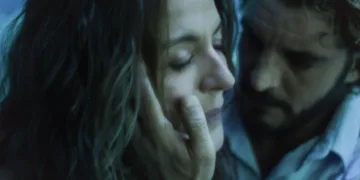
The film’s second half concentrates on that collapse, drawing from psychological thriller technique to chart her inner disorientation. Her confinement in a Spanish psychiatric hospital arrives through distressing expressionistic framing, with compositions that press the body into corners and make space itself feel punitive. The sequences of brutal medical treatment, specifically cardiazol shock therapy, carry a harsh clinical intensity that stresses the violation of her physical autonomy.
Here the film studies the uneasy relation between genius and psychosis with unsentimental restraint, keeping suffering clear of decorative mystique. Carrington uses the canvas to hide, process, and externalize the terrifying images of her inner world. Creation becomes an assertion of artistic sovereignty under extreme psychic pressure. Free will in this film is fragile, battered, chemically invaded, yet still present in the hand that reaches for paint.
Textural Language and Soundscapes of the Canvas
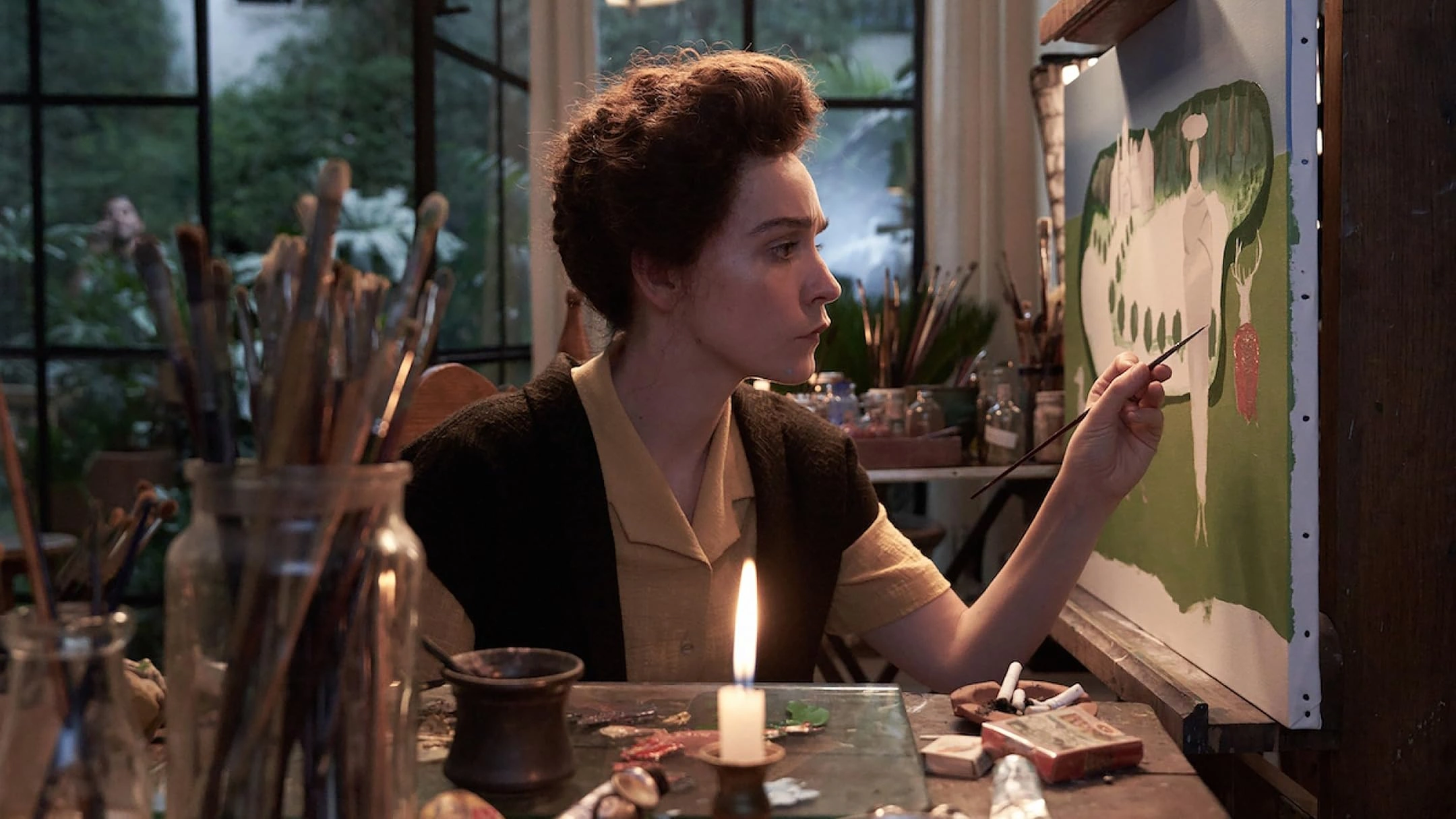
Cinematographer Tudor Vladimir Panduru gives the film a sumptuous visual grammar shaped by rich optical texture and warmth. The palette uses sunlit yellows and lush jungle greens, carrying the sensory weight of the environments that informed Carrington’s art.
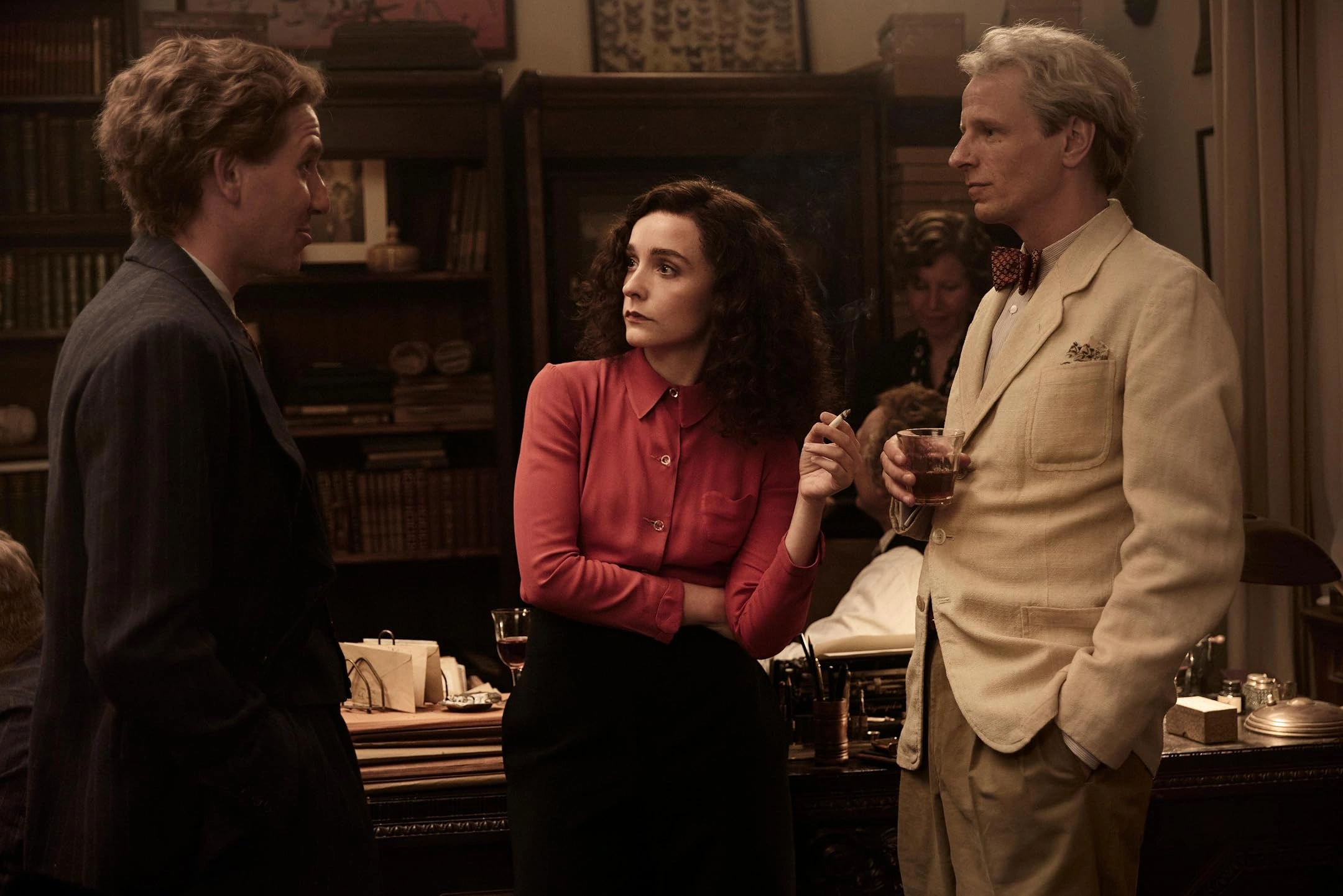
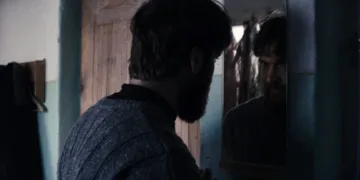
The shot composition draws from classic noir lineage: deep shadows, expressionistic angles, high-contrast lighting, and a clear interest in emotional isolation within the frame. The chiaroscuro here is psychological architecture. Light reveals divided interior states. Shadow gives Carrington’s isolation a visible contour, as if loneliness had learned draftsmanship.
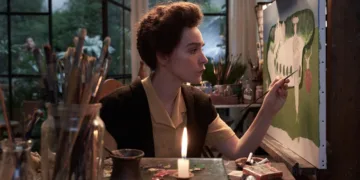
The sound design deepens that visual strategy. The audio moves from the quiet, rhythmic scratching of paintbrushes in candlelit studios to the heavy, oppressive breathing of the forest, shaping audience perception and tightening the tension around her solitude. Pacing performs a similar trick. The film slows around the physical act of painting, using tactile close-ups of pigments, canvas texture, and individual brushstrokes.
The camera lingers with a reverence that gives artistic labor time, weight, and moral seriousness. These sequences locate the film’s strongest expression in the quiet reality of an artist working in severe isolation. A brush meets canvas. A life, damaged and self-willed, answers back.
Leonora in the Morning Light premiered internationally at global festivals before debuting commercially. The independent historical drama rolls out across general release in UK cinemas beginning May 29, 2026, accompanied by selective regional Q&A tours featuring the filmmakers. Audiences can currently experience this visually striking exploration of surrealism and psychological resilience exclusively on the big screen during its theatrical window, with subsequent premium video-on-demand and streaming platform availability to be managed by Modern Films.
Where to Watch Leonora in the Morning Light (2025) Online
Full Credits
Title: Leonora in the Morning Light
Distributor: Modern Films
Release date: May 29, 2026
Rating: 15
Running time: 104 minutes
Director: Thor Klein, Lena Vurma
Writers: Thor Klein, Elena Poniatowska
Producers and Executive Producers: Lena Vurma, James Heath, Mónica Moreno Bayard, Alejandra Malvido, Marcel Lenz, Andrei Brovcenko, Simon Ofenloch, Chris D’Cruz, Gatherer Entertainment, Originarium, Aristotle Andrulakis
Cast: Olivia Vinall, Alexander Scheer, Cassandra Ciangherotti, Ryan Gage, István Téglás, Luis Gerardo Méndez, Denis Eyriey, Cat Jugravu, Wren Stembridge, Mercedes Bahleda
Director of Photography (Cinematographer): Tudor Vladimir Panduru
Editors: Matthieu Taponier
Composer: Mariá Portugal
The Review
Leonora in the Morning Light
Leonora in the Morning Light succeeds as a sensory homage to an extraordinary artistic visionary, though it falls short of an integrated cinematic masterpiece. Thor Klein and Lena Vurma prioritize exquisite formal beauty and textural precision over narrative cohesion. Olivia Vinall's sharp, commanding performance prevents the film from collapsing into standard biographical cliché, capturing a fierce psychological resilience. While the fragmented screenplay leaves vital aspects of the subject's life under-explored, the tactile execution transforms the simple act of painting into a profound existential statement. The piece remains a reliable, beautifully mounted tribute to a towering figure.
PROS
- Olivia Vinall delivers a fierce, uncompromising lead performance that anchors the picture across its sprawling chronology.
- Tudor Vladimir Panduru provides sumptuous cinematography, using expressionistic framing and rich optical textures to mirror Carrington's artistic language.
- The tactile direction treats the physical process of painting with immense reverence, giving close-ups of canvas and pigment room to breathe.
- The sound design creates a deeply layered, evocative atmosphere that mirrors her complex interior isolation.
CONS
- The fragmented, non-linear screenplay leaves massive gaps in the historical record, over-simplifying major political and personal milestones.
- The script's sparse dialogue relies on overly direct, clunky historical markers to establish the timeline.
- The narrative prioritizes her psychological trauma and deterioration at the expense of exploring her lasting artistic and political legacy.