











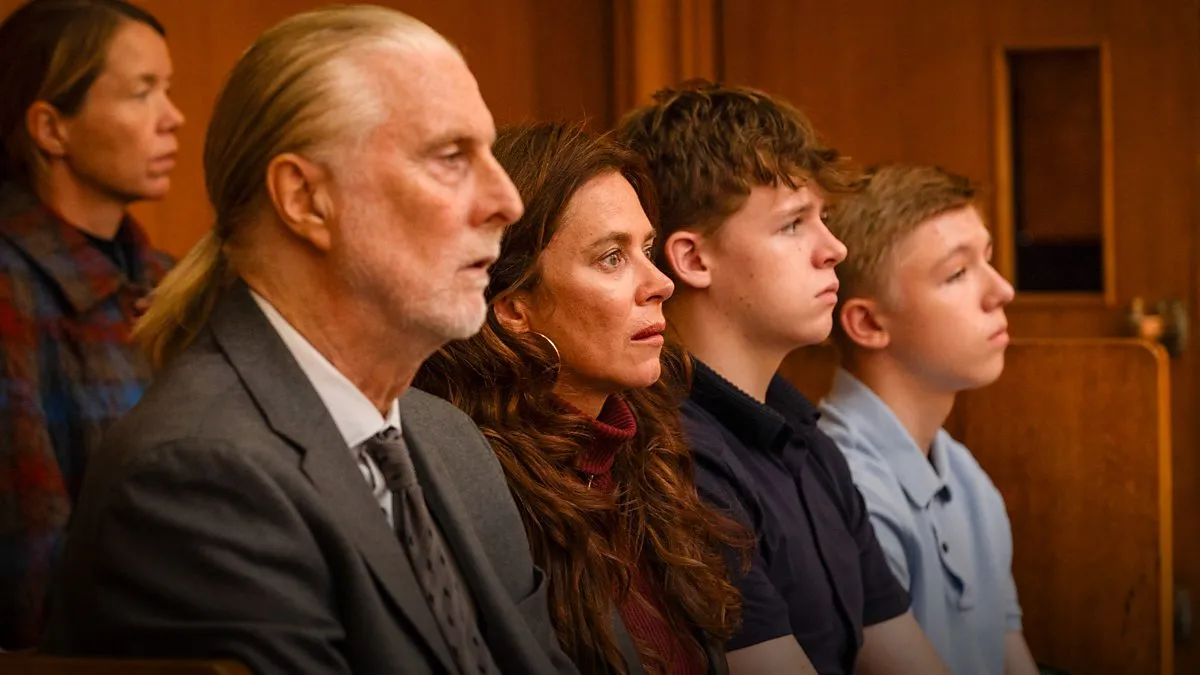

In an era where television often serves as a comforting escape, Unforgivable arrives like a bucket of ice water to the face. If you were looking for a feel-good binge, you’ve made a spectacularly wrong turn. This is a story that begins after the bomb has already gone off.
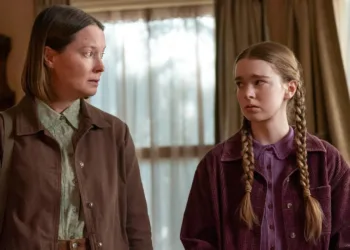
We are dropped into a working-class Liverpool family shattered from within by a sexual abuse crime. The story sidesteps the act itself to focus entirely on its toxic, sprawling aftermath. At the center is Anna, a mother played by Anna Friel with the brittle energy of someone running on pure rage.
Her son, Tom, has retreated into a fortress of silence following the abuse. And the cause of it all, Anna’s brother Joe, is about to be released from prison. His return isn’t just a plot point; it’s a lit fuse brought back to a house full of gunpowder. The air is thick with dread, set against a backdrop of grey skies and simmering resentment.
The Shockwaves of a Single Act
The drama excels at mapping the blast radius of trauma, showing how a single transgression sends out endless, devastating shockwaves. Anna’s life is a frantic, unwinnable war fought on multiple fronts. We see her at her supermarket job, the fluorescent lights humming over her as she tries to project a facade of normalcy while her world implodes.
Anna Friel’s performance is a masterclass in controlled chaos; she carries her exhaustion in her bones, in the slump of her shoulders and the dark circles under her eyes. She is not a saintly victim but a woman pushed past her limits, her love for her son calcifying into a righteous fury against anyone who stands in her way. Even her other, non-victimized son is caught in the undertow, neglected not from a lack of love but from a complete depletion of his mother’s resources.
Tom’s suffering is a black hole at the family’s center. His silence is not peaceful; it is a heavy, suffocating presence. Actor Austin Haynes does remarkable work with no dialogue, conveying worlds of pain and fear in a downcast glance or a sudden flinch. When he finally explodes in a shocking act of violence at school, it feels less like a choice and more like a pressure valve releasing.
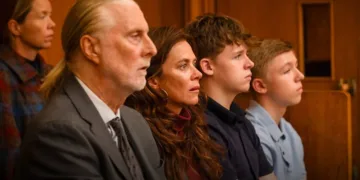
The family is atomized by the trauma. The patriarch, Brian, played by the great David Threlfall, responds with a hardline refusal to even speak Joe’s name. This moral clarity is complicated by his own secret guilt over marital affairs, a hypocrisy that festers beneath the surface. The death of the family matriarch becomes the ultimate test, forcing a grim question about her funeral: does family duty extend to the man who destroyed the family?
An Uncomfortable Seat at the Table
Here is where the show makes its most audacious, and arguably most important, move. It pulls up a chair for Joe, the perpetrator, and forces the viewer to sit with him. Bobby Schofield’s performance is the linchpin that makes this perilous decision work.

He portrays Joe not as a scheming predator but as a man utterly hollowed out by what he has done, his guilt a physical weight. We follow him into the sterile, tense environment of a hostel for sex offenders, a place of last resort run by a preternaturally calm former nun, Katherine (a perfectly understated Anna Maxwell Martin).
The therapy sessions between these two form the drama’s quiet, agonizing backbone. The direction here is claustrophobic, with tight close-ups that offer no escape as Joe recounts his crime in flat, horrifying detail. He describes the calculated process of grooming with a chilling matter-of-factness that is far more disturbing than any melodramatic confession.
The script is not asking for our sympathy, and it certainly isn’t granting absolution. It’s demanding something far more difficult: our sustained attention. It wants us to look at the human being who committed the inhuman act and grapple with the dissonance.
Schofield’s portrayal—the mumbled, barely audible answers, the eyes that refuse to meet anyone’s gaze—is what makes this possible. He presents a portrait of a man who hates himself so much that he leaves little room for anyone else to do so, a profoundly unsettling experience for the audience.
A Masterclass in Systemic Failure
Writer Jimmy McGovern has built a career documenting how official systems—courts, police, government—grind ordinary people into dust, and Unforgivable is a potent entry in his canon. The drama’s most acidic social commentary comes from a simple, infuriating disparity that speaks volumes about societal priorities. Joe, the offender, receives access to structured therapy while incarcerated.

Tom, his victim, is put on a 21-week waiting list for even a preliminary mental health assessment. Anna’s raw fury at this injustice during a visit to her GP is the viewer’s fury. The doctor is sympathetic but powerless, another cog in a machine that has broken down. This critique of the healthcare system is precise and damning.
The lens also turns to the justice system, which handed out a short sentence that feels more like a brief interruption than a meaningful punishment. The parole officer is not a villain but a harried bureaucrat whose pragmatic decision to simply redraw an exclusion zone on a map has devastating emotional consequences.
Then there is the education system, personified by a headmaster who speaks in jargon to mask his primary goal: offloading a “problem child.” Tom isn’t seen as a boy in need of support but as a liability to be managed. This is McGovern’s signature: showing how individual tragedies are compounded by the cold, impersonal machinery of the state.
The Chicken, the Egg, and the Unforgivable
Just when you think you have your moral compass oriented, the script deliberately shatters it. In a late-stage revelation, we learn that Joe was himself abused as a child by a trusted football coach. The script is far too intelligent to offer this as a simple get-out-of-jail-free card.

The information doesn’t arrive as an excuse but as a devastating complication, landing with the weight of a second tragedy. It forces a difficult re-evaluation not of Joe’s guilt, but of its origins. To ensure the point is not misunderstood, the narrative immediately introduces a friend who suffered the same abuse at the hands of the same man but did not go on to become a perpetrator himself.
The friend’s angry, bewildered question—”So why didn’t I do it?”—hangs in the air, articulating the audience’s own confusion and rejecting any simplistic theory about an inescapable cycle of violence. This narrative choice elevates the drama from a case study into a difficult philosophical inquiry.
It relentlessly circles the question in its title without ever offering a conclusive answer. Can this act be forgiven? And who has the right to grant that forgiveness? The drama suggests there are no easy answers, leaving the viewer to wrestle with the weight of that uncertainty long after the credits roll.
The Brutal Beauty of the One-Off
In a television landscape bloated with multi-season arcs and stretched-thin limited series, the sheer, dense compression of Unforgivable feels both like a throwback and a radical act. The performances are a murderer’s row of British talent. Friel is a live wire of maternal ferocity and Schofield delivers a career-defining performance of quiet devastation.

They are supported by the impeccable, grounding work of Anna Maxwell Martin and David Threlfall, who create a believable and broken emotional world. McGovern’s script is a masterwork of unsentimental writing; it is direct, honest, and respects its audience enough to refuse them easy emotional cues or tidy resolutions. The 105-minute runtime is packed with enough plot, pain, and moral complexity for a conventional six-part series.
This intense concentration is the source of its power, creating a relentless, breathless experience that might feel overloaded to some. The story doesn’t build to a neat finish. It simply stops, culminating in a final, poignant scene that offers not resolution, but a flicker of something more ambiguous. It’s a harrowing, essential piece of work, designed not to satisfy, but to endure.
“Unforgivable” is an original drama from award-winning screenwriter Jimmy McGovern that explores the devastating aftermath of an act of abuse perpetrated by a family member. It premiered on BBC Two on Thursday, July 24, 2025, at 9pm and is also available to stream on BBC iPlayer.
Full Credits
Director: Julia Ford
Writers: Jimmy McGovern
Producers: Donna Molloy
Executive Producers: Jimmy McGovern, Colin McKeown, Nawfal Faizullah, Katherine Bond
Cast: Anna Friel, Anna Maxwell Martin, Bobby Schofield, Austin Haynes, Finn McParland, David Threlfall
The Review
Unforgivable
Unforgivable is a masterpiece of misery, a harrowing and intellectually audacious piece of television. Anchored by breathtakingly brave performances and a script that refuses easy answers, it forces viewers to confront uncomfortable questions about guilt, trauma, and redemption. It is not an easy watch—it is dense, demanding, and deeply unsettling. But for those willing to endure its emotional gauntlet, it offers a profound and unforgettable experience. This is essential, if painful, viewing.
PROS
- Exceptional, career-best performances from Bobby Schofield and Anna Friel.
- An intelligent, unsentimental script that tackles a difficult subject with nuance.
- Sharp, biting social commentary on institutional failures.
- Brave and challenging direction that forces the audience into uncomfortable perspectives.
- The concentrated power of the single-drama format.
CONS
- Relentlessly grim and emotionally draining, making it a difficult watch.
- The narrative can feel overloaded, packing a lot of plot into a short runtime.
- Its abrupt ending may leave some viewers unsatisfied.