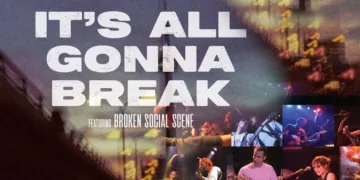

















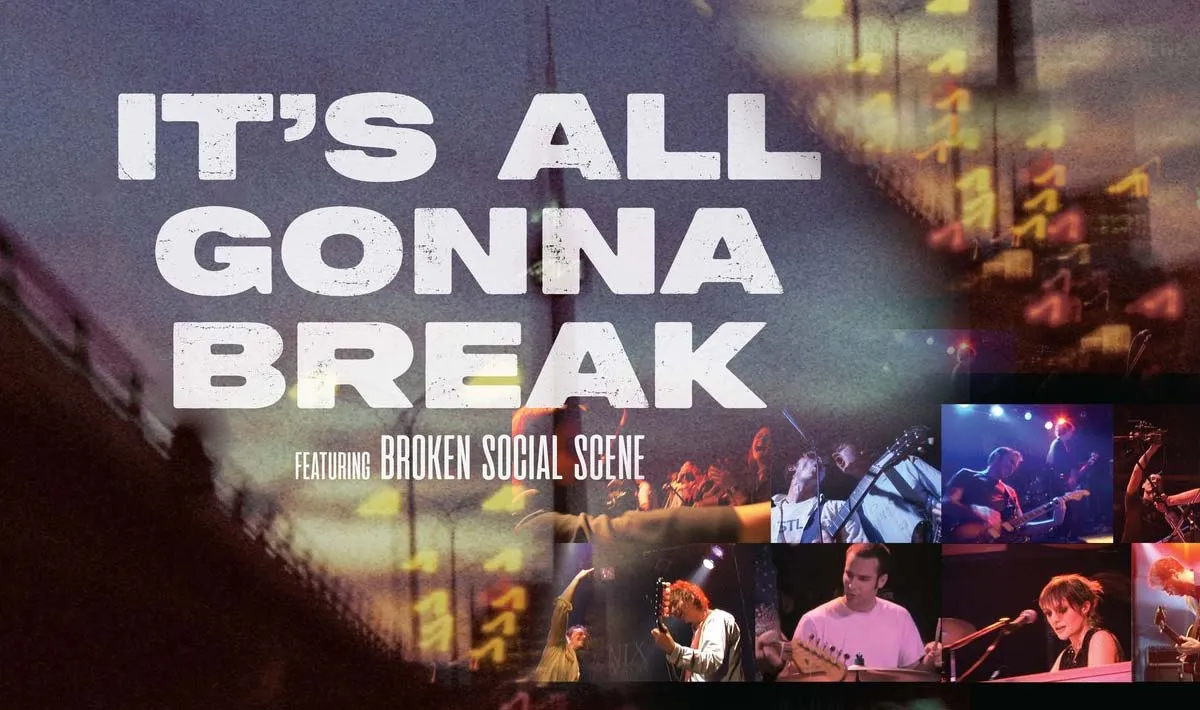

Broken Social Scene was less a band and more a recurring state of being, a flickering constellation of artists in the Toronto sky. It was a beautiful, necessary fracture in the idea of a fixed musical identity. At its center were Kevin Drew and Brendan Canning, but its edges were always dissolving into a sprawling organism of temporary and permanent members.
To document such a thing requires a different kind of lens. Director Stephen Chung provides it in It’s All Gonna Break, positioning his camera not from the outside but from deep within the chaos he called friendship.
The film is built from the ghosts of old videotapes, an archive of a past that was captured, shelved for over a decade, and then resurrected. This is not a story of conflict and resolution. It is a meditation on the quiet entropy of time, the creation of a fragile thing, and the memory of its sound.
An Archive of Phantoms
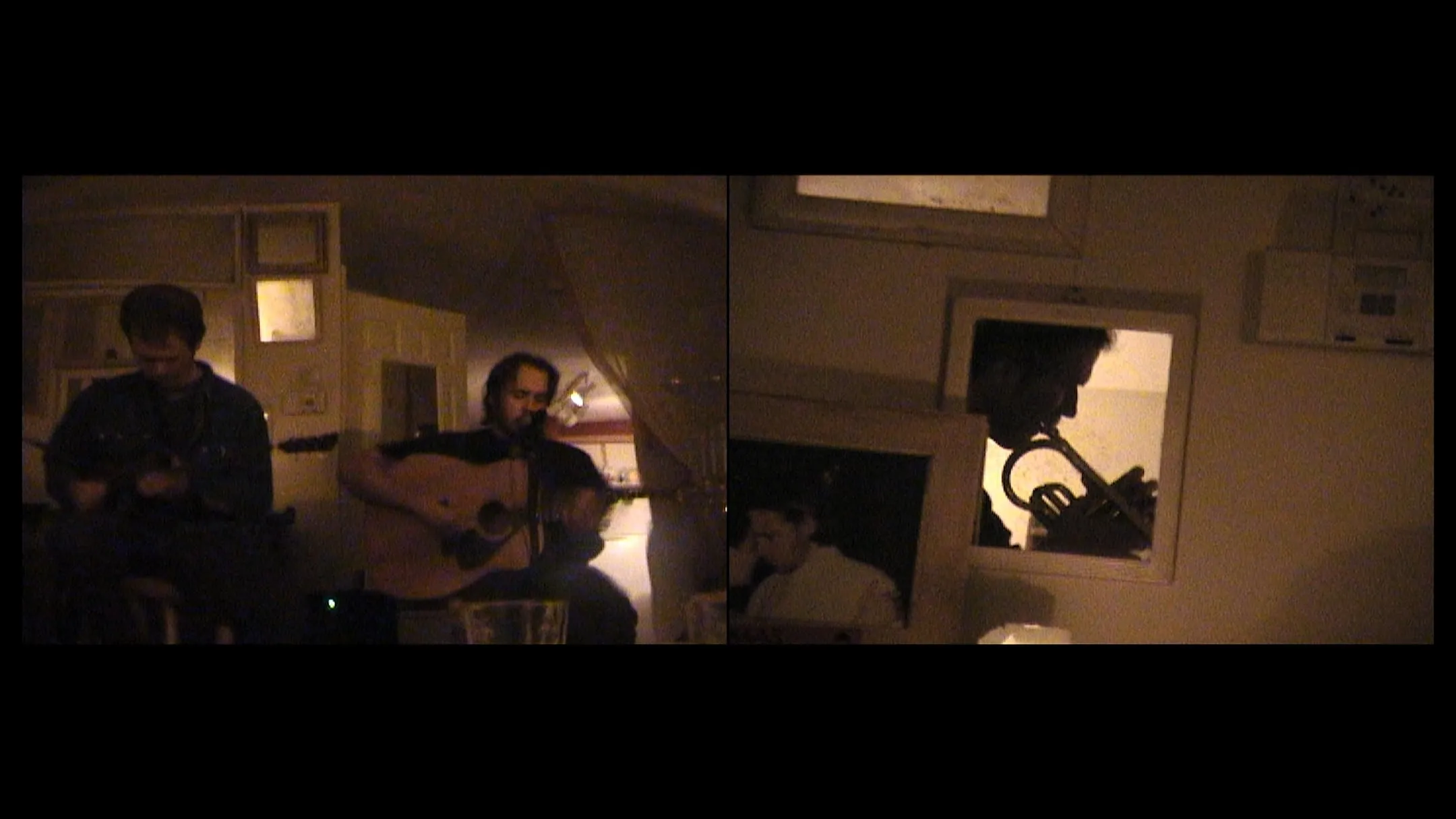
The director’s gaze is everything here. Stephen Chung’s long friendship with the musicians is the film’s anchor, its weakness, and its soul. We see the world through his lens, a grainy, handheld view of the early 2000s that feels like a half-remembered dream. This is an artifact from a world before the digital panopticon, and its hazy texture gives the past an authentic weight, a tangible ghostliness.
The video image itself becomes a flawed vessel for truth, a subjective echo that proves how imperfectly we preserve our own history. The film’s own story is a study in temporal displacement. Chung assembled a version in 2007, a snapshot taken too close to its subject. The band declined, sensing the narrative was not yet formed. What does it mean for a story to be “ready” only when its moment has passed?
The revival of the project transforms the film into a self-aware reflection on memory itself. It becomes a document of finishing an abandoned thought, of artists confronting their younger, spectral selves. The new interviews show the members watching this footage, sometimes with nostalgia, sometimes with the quiet shame of seeing a former self act with unearned confidence. This intimacy yields moments of profound honesty. We see not rock stars, but people, their guards down, their anxieties and simple joys laid bare for the camera of a trusted friend.
The Shape of Beautiful Noise
A body in constant flux cannot be mapped with straight lines. The film’s structure mirrors the glorious chaos of its subject, eschewing a tight narrative for a loose, associative drift through time. It is a film shaped like the beautiful noise the band made, a stand against the very idea of linear progression.
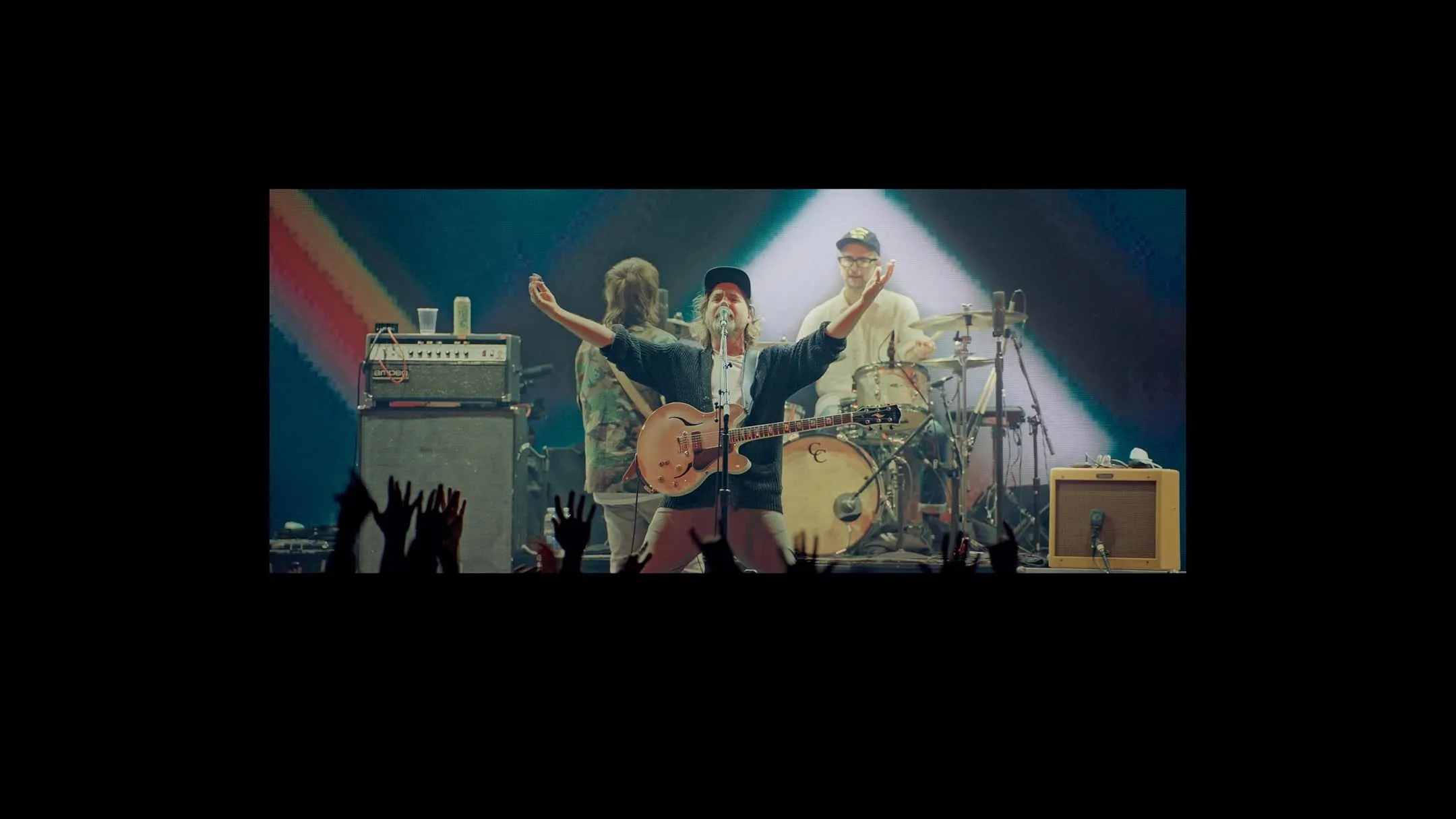
We witness the genesis in freewheeling jam sessions, the bewildering moment when their album You Forgot It In People caught fire, and the strange ascent to performing at major festivals like Lollapalooza. The documentary serves as a time capsule for the Toronto music scene of that era, a lost world where the city was cheap enough to incubate such sprawling, unprofitable beauty.
It evokes a specific post-grunge vacuum, a Canadian music scene often treated as an afterthought, which allowed something so organic and strange to grow in the shadows. This chaotic ethos was also its self-destruct mechanism. The logistical strain of a band with a dozen members on stage was not just a challenge; it was the physical manifestation of its core philosophy.
The impossibility of the economics and the sheer human friction were built into its DNA. The title feels less like a prediction and more like a statement of purpose. Chung makes a deliberate choice to end the story there, after the peak.
He seals the film like a photograph of a specific time, avoiding a complete biographical account of what came next. The story is the moment, a poignant act of preservation that freezes the band in time before the inevitable dissipation into solo careers and the quieter realities of adult life.
The Quiet at the End of the Party
Who is this ceremony for? The film’s deep immersion in rehearsal tapes and private jokes seems destined for the faithful, a sacred text for those who were already there. For the uninitiated, its gentle current may feel aimless, a party to which they have not been invited.
The documentary is notable for what it lacks: there are no villains, no betrayals, no dramatic arcs of addiction and recovery. Its refusal of conflict is its most unsettling and perhaps most honest quality. What does it say about life if the primary struggle is not against an external enemy but against internal dissolution and the simple passage of time?
This is a more profound, existential threat, and the film’s gentle tone becomes its heaviest element. It dismantles the mythology of the rock band, which offers a kind of immortality through legend. By stripping that away, what is left? Mortality. Friendship. The quiet, human truth of things ending. Is this a comfort or a source of existential dread?
Perhaps the film’s insularity is not a flaw, but a statement about the nature of shared experience. Some art is not meant to be universal; it is a private monument for a specific tribe. It is a heartfelt document, valuing a vulnerable sincerity over any constructed drama. It stands as a portrait of a messy, human experiment, a requiem for a sound, an era, and a form of youthful idealism that, by its very nature, could not last.
The documentary film, It’s All Gonna Break, chronicles the indie rock band Broken Social Scene. It premiered in the US in select theaters on May 30, 2025. It was also released on video on demand (VOD) in the US on August 5. The film is available to stream on platforms such as Apple TV+ and Prime Video.
Full Credits
Director: Stephen Chung
Writers: Andrew Beach, Andrea Menzies
Producers and Executive Producers: Ann Shin, Diana Warme (Producers); Stephen Chung, Hannah Donegan, Andrea Menzies, Ann Shin (Executive Producers)
Cast: Broken Social Scene, Ohad Benchetrit, Stuart Berman, Brendan Canning, Miles Chung, Stephen Chung, Jason Collett, Evan Cranley, John Crossingham, David Drew, Kevin Drew, Maggie Drew, Leslie Feist, Jo-Ann Goldsmith, Emily Haines, Scott Kanberg, Lisa Lobsinger, Yvonne Matsell, Amy Millan, Dave Newfeld, Julie Penner, Justin Peroff, Jeffrey Remedios, Ryan Schreiber, James Shaw, Charles Spearin, Andrew Whiteman
Director of Photography (Cinematographer): Stephen Chung
Editors: Andrew Beach, Graham Withers
The Review
It's All Gonna Break
A poignant and deeply personal document, It's All Gonna Break trades rock-and-roll cliché for a more profound, quiet truth about friendship and impermanence. Its loose structure and lack of conflict mirror its subject perfectly, creating an authentic but challenging experience. While perhaps too insular for newcomers, for those attuned to its melancholic frequency, it is a beautiful, haunting requiem for a time, a place, and a sound.
PROS
- The film's sincerity and honesty provide a refreshing departure from typical music documentary tropes.
- Director Stephen Chung's friendship with the band yields remarkably candid and unguarded footage.
- Its chaotic, loose form powerfully reflects the sprawling, unconventional nature of the band itself.
- It successfully captures the specific mood and conditions of the early 2000s Toronto music scene.
CONS
- The deep focus on insider moments may not engage viewers unfamiliar with Broken Social Scene.
- The absence of traditional conflict or a strong story arc can make the film feel aimless.
- The experience is highly subjective and rooted in the director's personal archive, rather than a comprehensive history.