
















We first meet Jimmy Lang not as a man, but as a collapsing point of consciousness. He is a filmmaker entombed within his own apartment, a space that has become both fortress and prison, insulated by a haze of narcotics and sour regret. His state is one of perpetual siege, a war waged against the phantoms of a failed career and a dissolving self.
Into this hermetic ruin comes a new terror, or perhaps an old one given monstrous form: the frightening certainty of alien abduction. The conviction arrives with the force of revelation. Is this the birth of a new, awful reality, or the final, spectacular implosion of a mind? His desperate call to Stiggs, a friend estranged by the fragile virtue of sobriety, is a lifeline thrown into the void, a plea for a shared world that may no longer exist.
A Fever Dream in 16mm
The film refuses to let us leave the apartment, for the apartment has become the whole of the world, a physical manifestation of a mind turning inward upon itself. This claustrophobia is absolute, mirroring the existential condition of a consciousness trapped within its own perceptions, unable to verify an outside world. Every surface is a testament to a former self, a museum of past glories and present decay.
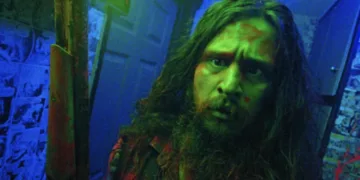
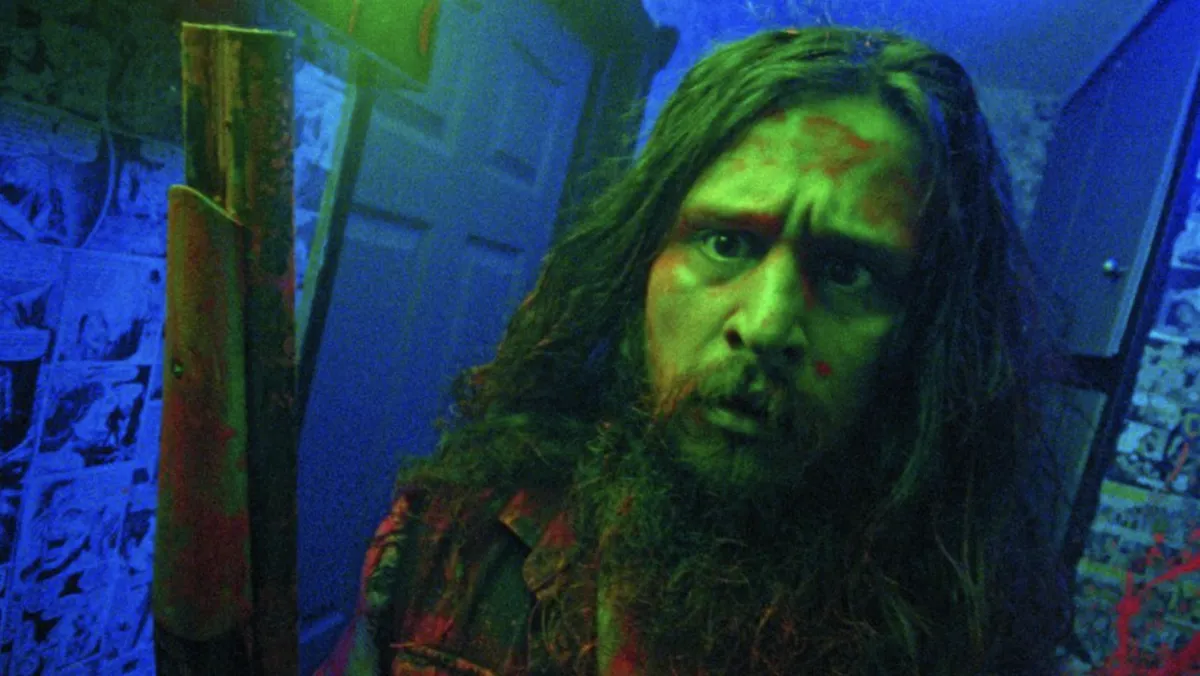
Vintage horror posters, like a prominent display for Cannibal Holocaust, act as silent idols from a time when Jimmy’s creative impulses were directed outward. Now, they are merely wallpaper for his collapse. Into this space, a sensory siege is launched. The image is drowned in a violent pulse of color, a fever of electric blues that bleed into sickly greens and lurid pinks.
This is not lighting; it is a chemical reaction, a visual scream that denies any peace. This aggressive aesthetic creates a disorienting, intoxicating atmosphere where the grime becomes beautiful and the panic hypnotic. We are thrown directly into this dissolution through an unblinking first-person perspective, forced to inhabit his fracturing perception.
When the camera pulls back, it never finds stillness. Its frenetic rhythm mimics a racing heart, a paranoid mind darting from shadow to shadow, unable to rest. The choice to use grainy 16mm film adds a skin of imperfection, a tactile decay that underscores the fragility of the image and the sanity it depicts.
The Body and Its Demons
Out of the neon murk, the invaders appear. They are not specters of cosmic horror but absurd idols of terror, their puppet-like forms and bulging eyes a throwback to a more tactile kind of nightmare. The deliberate artifice of their design creates a strange dissonance with the extreme gore that follows, as if a violent id has weaponized the contents of a dusty toy chest.

Their destruction is a series of grotesque baptisms, a visceral exorcism performed with whatever object is at hand. Heads split open like rotten fruit, spilling forth goopy, luminous blood that paints the walls in alien viscera. This relentless splatter transcends shock, becoming a physical manifestation of a psychological war.
The central tenet that alcohol provides a shield against the aliens is a perfect addict’s rationalization, a philosophy of the damned. It sanctifies the very poison that corrodes Jimmy’s reality, twisting self-destruction into an act of heroic self-preservation. Do we question if the creatures are real?
The inquiry feels secondary. They function as the perfect metaphor for the addictions that have already breached the host. When Stiggs, the anchor to sobriety, finally breaks, it is the film’s most nihilistic turn. He represents the possibility of a life outside the chaos. His corruption confirms there is no escape, only a shared damnation. His sobriety was a temporary truce, not a victory, and his relapse is a quiet moment of surrender to his friend’s abyss.
Narcissus in the Maelstrom
That Joe Begos, the film’s creator, also plays its tormented lead is the work’s central, unavoidable proposition. This is an act of cinematic self-immolation, a performance that blurs the line between a vulnerable confession and a kind of raging narcissism. Is this an exorcism or an exercise in ego?

Perhaps the two are inextricable. His Jimmy is a raw nerve, flailing against unseen chains with a litany of profanity that feels less like dialogue and more like a primal scream from a mind caught in a feedback loop. Opposite him, Matt Mercer’s Stiggs is a ghost of a former life, a walking mirror of the stability Jimmy has surrendered.
Their reunion is not a partnership but a volatile reaction, a study in toxic loyalty. Jimmy’s need is a form of vampirism, draining Stiggs’s hard-won stability to fuel his own war. Begos’s direction is a direct extension of this performance: abrasive, relentless, and utterly committed to overwhelming the senses.
The film does not build tension so much as it mainlines a state of being. It is a confrontational, unapologetic artifact that rejects passive viewing. It does not ask for sympathy or understanding. It presents a raw, unfiltered slice of a personal hell and dares its audience not to look away.
“Jimmy and Stiggs” is a horror film directed and written by Joe Begos. It was released nationwide in the US on August 15, 2025. The film’s runtime is 1 hour and 35 minutes. It was shot on 16mm film. The soundtrack was released digitally on August 15, with a physical release planned for October. Currently, you can watch it in theaters. The film’s distributors are The Horror Section and Iconic Events.
Full Credits
Director: Joe Begos
Writers: Joe Begos
Producers and Executive Producers: Joe Begos, Josh Ethier, Matt Mercer, Josh Russell, Sierra Russell, Eli Roth, Connor DiGregorio, Nicholas McCarthy, Jon Schnaars, Raj Brinder Singh, Christopher Woodrow
Cast: Joe Begos, Matt Mercer, James Russo, Riley Dandy, Josh Ethier, Ye Gao, Daichi Harashima, Chuan-jun Wang, Xiao Wang, Zhener Wang, Enyou Yang, Haoyu Yang, Liu Yichun, You Zhou
Director of Photography (Cinematographer): Brian Sowell, Mike Testin
Editors: Josh Ethier
Composer: Steve Moore
The Review
Jimmy and Stiggs
A raw, frenetic portrait of addiction's vortex, Jimmy and Stiggs is less a narrative and more a sensory assault. It weaponizes low-budget gore and a nauseating neon aesthetic to plunge the viewer into a state of psychological collapse. While its relentless, self-indulgent style will alienate many, it succeeds as a confrontational piece of filmmaking. It is a singular, unapologetic vision of a personal hell, a chaotic exploration of codependency and the monsters we create to justify our self-destruction. It is a difficult, abrasive, and strangely fascinating work.
PROS
- A singular and unapologetic directorial vision.
- Striking, visceral cinematography and a bold neon color palette.
- Effective use of practical gore and creature effects.
- Functions as a powerful, if abrasive, metaphor for addiction and toxic relationships.
- The raw, unhinged lead performance is committed and intense.
CONS
- The relentless, abrasive style can be exhausting and monotonous.
- A thin narrative that prioritizes sensory overload above story.
- The lead performance and directorial focus can feel self-indulgent.
- Its confrontational nature will likely alienate a broad audience.
- Lacks subtlety in its thematic exploration.