






















![Kingdom Hearts Collection [I-III] Review](https://gazettely.com/wp-content/uploads/2026/10/Kingdom-Hearts-Collection-I-III-1-360x180.webp "Kingdom Hearts Collection [I-III] Review: KHII Holds Steady as Newer Entries Fluctuate 40")
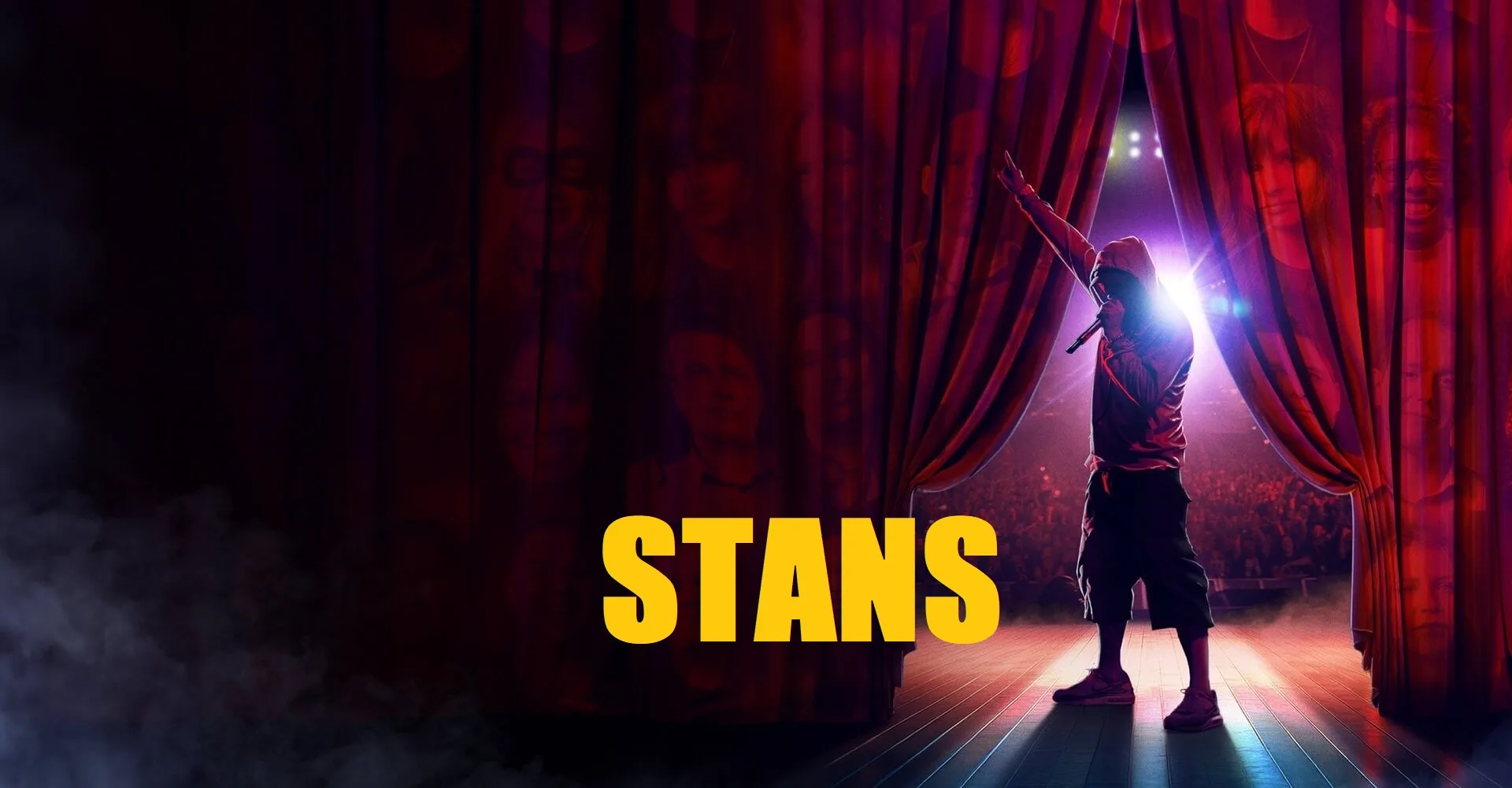

A peculiar thing happens when an artist becomes a cultural landmark: the story ceases to be about them. It becomes about the people who listen. The documentary Stans is ostensibly about the rapper Eminem, yet he is present more as a gravitational force than a subject. The film’s true focus is on the planets and asteroids caught in his orbit.
Directed by Steven Leckart, this is an exercise in narrative inversion, exploring a legacy not through the creator but through the receivers. Its title is, of course, derived from the artist’s iconic 2000 song, a chilling epistolary tale of obsessive fandom gone wrong. The term’s lexical journey from a specific, dark warning to a generic (and often proud) label for intense devotion is one of the more curious linguistic shifts of the new millennium.
The documentary gives a platform to the modern bearers of this title, letting them articulate the bond they feel. It is an examination of the strange, powerful symbiosis between a distant star and the people who find their light in his.
The Oral Historians of a Digital Age
The film makes a radical choice in its structure: it outsources its narrative authority. An omniscient narrator is replaced by a chorus of believers who guide us through Marshall Mathers’s life with the fervor of disciples. They are the storytellers here, a new kind of oral historian for an age of digital folklore.
We meet Zolt from Paris, a man whose physical resemblance to his idol feels less like happenstance and more like a sustained act of artistic curation. We meet a woman whose skin is a canvas dedicated to Eminem’s face, a permanent testament to her loyalty. These individuals are not presented as footnotes; they are the living text.
They recount career milestones with a precision that would exhaust a biographer, because for them, it is not history—it is scripture. This devotion provides an unusual texture. The fans’ perspective is subjective and emotionally charged, a stark departure from the detached tone of most biographical works.
Their encyclopedic knowledge is interwoven with personal anecdotes, creating a tapestry where an album release date holds the same weight as a personal crisis it helped them survive. It is a powerful, if slightly unsettling, method of storytelling that places the emotional truth of the listener above the objective facts of the artist’s life.
The Man Behind the Curtain Pulls it Back (Slightly)
Eminem does, eventually, take the stage. His rare sit-down interview functions as the film’s grounding wire, a direct transmission from the man himself that anchors the swirling adoration of his followers. He speaks with a weary clarity on the familiar trinity of celebrity struggle: the vertigo of fame, the abyss of addiction, and the quiet complexities of fatherhood.
While the subjects are not new, his presence is vital. He is the quiet sun confirming the wild theories of the astronomers who have spent their lives studying him. He shows a piercing self-awareness about the very strangeness the film documents, speaking of his discomfort with fans making pilgrimages to his demolished childhood home.
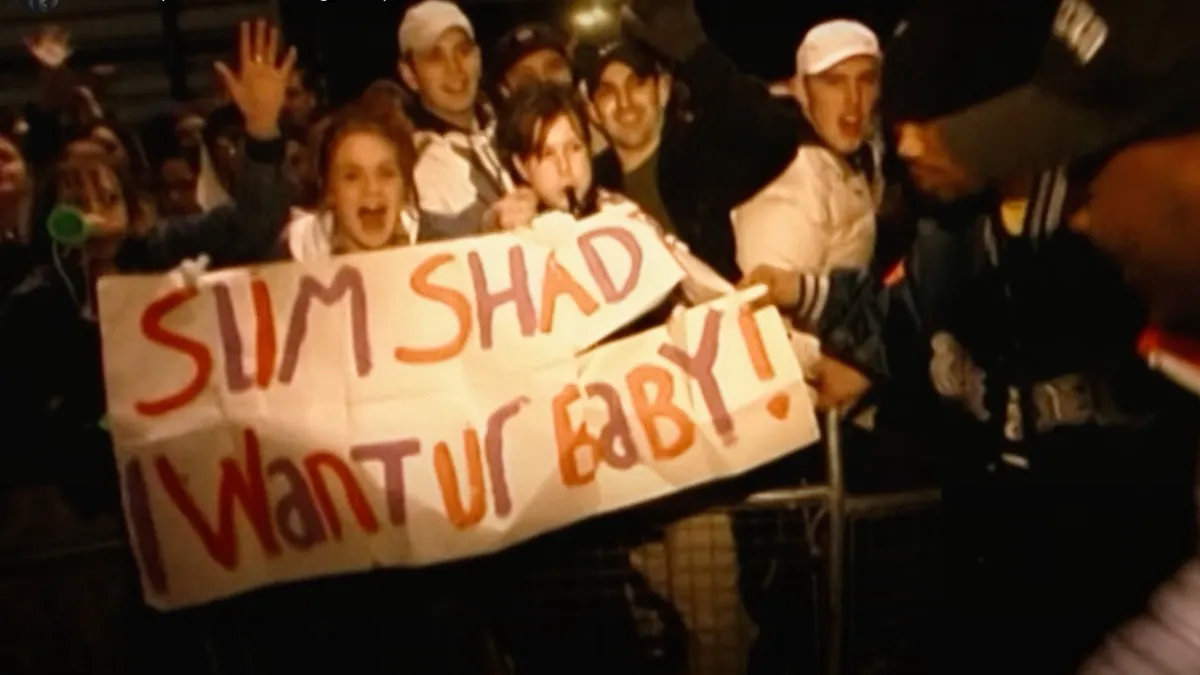
He understands the dynamic from both sides, at one point reflecting on his own idolization of LL Cool J with a candor that momentarily dissolves the barrier between icon and fan. The film also diligently dissects his personas, separating Marshall Mathers (the man), Eminem (the artist), and Slim Shady (the agent of chaos).
This psychological sorting is a crucial piece of internal and external brand management. It allows the artist to compartmentalize his own history, and it gives his audience a framework to forgive the transgressions of ‘Shady’ while celebrating the genius of ‘Eminem’.
The Cathedral of the Parasocial
At its core, Stans is a study of the parasocial relationship, that distinctly modern form of one-sided intimacy. The film builds a cathedral to this idea, portraying the bond between artist and fan as a sacred, life-affirming connection. It is a form of secular worship, where lyrics become hymns and concert halls become sanctuaries.

This documentary consciously avoids the darker alcoves of its own cathedral, sidestepping the obsessive pathologies that the original “Stan” character embodied. Instead, it focuses entirely on the therapeutic power of music. Albums like Recovery are framed as public markers of a private journey that gave listeners a map for their own battles.
The film posits that Eminem’s unflinching vulnerability about his demons helped normalize conversations about mental health and cracked the stoic facade of mainstream hip-hop. This creates a feedback loop of reciprocal catharsis: the artist’s confession provides a release for the listener, and the listener’s devotion fuels the artist’s next act of public introspection. It is a fragile but potent ecosystem built on shared wounds, a testament to the human need to see our own struggles reflected in the stories we consume.
The Polished Monument to a Living Legend
One must never forget that Stans was produced by Shady Films. This fact is not a minor detail; it is the film’s philosophical foundation. This is not a work of critical journalism but an act of legacy-building. It is a monument, meticulously crafted and approved by its subject, with his most loyal followers serving as the willing stonemasons.

The roster of commentators—close collaborators like Dr. Dre, younger admirers like Ed Sheeran, and even the oddly fitting presence of Adam Sandler—all work in service of this polished narrative. The film has no dissenting voices because it was never designed to accommodate them. What the documentary omits is therefore more revealing than what it contains.
There is no meaningful reckoning with the artist’s most controversial lyrics, no deep dive into the charges of misogyny and homophobia that have been a constant counterpoint to his acclaim. These issues are neatly swept aside. The film’s true purpose is not to question or analyze but to celebrate and solidify. It is an expertly constructed portrait, not of the artist as he was, but of how he, in the autumn of his career, wishes to be seen and remembered.
“Stans” is a documentary film that delves into the relationship between rapper Eminem and his dedicated fanbase. The term “Stan”, which refers to an obsessive fan, originated from Eminem’s song of the same name released in 2000. The film explores the lives of various fans, showcasing the profound impact Eminem’s music has had on them, and explores the complexities of fame and fandom. Directed by Steven Leckart, the documentary blends interviews, archival footage, and stylized re-enactments to tell this story. It premiered at the SXSW London Screen Festival on June 2, 2025. The film is currently having a limited theatrical release in select cinemas worldwide from August 7th to August 10th, 2025.
Full Credits
Director: Steven Leckart
Producers: Eminem, Paul Rosenberg, Stuart Parr, Antoine Fuqua, Tony DiSanto, David Schiff
Executive Producers: Eminem, Bruce Gillmer, Amanda Culkowski, Michael Maniaci
Cast: Eminem, Marshall, Kripa, Nikki, Zolt Shady
The Review
Stans
Stans is less a documentary and more a beautifully crafted piece of authorized mythology. It succeeds completely at its intended goal: to celebrate the profound bond between an artist and his followers. As an intimate exploration of modern fandom and the power of empathetic resonance, it is compelling. However, as a critical portrait of a complex artist, it is a deliberate non-starter. The film is a fascinating, polished, and ultimately hollow monument, revealing more through its calculated omissions than its heartfelt declarations. It is a study of worship that refuses to question the deity.
PROS
- An intimate and often moving portrayal of the fan-artist connection.
- Features a rare and candid sit-down interview with Eminem.
- Effectively explores the positive role music can play in supporting mental health.
- Presents a unique narrative structure centered entirely on the fan perspective.
CONS
- Functions as an authorized tribute, lacking any critical distance or journalistic rigor.
- Avoids serious engagement with the controversial aspects of Eminem's career and lyrics.
- Presents a sanitized, one-sided view of fandom, ignoring its more toxic potential.
- Feels more like a carefully managed piece of legacy-building than an objective documentary.