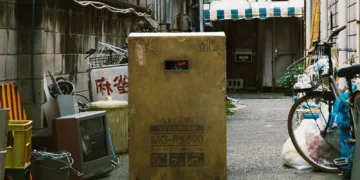



























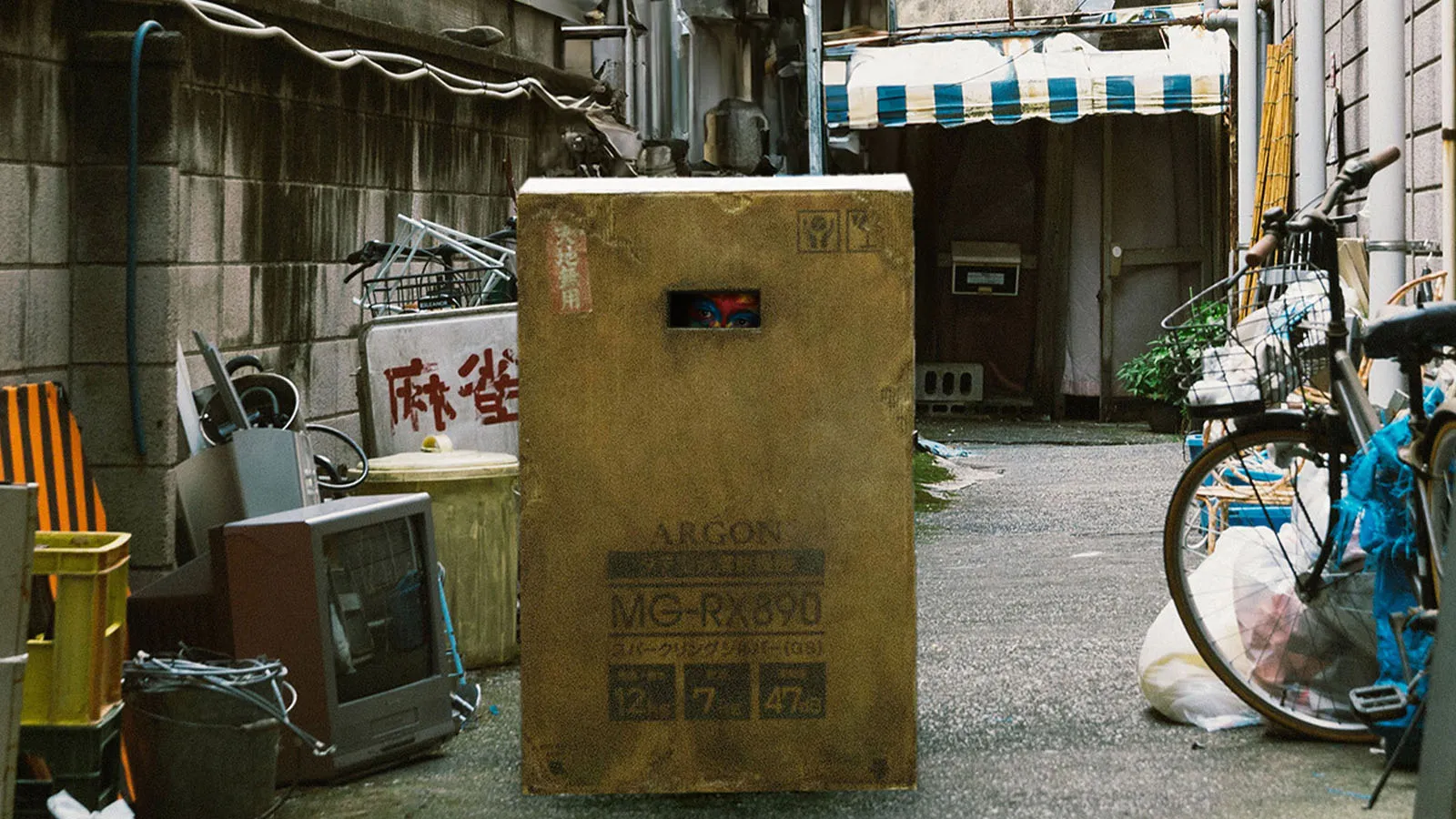

The world opens to a man inside a box. This is not a portrait of destitution but a renunciation, a turning away from the light of a society deemed counterfeit. In Gakuryû Ishii’s The Box Man, the cardboard shelter is a philosopher’s cave, a self-selected exile from a world of empty signifiers. Here, one abandons the fiction of a shared reality to perhaps glimpse something true.
The protagonist, a photographer who names himself “Myself,” is the current occupant of this strange freedom. He is a ghost in his own life, an observer peering through a stark rectangle cut from the wall of his world. His solitude is soon threatened.
A “Fake Doctor,” a man of murky science and desperate curiosity, develops a perilous fixation on the box and the secrets it might hold. Their desires collide, two opposing gravities pulling at a single, hollow object. What begins is a strange catechism on the nature of seeing and being seen, a search for an authenticity that may only exist within the deepest isolation.
A Symphony of Confines
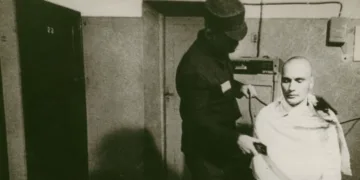
Ishii films this existential query with the spirit of a punk rock manifesto, an aesthetic assault that rejects passive viewing. The screen convulses with a nervous energy, its visual texture shifting from grainy, high-contrast black and white to sudden irruptions of color.
The monochrome sequences evoke a timeless, stark reality reminiscent of post-war Japanese photography, while the color feels intrusive, a layer of artificiality laid over a purer world. Outside the box, the city is a severe composition of industrial lines and hard angles, a hostile geometry that offers no comfort.
We are often trapped with the protagonist, our vision compressed to the letterbox slit through which he views existence. This forces a strange intimacy; the cinematic frame becomes his frame, making us complicit voyeurs in his detached surveillance. The effect is a screen within a screen, a constant reminder of the mediated nature of perception.
This visual discordance is matched by a score that lurches between the shriek of industrial noise and the quiet hum of ambient reflection, with moments of urban jazz punctuating the silence. The soundscape is the film’s erratic heartbeat, mirroring the protagonist’s flight from external chaos into an internal, perhaps more turbulent, quiet. The aesthetic is not one of comfort; it is a meticulously crafted disorientation.
On Becoming Nothing to See Everything
To inhabit the box is to perform a kind of ritual death of the self, an act of radical subtraction. Identity is shed like a useless garment, and in its place is the pure, disembodied act of observation. The film probes this fragile state, treating the box as a paradoxical object. It is a suit of armor against a society of surfaces, a mobile hermitage for the modern soul alienated to the point of disappearance.

This condition echoes a deep cultural undercurrent of social withdrawal, a desire to unplug from a world of relentless demand. Yet the act of hiding makes the hider a spectacle. “Myself” seeks anonymity but inspires a dangerous obsession in others who wish to claim his void for themselves. This friction exposes the film’s central questions about reality.
The observer seems to hold power, but is he seeing truth or merely projecting his own state onto the world? The conflict with the “Fake Doctor” is a physical manifestation of this philosophical tension. It is a battle between two forms of madness, one passive and observational, the other active and dissecting. Their struggle is a fight for the right to define existence, further complicated by the film’s suggestion that written accounts have the power to alter reality itself, transforming observation into creation.
An Invitation to the Periphery
The film’s strange world is held together by performers who fully submit to its severe logic. Masatoshi Nagase’s “Myself” conveys a complete interiority through posture and stillness alone, a difficult feat from within a featureless container. In opposition, Tadanobu Asano’s “Fake Doctor” radiates a cold, intellectual menace, his obsession born of a desire to classify and control.
Amidst their metaphysical combat, the nurse Yoko offers a flicker of warmth. She is a point of emotional gravity in a dehumanized landscape, a character still tethered to a world of feeling, making her both a potential salvation and a profound threat to the Box Man’s project. This is a demanding film. Its narrative is opaque, its pacing can feel punishing, and it rejects simple interpretation or catharsis.
The long runtime forces the viewer into a state of contemplation that mirrors the protagonist’s own. It does not ask for empathy, but for a consideration of a position. It is a cinematic provocation for those drawn to the periphery of narrative, for viewers who find poetry in existential dread and appreciate a film that functions as an artifact of rebellion. It asks you to look through its narrow slit and question the walls of your own.
The Japanese drama film The Box Man had its world premiere on February 17, 2024, at the 74th Berlin International Film Festival. It was also screened at the Seattle International Film Festival (SIFF) in 2024. The film is distributed by Happinet Phantom Studios in Japan. In June 2025, a Blu-ray and digital release of the film were announced by Third Window Films.
Full Credits
Director: Gakuryû Ishii
Writers: Kiyotaka Inagaki, Gakuryû Ishii
Producers and Executive Producers: Keisuke Konishi, Tomohiko Seki
Cast: Masatoshi Nagase, Tadanobu Asano, Koichi Sato, Ayana Shiramoto, Yuko Nakamura, Kiyohiko Shibukawa
Director of Photography (Cinematographer): Hideho Urata
Editors: Banri Nagase
Composer: Michiaki Katsumoto
The Review
The Box Man
The Box Man functions as a cinematic object for consideration, not simple enjoyment. It is a severe, intellectually demanding work of punk-rock cinema that trades narrative comfort for a deep examination of existential solitude. Director Gakuryû Ishii offers a disorienting, often frustrating, yet visually and philosophically potent vision. For viewers willing to embrace its abrasive nature, the film is a powerful study on the act of seeing and the desire to disappear from a world of surfaces.
PROS
- The film employs a striking aesthetic, shifting between high-contrast monochrome and color, with deliberate geometric framing.
- A dynamic score ranges from industrial noise to ambient quiet, effectively creating a disorienting and immersive atmosphere.
- It explores deep philosophical themes of identity, alienation, voyeurism, and the nature of reality.
- The cast fully embraces the film's absurd and severe logic, delivering effective portrayals.
CONS
- The film requires significant patience and intellectual engagement from the viewer.
- Its abstract, non-linear story can be difficult to follow and may frustrate those seeking a clear plot.
- The deliberate pacing and long runtime can feel alienating and inaccessible.
- The film prioritizes ideas over emotion, offering a cold and detached viewing experience.