




















In a world where the sun has vanished and zombies roam free, the last thing you’d expect to find is hope. Yet Gloomy Eyes, a puzzle-platformer adapted from its acclaimed VR film origins, builds its entire foundation on this unlikely premise. Players step into a post-apocalyptic realm where humanity cowers behind walls while the undead shamble through perpetual darkness.
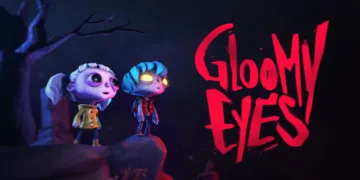
The story centers on two children whose friendship defies every social convention of their world: Gloomy, a zombie boy whose glowing eyes pierce the gloom and whose humanity remains intact despite his undead state, and Nena, a spirited girl trapped by her uncle’s oppressive guardianship. Their quest to restore daylight to the world becomes both a literal journey through 14 handcrafted chapters and a metaphorical exploration of connection across impossible divides.
What sets Gloomy Eyes apart is its “solo co-op” approach, where players control both characters to solve environmental puzzles. This mechanic serves the narrative beautifully, making their interdependence a core gameplay element rather than a thematic afterthought. The Tim Burton-esque aesthetic creates what the developers call “cozy horror” – a contradiction that somehow works, wrapping genuinely unsettling imagery in warmth and charm. At roughly four to five hours, this condensed experience prioritizes emotional impact over extended gameplay.
The Dance of Two Souls
The mechanical heart of Gloomy Eyes lies in the delicate balance between its protagonists’ opposing abilities. Gloomy can safely navigate among his fellow zombies, manipulate heavy objects, and hurl stones at distant targets, but bright lights become deadly obstacles that drain his health rapidly. Nena represents his perfect counterpart: she thrives in illuminated spaces, activates switches with nimble fingers, and leaps across gaps that would stop her companion cold, yet any zombie encounter spells instant death.
Character switching happens with a single button press, creating a rhythm that feels natural within minutes. The best puzzles require players to orchestrate complex sequences where both characters work in harmony. You might have Nena activate a switch to turn off lights, allowing Gloomy to pass through and throw objects to create a safe path for her return journey. These scenarios feel less like traditional puzzle-solving and more like choreographing a careful dance.
The game’s diorama view becomes essential for understanding each level’s spatial relationships. With a button press, the camera pulls back to reveal the entire stage as a rotating miniature world. This perspective helps players spot hidden pathways and collectibles that remain invisible from the standard fixed camera angles. However, the regular gameplay camera occasionally creates frustrating blind spots, particularly in darker areas where crucial interactive elements can hide just outside the frame.
Boss encounters punctuate the puzzle-focused gameplay when Gloomy transforms into an enraged combat form. These sequences provide welcome variety without overstaying their welcome, maintaining the game’s accessible difficulty curve. The checkpoint system proves forgiving, rarely forcing players to repeat significant progress when experiments go wrong.
Visual Poetry in Motion
Gloomy Eyes achieves something remarkable in translating its cinematic origins to interactive form. The character designs immediately capture attention: Gloomy’s exposed brain and ethereal glow contrast beautifully with Nena’s expressive human features, both rendered with the oversized heads and eyes that give them an almost toy-like appeal despite the macabre setting.

Each environment feels lovingly handcrafted, resembling elaborate dioramas brought to life. Gothic architecture crumbles under perpetual shadow while practical lighting effects serve both atmospheric and mechanical purposes. The interplay between light and darkness transcends mere visual flair, becoming a language the game speaks fluently throughout each chapter.
Eric Nolan’s narration anchors the entire experience, framing the adventure as a bedtime story told by an old gravekeeper. His gravelly voice adds weight to quiet moments and wonder to magical ones, creating the sensation of sitting beside a campfire while someone spins an impossible tale. The musical score adapts skillfully to each chapter’s emotional needs, from haunting melodies in abandoned spaces to playful carnival themes that somehow maintain the game’s eerie charm.
Technical performance remains solid throughout, with only minor shadow artifacts occasionally breaking the visual spell. The presentation successfully captures the cinematic quality of its VR predecessor while feeling natural on traditional gaming platforms.
Hearts Across the Divide
The narrative strength of Gloomy Eyes emerges from its commitment to exploring genuine friendship amid societal prejudice. Both Gloomy and Nena face rejection from their respective communities – he as a monster to be destroyed, she as a rebellious child to be controlled. Their partnership becomes an act of quiet revolution against fear and hatred.

Character development unfolds through actions rather than extensive dialogue. Players witness their bond strengthen through shared challenges, with mechanical cooperation reinforcing emotional connection. The supporting cast, from Nena’s authoritarian uncle to various zombie encounters, serves to highlight the protagonists’ unique relationship without overwhelming the intimate story.
However, the game’s pacing occasionally stumbles when puzzle solutions require both characters to traverse identical paths separately. These moments feel artificially extended, breaking the cooperative flow that otherwise drives the experience forward. Some late-game puzzles also suffer from obtuse logic that can leave players wandering without clear direction.
The four-to-five hour length feels appropriate for the story being told, though it raises questions about value at full price. Players seeking lengthy adventures might feel shortchanged, while those appreciating focused experiences will find every minute purposeful. The collectible Mementos and hidden Gravekeeper appearances in each chapter add replay value for completionists.
Gloomy Eyes succeeds most when it trusts its central conceit: that cooperation can overcome division, that friendship can bloom in the darkest places, and that hope persists even when the sun disappears. For players drawn to narrative-driven puzzlers like Brothers: A Tale of Two Sons or GRIS, this game offers a similar emotional journey wrapped in distinctive visual style. The mechanical innovation of solo co-op gameplay serves both practical and thematic purposes, making every puzzle solution feel like a small victory for understanding and connection.
The Review
Gloomy Eyes
Gloomy Eyes transforms a simple puzzle-platformer into something genuinely moving through its innovative character-switching mechanics and heartfelt narrative. While brief and occasionally frustrating with camera issues, the game's emotional resonance and distinctive Tim Burton-inspired aesthetic create a memorable experience. The solo co-op system brilliantly reinforces themes of interdependence and friendship. Despite pacing hiccups and limited replay value, this cozy horror adventure succeeds in proving that meaningful connections can flourish even in the darkest circumstances.
PROS
- Innovative solo co-op mechanics that serve both gameplay and narrative
- Distinctive Tim Burton-inspired visual style with excellent character design
- Compelling voice narration and atmospheric musical score
- Emotionally resonant story about friendship transcending barriers
- Accessible puzzle difficulty with logical progression
- Unique diorama view system for level exploration
CONS
- Short 4-5 hour length may feel insufficient for the price
- Fixed camera angles occasionally obscure important elements
- Repetitive backtracking when both characters must traverse same paths
- Some late-game puzzles feature obtuse solutions
- Minor technical issues with shadow artifacts
- Limited replay value beyond collectible hunting