
























Bloodthief arrives from indie developer Blargis as a first-person ultra-fast melee dungeon runner that strips away narrative pretense in favor of pure kinetic expression. You control a vampire tasked with eliminating undead threats, though the plot exists merely as scaffolding for what the game truly wants to offer: an exercise in relentless forward momentum. The premise is deliberately bare, avoiding character development or moral complexity. What remains is a focused meditation on movement itself.
The core loop asks you to sprint through 30+ levels using parkour abilities like sliding, wall running, jumping, and air dashing. Blood functions as both health and energy, creating a resource management system that demands constant aggression.
Kill enemies to collect ichor, spend it to perform enhanced maneuvers, and repeat until you cross the finish line. The game features retro graphics that evoke older shooters wrapped in a dark medieval fantasy aesthetic. A sandbox mode allows for experimentation outside the structured levels. This targets a specific audience: players who find satisfaction in mastering movement-focused challenges and speedrunning optimization.
The Vampire’s Paradox: Movement Mechanics and the Blood Economy
The blood system operates as Bloodthief’s central mechanical tension. Ichor serves dual functions: it protects you from death and fuels your supernatural abilities. Enemies drop blood when killed, which you must constantly collect because the meter diminishes over time. This creates psychological pressure. Standing still means vulnerability. Running out of blood reduces you to a fragile state where a single hit ends your run. Getting hit while blood remains drains your reserves instead of killing you outright. The design forces aggression and forward thinking simultaneously.
Movement abilities reflect different approaches to speed-based gameplay. Sliding propels you across surfaces with frictionless velocity. Air dashing launches you forward like a projectile, while ground pounding provides vertical attack options. Wall jumping requires no blood expenditure, functioning as your baseline traversal tool. Wall running, however, feels inconsistent. It drains speed and height almost immediately, creating moments where the ability seems more like an unintended exploit than a reliable mechanic. The game’s speedometer can register velocities up to 100 KMH, transforming you into something closer to a missile than a character.
Controls achieve accessibility without sacrificing depth. The input scheme never overwhelms you with complexity. Button presses feel intuitive even during chaotic sequences. When everything synchronizes, you become a killing machine that breaks sound barriers. The ‘Restart Level’ button sees frequent use, a design acknowledgment that failure is expected and repetition is mandatory. Aerial control introduces friction into an otherwise fluid system. Simple jumps occasionally feel clunky, your mid-air adjustments limited in ways that contradict the game’s promise of total spatial mastery.
Combat suffers from similar issues. Attacking amounts to button mashing with little strategic consideration. Kills lack satisfying feedback. Sometimes an enemy’s death doesn’t register cleanly, forcing you to glance backward mid-run to confirm elimination. This breaks forward momentum, a cardinal sin in a game built around constant progression. Dashing into enemies produces flashy visual effects without corresponding tactile impact.
The Grind Dressed as Mastery: Progression Systems and Replayability
Bloodthief structures advancement around gating rather than empowerment. The leveling system doesn’t make your vampire stronger or faster. Instead, certain stages remain locked behind level caps that can only be reached by replaying earlier levels for better completion times. This design philosophy reveals an interesting assumption about player motivation: that the pursuit of optimization provides sufficient reward, independent of character growth or narrative payoff.
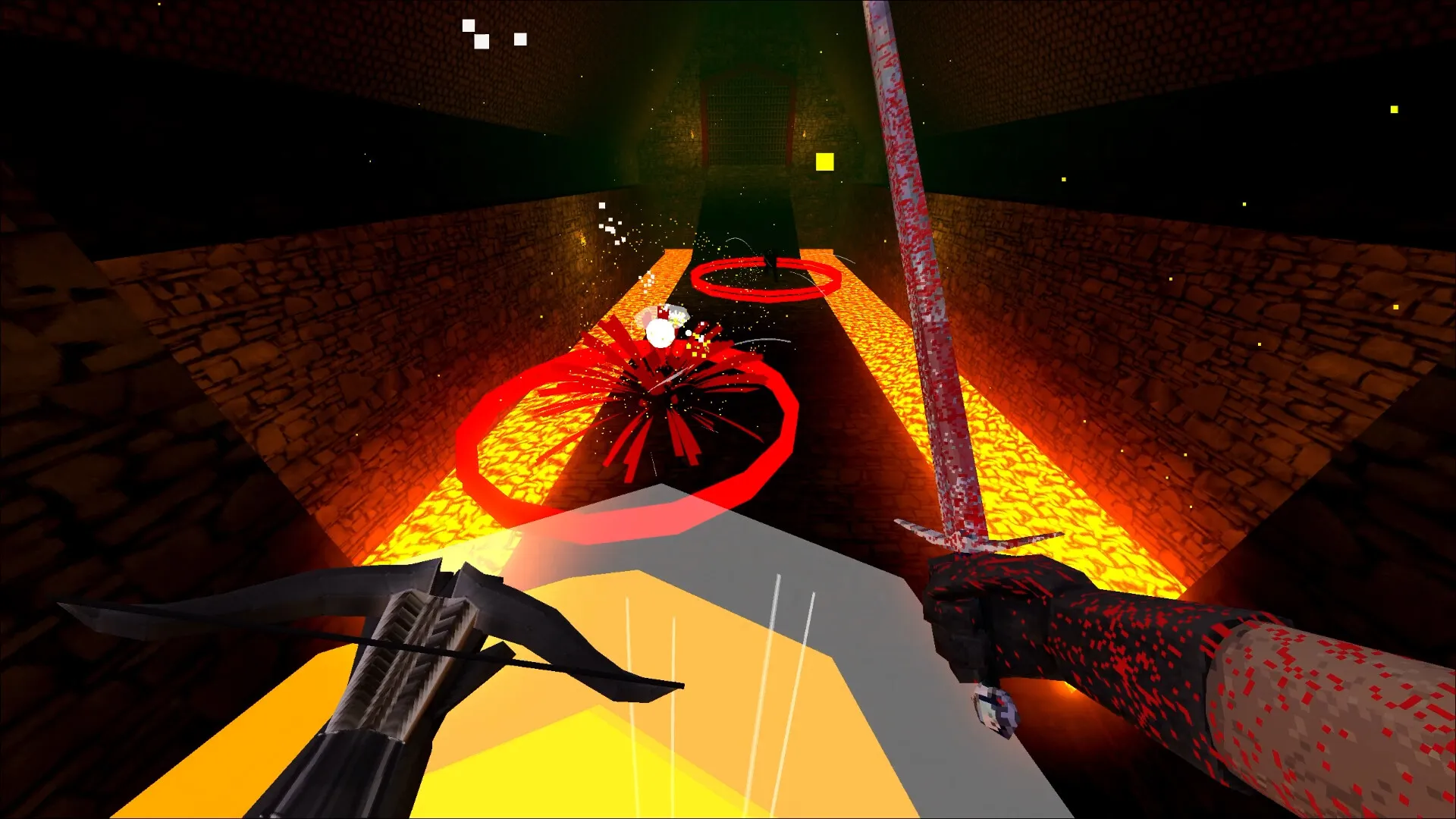
The system forces revisitation of content you’ve already cleared. Early levels, which tend to be the least engaging, must be replayed repeatedly to unlock later stages. Most levels feature essentially one optimal route, which limits the variety available during these mandatory returns. You’re not discovering new paths. You’re refining execution on predetermined tracks, shaving milliseconds through improved timing and tighter inputs.
Weapons and runes scattered throughout levels provide some mechanical variation. These items offer unique buffs that alter how your character plays, though the differences rarely feel significant enough to meaningfully change your approach. Most weapons look visually similar to your starting sword and function comparably. You unlock them through collecting artifacts, which are earned by completing levels or achieving fast times.
Secrets and collectibles embed exploration within speedrunning structure. Each level contains 2-3 collectible eyes hidden throughout the environment. Finding these eyes unlocks rewards, including a ghost that replays your best run, allowing you to race against your own previous performance. This transforms solitary speedrunning into a form of asynchronous self-competition. Artifacts that unlock weapons come from both level completion and speed thresholds, creating parallel progression paths that reward different play styles.
The medal system ranks performance through a hierarchy that reflects speedrunning culture’s internal stratification. Slow completions earn you a “Dung” medal. Decent runs receive “Blood” medals, equivalent to bronze tier recognition. Anything beyond requires near-perfect execution. The game expects you to optimize every section, saving seconds in one area to compensate for time lost elsewhere. Tutorial placement sometimes disrupts pacing for newcomers, as informational pop-ups can interrupt flow at inopportune moments.
The sandbox mode provides a practice space divorced from combat pressure. Here you can experiment with movement techniques without enemy interference. The mode doesn’t allow artifact collection or level progression, serving purely as a training ground. It could benefit from administrative tools for custom scenario creation, but its inclusion demonstrates awareness that mastery requires dedicated practice spaces.
Pixels and Precision: Presentation as Cultural Signifier
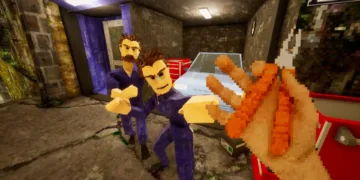
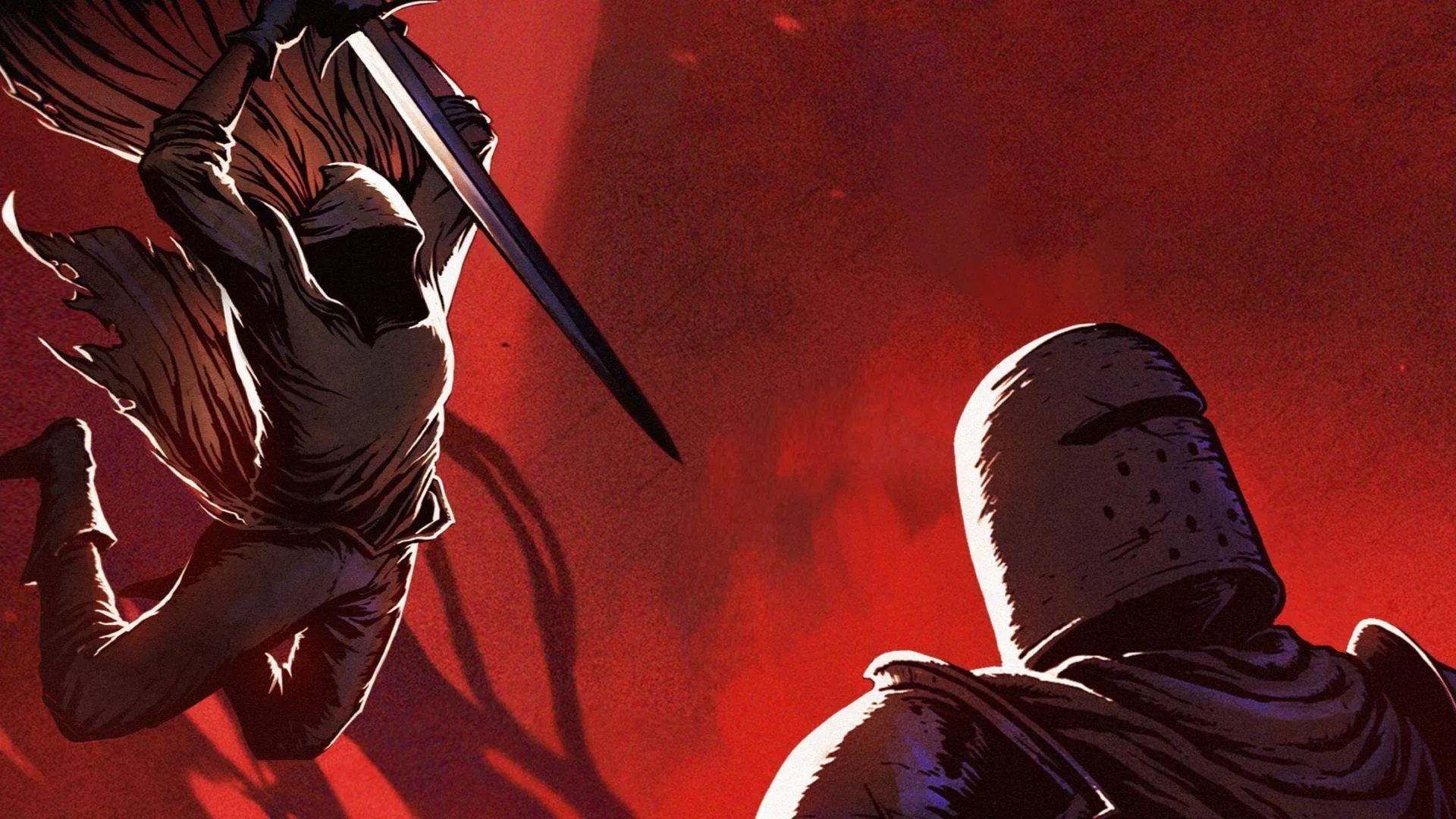
Bloodthief’s retro aesthetic positions it within a lineage of games that fetishize computing’s past. The pixelated textures and low-polygon models evoke older shooters like Quake while the dark medieval fantasy setting draws visual inspiration from Thief. This design choice reflects a specific moment in indie development: the conscious rejection of photorealism in favor of stylized nostalgia that carries both artistic and practical motivations.
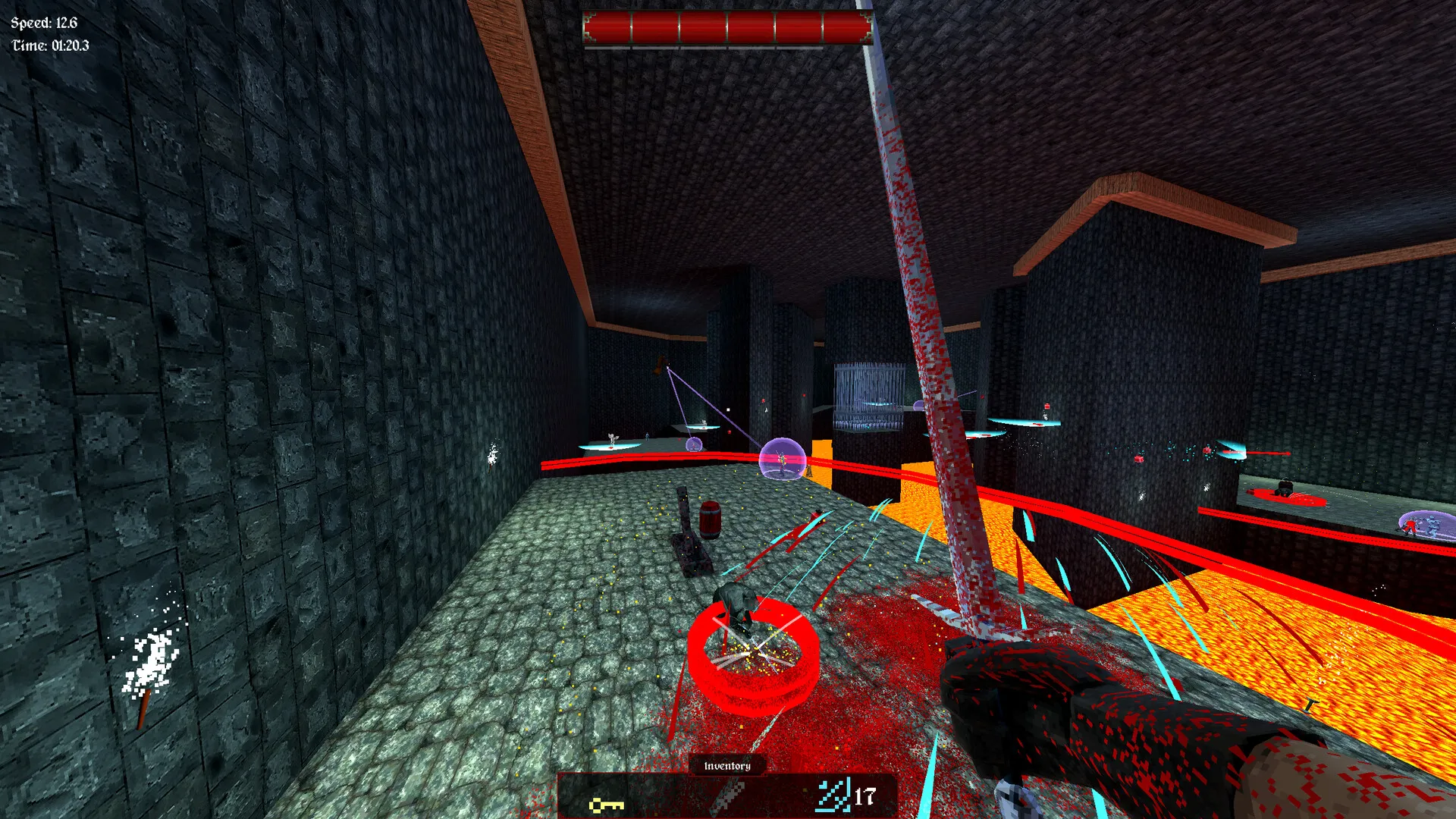
Level design employs color palettes and texture variation as navigational language. The game avoids modern conventions like yellow paint marking climbable surfaces. Instead, you learn to read environments through visual differentiation. Different materials suggest different interactions. The approach assumes player literacy in spatial problem-solving. Environments remain clear enough to prevent confusion, though the visual language requires acculturation to fully parse.
The soundtrack, composed by Occams Laser with sound design by Roman Perry, fuses gothic medieval rock with EDM aesthetics. The music reflects the game’s hybrid identity: one foot in dark fantasy tradition, the other in contemporary electronic culture. The fusion works because both genres share an interest in intensity and propulsion. Sound effects balance realism and fantasy without excessive flourish. The audio design creates atmospheric cohesion that supports the dark fantasy setting while maintaining energetic pace. The soundtrack proves enjoyable during play sessions, though it likely won’t find its way into external playlists.
The game’s audience specificity reveals important questions about accessibility and design intention. Bloodthief is fundamentally a speedrunning game, created by developers who understand that subculture’s values and expectations. The experience targets players willing to replay levels dozens or potentially hundreds of times to reduce completion times by seconds or fractions thereof. Trial and error forms the experiential core. Elements that appear as flaws from other perspectives function as intentional design choices here: softlocks from depleting blood reserves, demanding precision requirements, limited mechanical forgiveness.
The game doesn’t welcome casual players or those seeking relaxed experiences. The design doesn’t punish you for playing at your own pace, exactly, but it clearly prioritizes one specific audience. Level design choices reflect this bias. Stages tend to run 1-2 minutes longer than optimal for speedrunning purposes.
Maps include sections that demand existing mastery rather than teaching skills through graduated challenge. The difficulty curve would benefit from better scaffolding: easier paths that let newcomers develop competence naturally, with more demanding routes reserved for veterans.
When the gameplay loop functions as intended, everything feels fluid and powerful. Your vampire protagonist becomes an extension of will, responding instantly to inputs and maintaining momentum through precise execution. When mechanical inconsistencies emerge or your timing falters, the entire flow stalls.
You restart and begin again. The experience suits players who can find meditative focus in repetitive physical tasks, who derive satisfaction from incremental improvement measured in quantifiable metrics. For those seeking depth, story, or mechanical variety, Bloodthief offers little. It knows exactly what it wants to be and pursues that vision with single-minded intensity.
The Review
Bloodthief
Bloodthief delivers an uncompromising speedrunning experience that excels at its singular vision while alienating broader audiences. The blood-fueled movement system creates exhilarating moments of flow, though mechanical inconsistencies and forgettable combat undermine precision. Its retro aesthetic and pulsing soundtrack effectively frame the action, but tedious level gating and limited route variety expose design limitations. This is a game for dedicated speedrunners willing to replay levels endlessly for marginal improvements. If that's you, Bloodthief offers rewarding mastery. For everyone else, it's a beautiful machine built for someone else's hands.
PROS
- Fluid, responsive movement controls at high speeds
- Innovative blood system creates meaningful risk-reward tension
- Ghost racing feature encourages self-competition
- Catchy gothic EDM soundtrack
CONS
- Combat feels shallow and lacks satisfying feedback
- Inconsistent wall running mechanics
- Tedious level gating forces replaying early content
- Limited aerial control during jumps
- Extremely niche appeal excludes casual players