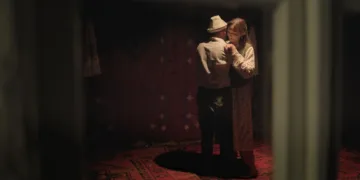































Veteran Kyrgyz writer-director Aktan Arym Kubat, admired for tender portraits of rural existence in Centaur and The Light Thief, brings a quietly focused gaze to Black Red Yellow. The film is Kyrgyzstan’s submission for the Academy Awards, and it unfolds across the breathtaking, unforgiving landscapes of the Batken region. Kubat sets the story in a proud village in the 1990s, still reeling from the economic and social aftershocks of the Soviet Union’s collapse. Transition here looks wrenching.
Many families leave for cities, and unemployed men slide into heavy drinking. The film’s calm surface comes from its attention to craft and routine, anchored by Turdugul (Nargiza Mamatkulova), the village’s master carpet weaver. Her work, rooted in land and tradition, provides the story’s spine. Kubat divides the film into three color-coded movements, black, red, and yellow, meant to track emotional weather and the recurring patterns of life that Turdugul weaves into cloth.
The Mechanics of a Vanishing World
Kubat’s storytelling thrives on observation. The film functions as an ethnographic portrait of post-Soviet village life, where scarcity and isolation dictate daily rhythms. Men, cut off from opportunity, drift through their days with a low-grade sense of displacement. Women keep the village functioning through constant domestic labor, maintaining households, raising children, and cooking for families that are fraying under pressure.
Their work forms the unseen base of the community. Within that imbalance, carpet weaving carries real narrative weight. For Turdugul, the loom is a lifeline that does more than pay bills. It offers purpose and steadiness in a world that feels as if it might slide out from under her at any moment.
Cinematographer Talant Akynbekov treats the weaving process with patient reverence. His lens stays close to the women’s hands moving across bright threads, turning craft into a kind of ceremony. Kubat places that devotion to tradition beside the social shifts reshaping the region. A powerful scene centers on an elderly grandmother who refuses to sell her property, mourning the steady exodus of neighbors to the big cities.
The abandoned houses around her stand as quiet memorials to a way of life disappearing in real time. Kubat highlights a matriarchal ethic built on sacrifice, survival, and continuity, a quiet strength that runs through the village’s women. That ethic meets a harsher patriarchal reality in scenes of neglect and excessive drinking, setting up the film’s core tension without raising its voice.
The Uncatalyzed Romance
The emotional conflict tightens around an arranged marriage already steeped in misery. Shirin (Aigul Busurmankulova) and Kadyr (Mirlan Abdykalykov) embody the post-Soviet despair hanging over the village, two people who feel trapped and grow more bitter with each passing disappointment. Shirin’s central anguish is her inability to conceive. She is practical in her routines and visibly heartbroken.

The narrative’s treatment of her is difficult to swallow. Busurmankulova plays Shirin with intense commitment, yet the story often frames her as a tiresome, nagging wife. Her legitimate frustration gets reduced to bad judgment, most clearly in the goat scene. The film’s angle seems designed to rationalize Kadyr’s discontent rather than grapple with the pain driving her.
Kadyr is drawn as a sullen husband who pours his attention into his horse and withdraws from his marriage. His unhappiness makes him an easy target for distraction. In the Red section, his attraction to Turdugul becomes explicit. The moment is presented as a natural shift, but it lands as a storytelling misstep. The attraction arrives suddenly, without the buildup or emotional current that a romance like this needs to feel inevitable or dangerous. Shirin’s growing suspicion follows logically and fuels her furious act of revenge against the loom.
The story moves into a final confrontation where Turdugul rejects Kadyr with a simple, cutting line: “If you didn’t make your wife happy, how will you make me happy?” Kubat treats her choice as a moral victory. The cost is a heroine who accepts duty over desire, surrendering personal happiness to principle. That decision leaves the emotional depths of the two women, Shirin and Turdugul, only partially explored, even though the film positions their lives as its true pulse.
Pacing and Palette
Kubat’s direction is defined by tenderness and serene clarity. He favors long takes and quiet observation, creating a poetic flow that lets everyday labor and landscape speak for themselves. The pace leans into stillness and silence, and that calm occasionally blunts the film’s emotional momentum inside its compact running time. Akynbekov’s imagery remains a steady strength. Earthy tones and natural light echo the carpets Turdugul weaves, and the camera frames village work against mountains and valleys that feel majestic and timeless.

The narrative structure uses a framing device of an older woman traveling in a van, then divides the film into three chapters: Black for calmness, Red for intensity, Yellow for nostalgic melancholy. The design is clear and coherent, yet the film holds a uniform, even-handed tone across all three movements.
The colors suggest a stronger emotional arc than the story allows itself to take, since each section plays at nearly the same register. Traditional tunes hummed by villagers float through the soundtrack, lending a gentle folk-tale feeling and reinforcing the endurance of culture even as the village itself begins to thin out.
Black Red Yellow is a 2025 Kyrgyz drama film co-written and directed by Aktan Arym Kubat. It premiered at the Shanghai International Film Festival on June 18, 2025, where it won the Golden Goblet for Best Feature Film. The film officially premiered in Kyrgyzstan on August 31, 2025, and explores themes of love, duty, and tradition through the story of a master carpet weaver in a struggling post-Soviet village. As of today, November 23, 2025, the film is continuing its international festival circuit and is Kyrgyzstan’s submission for the 98th Academy Awards for Best International Feature Film. Information on broader streaming or theatrical distribution in other territories is pending.
Full Credits
- Title: Black Red Yellow (Kara Kyzyl Sary)
- Distributor: Kyrgyzfilm National Film Studio
- Release date: June 18, 2025 (World Premiere, Shanghai), August 31, 2025 (Kyrgyzstan)
- Running time: 93 minutes
- Director: Aktan Arym Kubat
- Writers: Topchugul Shaidullayeva, Aktan Arym Kubat
- Producers and Executive Producers: Aktan Arym Kubat, Akjol Bekbolotov, Aida Usenova
- Cast: Nargiza Mamatkulova, Aigul Busurmankulova, Mirlan Abdykalykov
- Director of Photography (Cinematographer): Talant Akynbekov
- Editors: Evgeniy Krokhmalenko
- Composer: Balasagyn Musaev
The Review
Black Red Yellow
Black Red Yellow succeeds as an atmospheric document of a specific time and place, beautifully rendered through Talant Akynbekov’s camera. Kubat’s tender style captures the quiet despair and enduring spirit of a struggling community. However, the film struggles to fully execute its emotional core. The central romance lacks necessary dramatic build, and its depiction of the unhappy wife, Shirin, undermines the film's otherwise nuanced focus on matriarchal strength. It is an aesthetically rewarding but narratively uneven piece that prioritizes tradition over character development, leaving key emotional threads frustratingly unspooled.
PROS
- Exceptional, observant cinematography that captures the beauty and hardship of the Kyrgyz landscape.
- The effective depiction of post-Soviet village life and the clash between tradition and modernity.
- The ceremonial lensing of traditional carpet weaving as a significant cultural and spiritual act.
- The strong performance by Aigul Busurmankulova as Shirin, despite the character's limited narrative sympathy.
CONS
- The central forbidden romance between Turdugul and Kadyr is underdeveloped and lacks palpable chemistry or setup.
- The slow, deliberate pace sometimes hinders the emotional momentum of the story.
- The narrative’s treatment of Shirin often reduces her legitimate frustration to a clichéd, nagging caricature.
- The film’s three-part structure based on color symbolism does not translate into a distinct, evolving tonal progression.







