















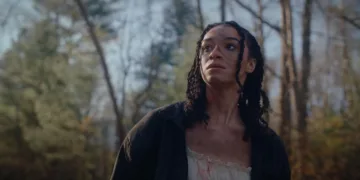












Dechen Roder’s sophomore feature, I, the Song, approaches identity through a mystery setup that opens into psychological drama. The story follows Nima (Tandin Bidha), a quiet schoolteacher shaken when a sensational “blue video” spreads online. The clip shows another woman who looks uncannily like Nima, and the resemblance triggers rumor in her tight-knit community.
Nima is fired from her job, her boyfriend doubts her and leaves, and her everyday life collapses overnight. With her name smeared and her future narrowed, she sets out to find the stranger, Meto (also played by Bidha), and clear herself. Her search carries her across Bhutan, moving from the capital Thimphu to the border town Gelephu. What starts as a practical attempt to locate a look-alike grows into an existential inquiry into the life Nima never lived, shaping a mood that feels both atmospheric and inward-looking.
Mirroring Souls and Modern Friction
Casting Tandin Bidha in both lead roles drives the film’s doppelgänger tension. Nima lives dutifully and contained, following social expectations and often moving through scenes with her head lowered. People remember Meto as extroverted, passionate, and restless, someone who drew attention and pushed against routine. Nima’s pursuit of Meto becomes a quiet catalyst for change.
Each stop on the trail reveals choices Meto made, risks she took, and connections she formed, and these fragments offer Nima new ways to see herself. The closer she gets to Meto’s story, the more Nima feels a mix of awe and envy toward a person who seemed to inhabit the world with ease.
Roder backs this internal shift with sharp visual contrasts. Nima’s present-day scenes sit in cool blue tones that echo her isolation and disorientation. Moments tied to Meto’s past arrive in warm amber light, suggesting a life lived in motion. The narrative also ties personal crisis to modern social pressure.
The “blue video” functions as a digital-age ruin, showing how a privacy breach can detonate a reputation inside a small, connected society. Alongside that storyline runs a secondary thread about a traditional song being taken to the city and commodified. That subplot links Nima’s personal violation to a longer history of cultural theft, pressing the film’s concern with identity on both an individual and communal scale.
Visual Language and Narrative Pacing
I, the Song leans into an intense, stylized look. Cinematographer Rangoli Agarwal uses strong color filters, chiefly blue and amber, to shape mood and suspense. The result carries a dreamlike, slightly mystical texture that fits the film’s interest in spiritual connection and transformation. Roder structures the narrative in non-linear fashion, cutting between Nima’s present and Meto’s past.

Several sequences stage the two women side by side across different periods, letting composition create a soft, unsettling ambiguity. The viewer is left to wonder if Nima is tracing a human life or chasing a mythical parallel self. The structure can feel disorienting at points, yet it keeps the central mystery alive and reinforces the sense that Nima’s investigation runs through memory and imagination as much as geography.
Music anchors these images. The title points to sound as a guiding force, and the soundtrack blends diegetic Dzongkha folk songs, tied to tradition and place, with a more experimental ambient score. Characters perform many of the songs themselves, so music functions as lived emotion, tying landscape, custom, and inner feeling into one current. The film’s slow-burn pacing gives the psychological drama room to unfold without haste. That patience builds an oneiric mood and keeps the Bhutanese setting from turning into spectacle, letting the place feel inhabited rather than displayed.
Mastery in Performance and Context
Tandin Bidha’s dual performance holds the film together. She separates the shy, soft-spoken Nima from the outwardly confident Meto through small shifts in posture, voice, and expression, providing the emotional footing the layered structure requires. Her control makes the doubled roles feel like two fully realized lives sharing a face, and the film’s emotional stakes land because she keeps both women distinct even in echoing moments.

Tandin (Jimmy Wangyal Tshering), a musician and Meto’s ex-boyfriend, adds charm and momentum to Nima’s search. The character is lightly sketched in places, and that thinness reads as part of the film’s view of the men in these women’s orbits. The men in Nima’s and Meto’s lives appear mediocre or possessive, and their demands take up too much room in the women’s thoughts, becoming a recurring barrier to freedom.
Brief appearances from supporting figures, including Meto’s blind grandmother and Nima’s skeptical boyfriend, deepen Nima’s isolation and keep her moving forward. Taken together, the ensemble grounds the film’s mystical aims in recognizably human pain, desire, and reinvention.
I, the Song is a 2024 Bhutanese drama film that premiered internationally at the Tallinn Black Nights Film Festival on November 19, 2024, where its director, Dechen Roder, won the Best Director award in the Critics’ Picks Competition. The film follows a schoolteacher in Bhutan who, after being falsely accused based on a viral video featuring her doppelgänger, sets out on a journey that forces her to re-examine her own identity and desires. The film has been actively showcased across the international festival circuit throughout 2025, winning several awards, and was selected as Bhutan’s entry for the 2026 Academy Awards. As of today, November 23, 2025, specific wide theatrical or streaming availability depends on your region, but it is handled by the international sales agent Diversion and is a co-production across Bhutan, Norway, Italy, and France.
Full Credits
Title: I, the Song
Distributor: Diversion (International Sales Agent); Dakinny Productions, Girelle Production, Volos Films, and Fidalgo Films (Territorial Producers/Distributors)
Release date: November 19, 2024 (World Premiere at Tallinn Black Nights Film Festival)
Running time: 113 minutes
Director: Dechen Roder
Writers: Dechen Roder
Producers and Executive Producers: Dechen Roder, Johann Chapelan, Fernanda Renno, Stefano Centini, Paolo Maria Spina, Mikaël Barre, Michaël Gauthier, Mathilde Solimeo, Nyema Zam, Thinley Choden
Cast: Tandin Bidha, Jimmy Wangyal Tshering, Tshering Dorji, Sonam Lhamo, Dorji Wangdi, Ugyen Norbu
Director of Photography (Cinematographer): Rangoli Agarwal
Editors: Noémie Loeve, Dechen Roder
Composer: Tashi Dorji
The Review
I, the Song
I, the Song is a captivating psychological drama that leverages rich visual language and a stellar dual performance to explore the friction between personal desire and cultural expectation. Dechen Roder masterfully weaves together themes of digital-age scrutiny and traditional identity loss, creating a film that is both specific to Bhutan and universal in its emotional resonance. While the non-linear structure occasionally introduces confusion, the film’s unique blend of mystery, mysticism, and music solidifies it as a sophisticated, memorable cinematic work.
PROS
- Deep, resonant themes of identity and cultural tension.
- Stunning cinematography with masterful use of color (blue/amber).
- Tandin Bidha gives a brilliant, nuanced dual performance.
- Strategic use of music, blending traditional and ambient styles.
- Avoids cultural exoticism while offering an intimate perspective.
CONS
- Non-linear, episodic structure can feel confusing at times.
- The romance subplot with Tandin is sometimes unconvincing.
- Pacing is deliberately slow, which may challenge some viewers.
- The characterization of Tandin and other male characters feels thin.