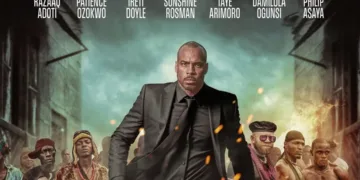



























Son of the Soil opens as a hard-hitting revenge thriller set in Lagos, a piece of action-driven cinema that foregrounds kinetic movement and direct confrontation. The story follows Zion Ladejo, played and scripted by Razaaq Adoti, a former special forces soldier who returns to his Nigerian home. His objective is clear: he seeks to avenge the brutal murder of his sister Ronke (Sharon Rotimi), killed after uncovering the operation of wealthy and ruthless drug kingpin Dr. Baptiste (Philip Asaya).
Shot on location, this UK/Nigerian co-production builds a gritty, hyper-realistic look in the streets of Lagos. Director Chee Keong Cheung establishes a fast pace and an action-first approach, shaping a narrative where brute force and immediate retaliation take priority over extended exposition. The rapid plunge into street-level chaos echoes the high-stakes visual intensity familiar from global action cinema.
Cinematic Symbolism and Stylistic Brutality
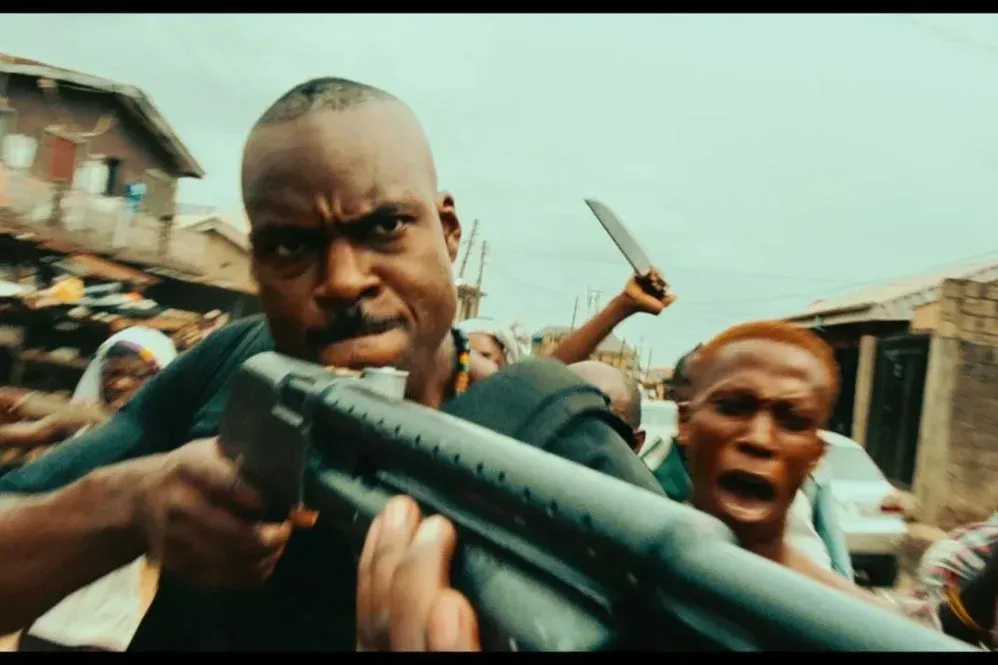
The film’s most convincing qualities lie in its technical craftsmanship and its unflinching approach to screen violence. Action scenes land with visceral impact and a harsh, physical charge, creating a lean and swiftly moving experience. The violence feels varied and highly personal, with beatings, immolations, and the precise use of weapons such as machetes and guns. This graphic choreography defines the film’s aesthetic identity. A standout flourish replaces a standard car chase with a tense “keke” (commercial tricycle) sequence, a clever choice that grounds the action in local Lagos reality.
Cheung’s direction leans on handheld camera work to catch the city’s restless energy, giving many scenes a raw, immediate texture. A key stylistic decision is the frequent use of the Dutch angle, the canted frame that tilts the image. At first it adds a sense of unease and instability, but constant repetition turns it into a distracting habit rather than a subtle mood choice. On a technical level, the production succeeds through sound design that strongly amplifies the impact of each blow and gunshot. A vivid, dark color palette supports the film’s gritty and forceful visual identity.
Character as Function: The Cost of Pacing
Son of the Soil pursues a clear narrative goal that places action above all else. The drive for relentless momentum leaves character development and story complexity undernourished, recalling the stripped-down formulas of 1980s action cinema. Zion Ladejo has military training, yet he appears on the page as a haphazard lead who relies heavily on narrative coincidence to stay alive.
Also Read
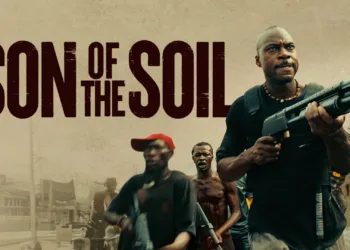





There is a perceptible distance between Zion’s stated history of military service and Lagos familiarity and Razaaq Adoti’s performance, which suggests a protagonist who struggles with the language and mannerisms of the setting. This gap makes the character harder to accept as written. Zion’s lack of tactical thinking while pursuing powerful opponents, underscored by his failure to protect his mother, played by Patience Ozokwor, further weakens his credibility as an elite soldier.
Supporting characters work mainly as mechanisms for story progression or simple moral indicators. Ronke’s death functions as the initial trigger. Dr. Baptiste conveys a strong sense of menace, yet the audience receives little information about his influence or reasoning, so his villainy feels thinly sketched.
The presence of the cute street urchin sidekick (Ijelu Folajimi) seems designed to underline Zion’s moral alignment. Veteran actor Patience Ozokwor brings a short but effective note of emotional weight as Zion’s mother. The frantic pacing and jittery camera style leave emotional beats, such as Zion’s grief, without room to breathe, and the film struggles to convey the full impact of the personal losses on screen.
Lagos: Setting as Spectacle Versus Reality
The most striking strength of Son of the Soil lies in its authentic visual sense of place. Location shooting allows the film to capture the imposing physical structures and raw, chaotic rhythm of Lagos street life. This insistence on real streets and markets gives the images a strong feeling of grounded realism.
The script folds in recognizably Nigerian details, such as ordering amala and egusi or staging “keke” chases, which act as clear cultural markers. At the same time, these touches can feel like surface-level flourishes that compensate for the perceived foreignness in the lead performance and the directorial eye.
A sharp divide opens up between this grounded visual authenticity and the film’s social logic. Action scenes often ignore the practical realities of a densely populated Lagos. Armed confrontations in crowded markets would logically provoke strong reactions from bystanders; here, the background crowd remains strangely passive, which weakens the film’s claim to grit.
Plot decisions such as a wealthy crime boss taking a hostage on a public train stretch believability even further. These choices point to a directing approach that privileges the look and mechanics of violence, the gore and gruesomeness, as signs of technical control. The camera watches the carnage with a sense of spectacle that feels detached from any sustained social or philosophical engagement with life in the city.
Son of the Soil is a Nigerian/UK co-production and action thriller that premiered in late 2024 and 2025. It opened in UK cinemas from December 5, 2024, and had its Nigerian theatrical release starting November 21, 2025, after screening at several festivals, including the Black Star International Film Festival and AFRIFF. As of today, December 1, 2025, the film is in its theatrical run in Nigeria and may be available on digital platforms or streaming services in other territories.
Full Credits
Title: Son of the Soil
Distributor: Action Xtreme (UK), Nile Entertainment (Nigeria)
Release date: November 21, 2025 (Nigeria), December 5, 2024 (UK)
- Director: Chee Keong Cheung
Writers: Razaaq Adoti
Producers and Executive Producers: Wingonia Ikpi (Producer), Elias Tahan (Executive Producer), Philip Asaya (Executive Producer), Chee Keong Cheung (Executive Producer)
Cast: Razaaq Adoti, Philip Asaya, Sharon Rotimi, Patience Ozokwor, Ijelu Folajimi, Damilola Ogunsi, Taye Arimoro
The Review
Son of the Soil
Son of the Soil delivers an aggressively paced, visually striking action experience set against the raw backdrop of Lagos. Director Chee Keong Cheung excels in delivering visceral fight choreography and intense technical flair. The film succeeds as pure, unfiltered genre spectacle, yet it lacks the narrative depth to be truly memorable or insightful. Protagonist Zion Ladejo’s motivations are clear, but the thin script forces him into illogical situations, often sacrificing realism for plot convenience. It is a thrilling, flawed exercise in style.
PROS
- Visceral and brutal action choreography.
- Impressive on-location shooting capturing Lagos's chaotic energy.
- Strong technical identity (sound design, color palette).
- Creative, setting-specific action sequences (e.g., "keke" chase).
- Patience Ozokwor's powerful supporting performance.
CONS
- Shallow character development for the protagonist.
- Reliance on plot convenience and coincidence.
- Jarring disconnect between visual realism and social believability.
- Overuse of the Dutch angle becomes distracting.
- Emotional moments fall flat due to lack of narrative focus.