




























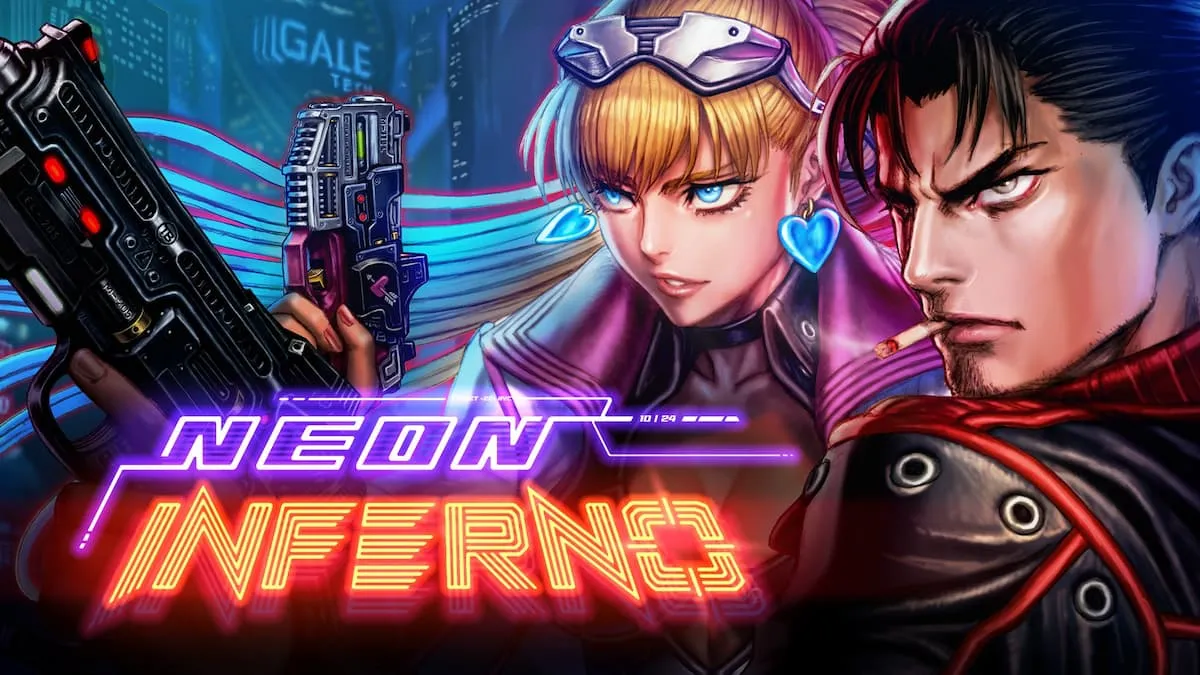

The modern revival of high-octane 2D shooters often struggles to step beyond simple homage. Neon Inferno positions itself inside that resurgence, presenting a high-speed experience across the fractured skyline of a dystopian New York City in 2055. This future metropolis functions as an open war zone carved into territories by entrenched mafia syndicates and watched over by corrupt law enforcement.
The player enters this conflict as an assassin, choosing either Angelo Morano or Mariana Vitti, hired to erase rival bosses and establish a new order. The framing keeps both assassins aligned in their core abilities, which pushes attention toward how the action systems behave. The design leans on intense, close-quarters confrontation, tight gunplay, and a stack of specialized mechanics that demand active engagement.
Core Mechanics: Chaos and Precision
Moment-to-moment play in Neon Inferno rests on fast 2D platforming. Movement feels sharp, and a responsive shooting system supports directional fire across the side-scrolling plane. Infinite-ammo gunplay gives each burst a satisfying punch. The game then layers two key mechanics on top of this familiar base to create a skill ceiling that rewards players who study and master its systems.
The first pillar is the Deflection/Bullet Time ability. The assassin’s melee strike carries a vital role as a parry for specific green enemy shots. Landing that parry often separates a promising high-score run from a sudden death. A successful deflection, followed by holding the dedicated button, triggers a short slow-motion state. The move shifts from shield to weapon in that window, since the returned bullets can be steered into new targets, striking enemies across the screen or in the background layer. A cooldown governs this power, asking players to reserve it for priority moments such as dense waves or narrow boss opportunities, and rewarding timing, encounter knowledge, and composure.
The second pillar is the Gallery Shooting Mechanic, which populates arenas with enemies in both the foreground and background. This two-plane arrangement recalls classic arcade shooting setups. Standard firefights on the main 2D lane feel fluid, but hitting distant threats requires holding a shoulder button to raise a crosshair and fire into the back line.
The way this system locks into the rest of the combat creates the game’s central mechanical tension. Once the background-aim state activates, the assassin becomes rooted in place, losing movement and dodge options. While attention stays fixed on the distant plane, nearby enemies continue to push forward and fire. During crowded sequences this design frequently triggers instant, aggravating deaths and breaks the otherwise steady rhythm of play.
The mechanic pulls players into static positions inside a game that thrives on perpetual motion and reactive dodging. The campaign still offers moments that broaden the action mix, with high-speed motorcycle chases built around constant lane swapping and evasive timing, along with set pieces that move combat to precarious high-rise spaces.
Presentation: Art, Audio, and Atmosphere
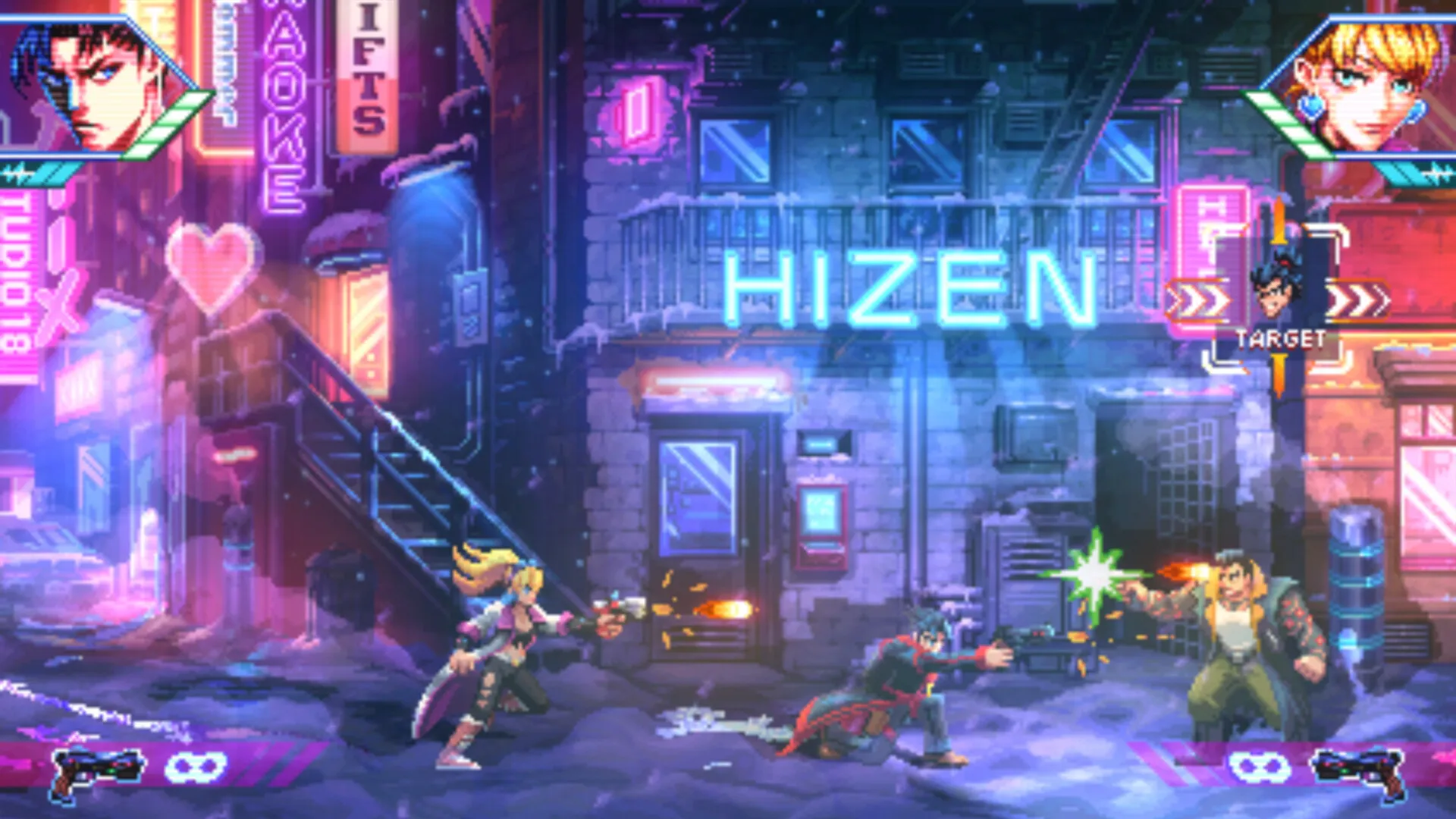
A significant part of Neon Inferno’s draw comes from its carefully tuned presentation. The game leans on striking 2D pixel art that pushes a familiar retro style toward a sharp technical and artistic display. Its cyberpunk setting feels fully realized, with a vivid neon palette that underscores the mix of grime and glow in this 2055 battleground. Visual fidelity sits comfortably beside contemporary standouts in the genre.
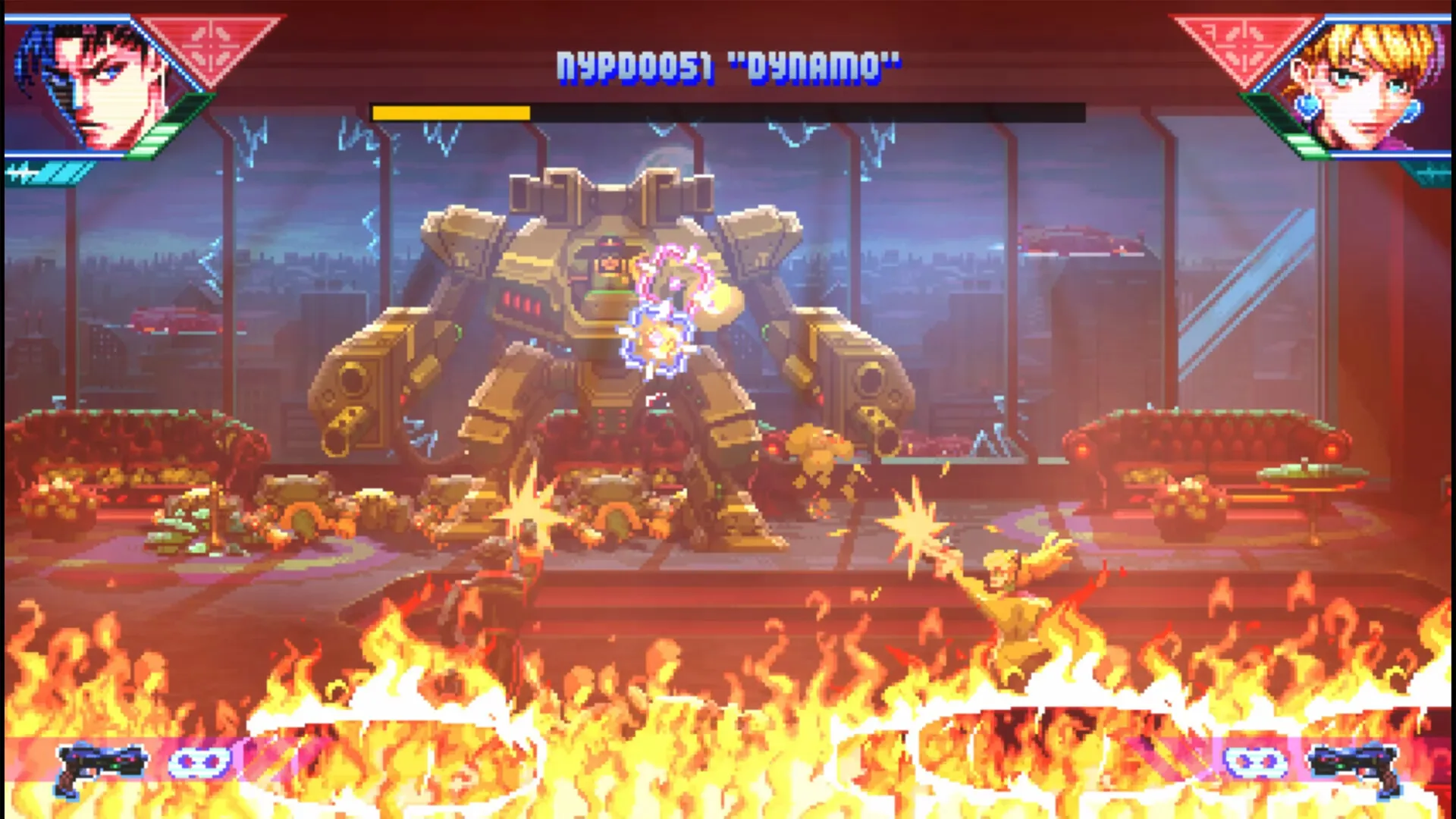
Environmental layouts span chaotic streets and ornate interiors that can be shredded by gunfire. Destructible elements across the scenery add motion to the backdrop, so each firefight feels as if it is tearing through a fragile city. For players who enjoy a stronger retro feel, an optional CRT filter applies an extra nostalgic layer to the picture.
Character animation keeps pace with the backdrop. Large, expressive sprites sell movement, weapon recoil, and impact. Detailed designs and harsh, emphatic death sequences support the game’s hard-edged tone. The soundtrack deepens that mood with a focus on electronic music and grungy electronica that matches the speed and relentlessness of combat. Occasional shifts in style, such as the smoother, low-key jazz piece that plays during mission selection in the bar, set up a brief sense of calm before the next violent stage.
Structure, Difficulty, and Longevity
Neon Inferno’s campaign spans roughly eight missions. Early stages let the player choose between three initial targets, which creates a limited degree of control over the opening difficulty curve. The structure then moves into a fixed route as the story tightens. Every mission ends in a demanding boss encounter that expects full use of the toolset, with a particular emphasis on the bullet deflection system.
The game aims squarely at players who enjoy extreme challenge. It offers three main difficulty settings, Novice, Normal, and Hard. Difficulty choice reshapes how many resources the player holds and how forgiving the checkpoint logic feels. Lower settings provide a sizable health pool and mid-stage checkpoints. Normal and Hard frequently require full level restarts after death. That philosophy places heavy weight on memorization and precise execution, building an experience that leans on pattern-perfect runs and repeated attempts.
Progression revolves around a performance-driven currency. At the end of each mission the game awards money based on health remaining, clear time, and casualty count. That income feeds a small shop of temporary tools, such as one-time special ammo types like homing or rapid fire, and plasma shields. The lack of persistence across missions weakens the sense of growth. Special ammo takes real effort to earn and disappears after a single use, which turns spending into a short-lived boost rather than a lasting reward for strong play.
Beyond the main Campaign, Arcade Mode stands as the purest expression of the game’s demands. This mode applies a single-life rule to the full set of eight missions, with no checkpoints at all, and expects flawless execution. The core campaign runs on the shorter side, and an expert player can clear it in roughly two to three hours, so most long-term appeal comes from local two-player co-op, since online play is absent, from pushing through the harshest difficulty spikes, and from chasing higher scores on the performance leaderboards.
The Review
Neon Inferno
Neon Inferno is a visually spectacular shooter that succeeds in creating a distinct cyberpunk atmosphere. Its Deflection/Bullet Time system is an inspired mechanic that rewards skill and deepens the combat. However, the decision to immobilize the player during background shooting frequently compromises the kinetic flow, introducing avoidable frustration. While the short campaign is highly replayable for score chasers and dedicated co-op partners, the restrictive resource economy limits meaningful long-term progression. It is a stunning, but intensely demanding, experience designed for a specific audience.
PROS
- Visually stunning, high-fidelity pixel art.
- Unique and satisfying bullet deflection/slow-motion mechanic.
- Excellent electronic and jazz soundtrack.
- High skill ceiling rewards memorization and precision.
- Local two-player co-op option.
CONS
- Character immobility during background aiming is frustrating.
- Punishing difficulty, even on easier settings.
- Short campaign length (approx. 2-3 hours).
- Limited, non-persistent progression/upgrade system.