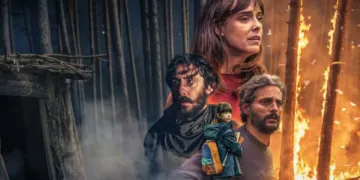











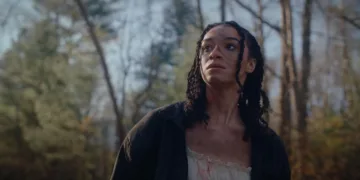










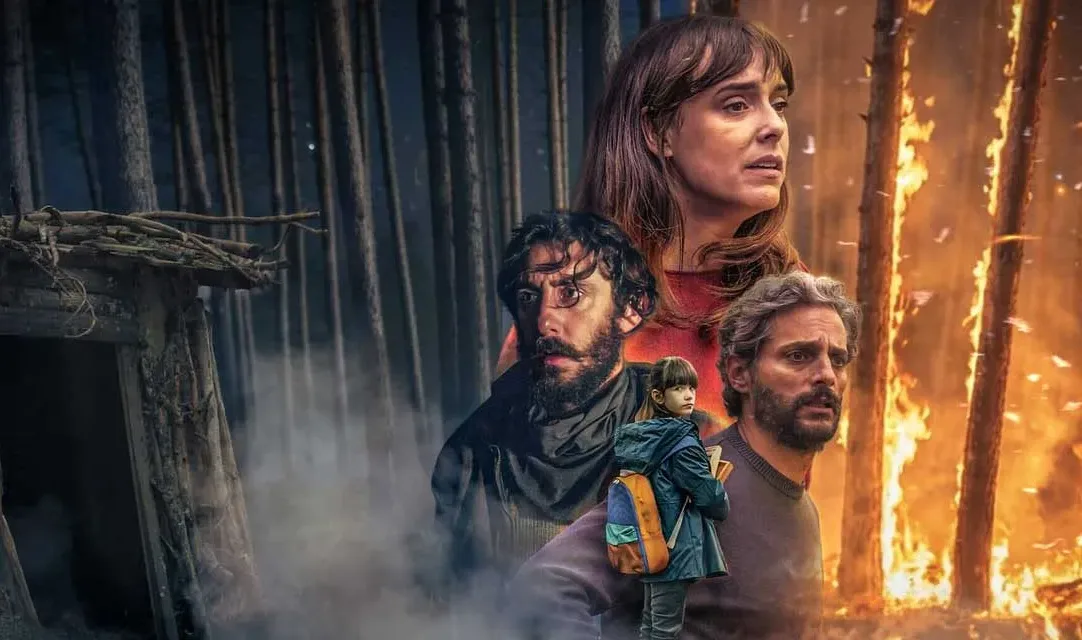

Mara returns to an isolated cabin to dismantle the life she built with her dead husband. The film, a Spanish thriller, places private mourning inside an environmental emergency and lets each crisis feed the other. Mara and her relatives sort photographs, keepsakes, and household remnants when a damaged electrical structure ignites the dry forest around them.
During this already volatile stretch, Mara’s young daughter, Lide, vanishes after a fierce argument. Authorities soon grasp the magnitude of the wildfire and issue evacuation orders, pushing the child search into suspension. The family faces a brutal choice: leave and live, or stay and keep searching.
From there, the picture shifts shape, moving from survival drama toward a tight psychological chamber piece. Panic strips away family cohesion, neighborly trust, and the social scripts people rely on in emergencies. The fire becomes a ticking clock for a domestic mystery already primed to explode.
The Reliquary of Grief and Domestic Friction
The film sets its stakes inside a quiet ritual of mourning before the exterior world catches flame. Mara moves through the cabin in a state of suspension, almost like a person carrying out instructions written by a former self. She returns for one purpose, to remove her physical trace from the place.
Her husband, Gus, remains everywhere in absent form. His presence lingers in the carvings, the photographs, the ordinary objects that now get forced into cardboard boxes. The process feels like grief administration (a cold phrase for a desperate act), a bid to compress a shared life into neat units so the property can be sold and the future can proceed.
Luis, her brother-in-law, arrives with his wife Elena and their son Dani. Their company produces a pressure-cooker domestic climate disguised as support. The house is full, and the fullness hurts. Kindness lands with weight. Every practical gesture carries the shape of what is missing.
The strain between Mara and her eight-year-old daughter Lide becomes the film’s first live wire. Lide cannot accept the loss of this refuge. She holds fast to the play hut in the woods, which the film frames as a symbolic redoubt of her father’s memory. After a heated exchange sends Lide running into the ferns, the script makes a sharp point: the emotional blaze began earlier than the wildfire.
The cabin works as a reliquary. Each object Mara touches contains a story she is trying to close. The film captures the dense stillness that arrives before catastrophe, that strange hush where everyone keeps moving and nothing feels stable. Grief leaves people exposed, and the chaos that follows finds every opening.
The Pyres of the Anthropocene
The disaster starts with mechanical failure. A faulty radio tower wire throws a spark onto the dry forest floor and triggers an accidental blaze that grows into something consuming. The film uses this event as a pointed image of human fragility inside damaged environmental conditions.
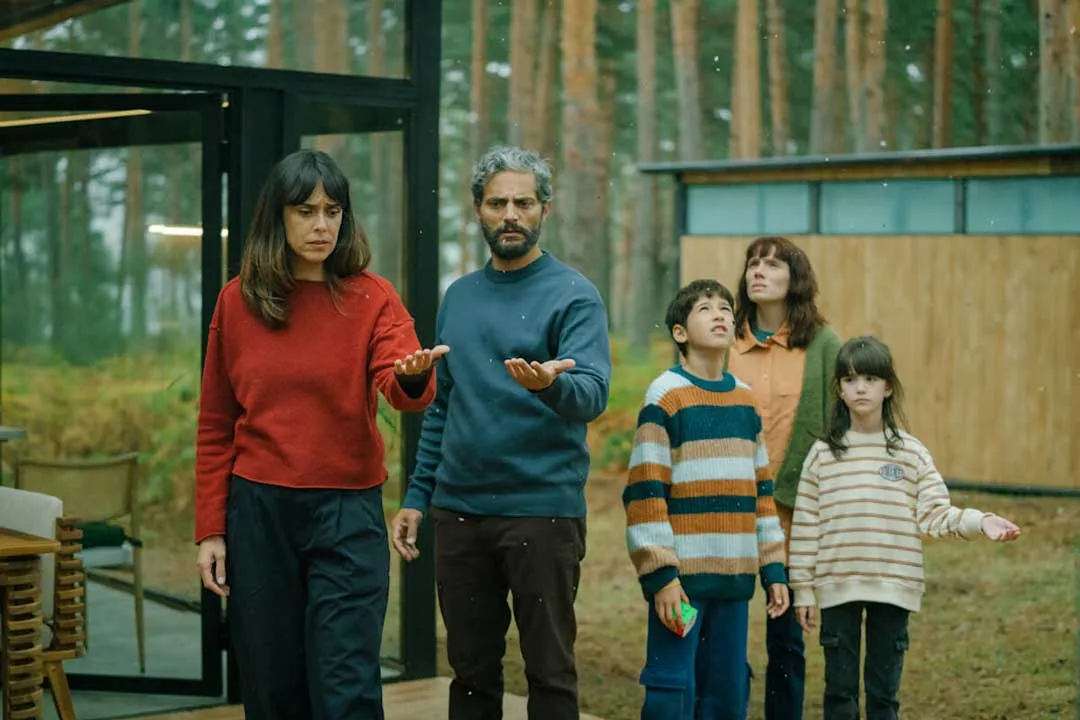
The forest appears as a tinderbox of brown ferns and combustible paths, a terrain waiting for ignition. During a family dinner, ash drifts down like snow. The image lands with grim force, a visual premonition of the inferno moving closer.
The title Firebreak refers to the cleared strip of land meant to stop the fire’s spread. That space becomes central to the plot and to the film’s symbolism. It marks the narrow margin between safety and erasure. Winds change, the blaze outruns control, and police suspend the search for Lide.
The result is a search crisis with the shape of historical disaster triage, where institutions start sorting lives under pressure and no one accepts the math. Evacuation orders place the family inside a moral conflict that pits group survival against the life of one missing child.
The film has a bleak reading of preparedness. Societies speak in the language of readiness right up to the minute systems fail. Here, police response, radios, and firebreaks all prove inadequate. What remains is the terror of a parent facing a natural force that ignores human urgency and rejects negotiation. The movie keeps returning to that point with admirable severity. Nature does not care about timelines, family histories, or procedural language. Bureaucracy meets flame and sounds suddenly very small.
The Neighbor as a Rorschach Test
As the wildfire closes in, the narrative shifts into a paranoia-driven thriller mode. The center of attention moves from the advancing blaze to Santiago, the neighboring forest ranger. He first appears as a helpful figure and gives Lide a gift, then his behavior begins to read as unstable. Mara finds Lide’s bracelet on the stickshifter of Santiago’s Jeep, and that discovery detonates her perception. She stops searching for a missing child and starts pursuing a suspected abductor.
Santiago practices what the film presents as thanato-rituals. He uses psilocybin in the woods to guide people through confrontations with death anxiety. That detail intensifies Mara’s suspicion and marks him as a social outsider in the grieving family’s eyes.
The film studies a form of catastrophe-bias, where people under severe pressure cast internal dread onto the nearest plausible target. Reason thins out. Judgment narrows. Mara’s desperation mutates into vigilante-mania, and the film treats that transformation as a second disaster line running alongside the wildfire.
The family’s internal fractures widen. Luis and Elena turn against Mara as her accusations become harsher and less tethered to proof. Social trust, one of the film’s key subjects, starts to collapse in real time. The script argues that neighborliness depends on stable conditions and shared confidence.
Put smoke in the air, remove visibility, add grief, add fear, and the social fabric frays almost immediately. In that atmosphere, everyone can be recast as a threat. It is a harsh view of community, though a persuasive one, and the movie presses it without sentimentality.
The Architecture of Suffocation
Director David Victori builds a visual system that mirrors the characters’ interior panic. Cinematographer Elías M. Félix photographs the burning forest as an oppressive environment, using smoke and ash to produce a hazy orange field that feels gorgeous and menacing in the same breath. The imagery does active dramatic work. It constricts sightlines, confuses spatial awareness, and weakens thought itself. Panic, in this film, has weather.
The changing aspect ratios are used with real purpose. As tension rises, the frame narrows, and the viewer feels the squeeze physically. The effect creates a form of cinematic entrapment that aligns with the characters’ condition as they are trapped between fire and suspicion.
Handheld camerawork sharpens the frantic pulse of the search sequences. The frame shakes, pivots, and lunges in ways that echo a parent’s destabilized body under acute stress. The visual plan understands that fear has rhythm. Victori and Félix translate that rhythm into spatial pressure.
Sound design carries equal weight. The fire’s roar remains present as a low, persistent force, almost a bass note of doom humming under the drama. It functions as an auditory ticking clock and keeps danger close even in moments where flames sit outside the frame.
The CGI fire communicates scale, which matters for the environmental dimension of the story. The sound communicates proximity, which matters for terror. The pairing works. You can feel the inferno before you see it, and that sensory pressure sustains tension across quieter scenes.
The Anatomy of Desperation
The film stands or falls on a cast capable of moving from muted grief to full hysteria without losing coherence. Belén Cuesta gives the central performance its volatile shape through what might be called manic-devotion. She captures the speed with which maternal love can become destructive under pressure. Her Mara reads as a person being stripped down by circumstance, piece by piece. Heroic framing would weaken the part. The film avoids that trap and gains force.
Enric Auquer plays Santiago with deliberate ambiguity. He functions as a human Rorschach test, a figure onto whom characters and viewers project fear, doubt, and suspicion. His odd behavior can register as guilt. It can also register as social awkwardness from a man living at the edges of community life. That uncertainty anchors the mistrust narrative in the second act and keeps the film from settling too soon into a single explanatory path. Auquer maintains tension by refusing easy readability (a skill many thrillers claim and few cast successfully).
Joaquín Furriel gives Luis a strong turn rooted in pressured pragmatism. The film tracks the corrosion of the supportive relative and reveals the brutal face that can emerge under crisis conditions. His version of reason darkens as the stakes rise, and the script lets that shift carry genuine menace.
The supporting cast stabilizes the ensemble dynamic. Diana Gómez serves as the clearest voice of reason in a story increasingly ruled by fear. She channels the audience’s wish for logic inside a situation that keeps punishing logic. Candela Martínez and Mika Arias give grounded performances that secure the emotional stakes. Their work keeps the child perspective tangible amid adult paranoia, grief, and environmental collapse. The film needs that grounding. Without it, the thriller machinery could drift into abstraction. With it, every accusation and every delay lands harder.
Firebreak (originally titled Cortafuego) is a high-tension Spanish psychological thriller that premiered globally on Netflix on February 20, 2026. The film explores the harrowing journey of a mother, Mara, whose trip to a secluded family cabin turns into a nightmare when her young daughter vanishes into the woods just as a massive, uncontrollable wildfire erupts. It is currently available to stream exclusively on Netflix.
Where to Watch Firebreak (2026) Online


Full Credits
Title: Firebreak (Cortafuego)
Distributor: Netflix
Release date: February 20, 2026
Rating: TV-MA
Running time: 107 minutes
Director: David Victori
Writers: Javier Echániz, Asier Guerricaechebarría, Jon Iriarte, David Victori
Producers and Executive Producers: Anxo Rodríguez, Ferran Tomás
Cast: Belén Cuesta, Enric Auquer, Joaquín Furriel, Diana Gómez, Candela Martínez, Mika Arias, Victor Ramos
Director of Photography (Cinematographer): Elías M. Félix
Editors: German Ciria, Chema Alba
Composer: Federico Jusid
The Review
Firebreak
Firebreak is a "disaster-pivot" thriller that swaps the horizontal scale of a wildfire for the vertical depth of human paranoia. While the mid-film transition into a kidnapping mystery feels somewhat jarring, the technical execution remains suffocatingly effective. It is a study of how grief and environmental collapse act as twin catalysts for the erosion of social trust. The film functions best as a Rorschach test for the viewer’s own cynicism toward their neighbors. It is a tense, though occasionally overwrought, exploration of the "emergency-self."
PROS
- Stellar performances, particularly the ambiguity of Enric Auquer.
- The innovative use of shifting aspect ratios to heighten claustrophobia.
- A visceral, oppressive atmosphere created by the smoke and sound design.
- A thoughtful critique of how panic destroys communal trust.
CONS
- The second act loses the environmental tension to focus on a familiar mystery.
- Some character decisions lean heavily into "idiot plot" territory.
- The CGI in the opening scenes lacks the polish of the final act.
- The conclusion may feel too sentimental for the preceding grimness.