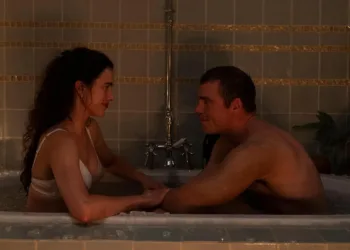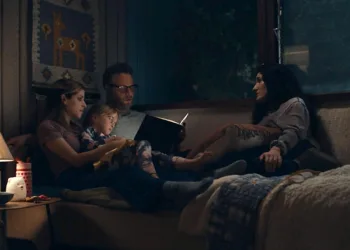


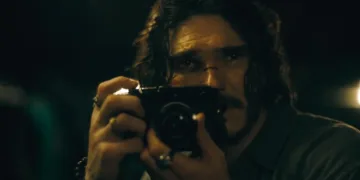
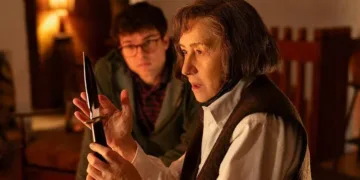
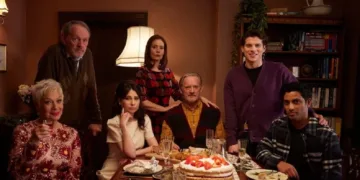



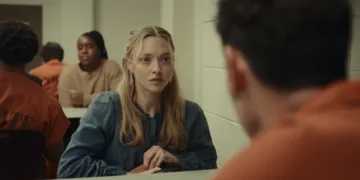












Paloma lives inside the abrasive grind of the Manhattan rental market, a predatory ecosystem where the need for shelter collides with the practiced charm of the professional grifter. She and her partner, Smith, run a parasitic model built on the most basic necessity. They lease luxury properties they do not own to marks who think they have finally planted a flag in the city. Their romantic bond plays like a private refuge from the daily performance, a quiet domestic pocket sealed behind professional masks. The scheme reads as a cynical comment on the gig economy, where identity becomes product, and everything carries a price tag.
Then they pick Dr. Robert Kezian as the next target. He is a distinguished neurosurgeon with a classic brownstone and a deep reservoir of private pain after the death of his wife, Rebecca. The con collapses with brutal, clinical efficiency. Paloma ends up trapped inside the heavy, silent walls of his home. The film leaves the wide, predatory hum of city streets and enters the suffocating quiet of a high-end prison. It is a hard turn. A nasty one.
The shift echoes a historical movement from open, chaotic warfare toward the quieter, institutional cruelty that thrives behind respectable doors. The story pivots from crime thriller momentum into a localized, physiological nightmare, where the body becomes the battleground and the house becomes the regime.
The Chromatic Descent of the Lens
Darren Lynn Bousman treats the frame like a living organism that tightens under psychological pressure. He uses a method I think of as Genre-Morphosis, the literal reshaping of the visual container to match the characters’ interior state. The film opens in a wide format that fits the cold, clinical deception of a crime setup. As the horror takes root, the aspect ratio narrows. The walls feel closer. Agency feels like it is being repossessed. That formal squeeze has a blunt clarity, almost rude in its certainty.
The lensing evolves too. The look travels from sharp, digital crispness into a blurrier, warped register aligned with medical horror, a shift that makes the image itself feel compromised. The camera’s “health” starts to fail in sympathy with the narrative’s ethics (a minor miracle when a stylistic idea also lands as a moral statement).
Bella Gonzalez’s cinematography feels heavy and tactile, allergic to the pristine sheen that can make contemporary digital horror look like a showroom display. Hyper-saturated primaries, red and blue, flood the screen and mirror the volatile, rage-loaded state of Kezian’s mind.
The lighting leans into a giallo sensibility (the Italian lineage of stylized, expressionistic violence), with canted angles and rainbow hues washing over Kezian’s most intense passages. The editing keeps a fast, music-video pulse that denies the audience a stable foothold. It becomes a visual assault, the kind that makes your eyes feel bruised, and it fits a world rewritten by a man holding a scalpel. Part of me admires the control. Part of me wants to blink and ask for mercy. The film encourages neither.
The cumulative effect argues that perception is fragile, as breakable as the brain’s own structures. The visuals do not simply decorate the horror; they behave like a warning about how quickly “reality” can become a clinical hallucination dressed in high production value.
The Ethics of the Unlikable Protagonist
Lauren LaVera plays Paloma with a refreshing lack of sentimentality. She is an unrepentant con artist who treats her victims as data points inside a transaction. LaVera gives her a prickly surface that refuses easy sympathy. Smith acts as a softer counterweight, though their relationship is presented through a physical intimacy that sometimes seems calibrated for the male gaze, with less attention paid to what that closeness adds to the story’s emotional geometry. That tension sits there, unresolved, and the film seems comfortable letting it sit there.
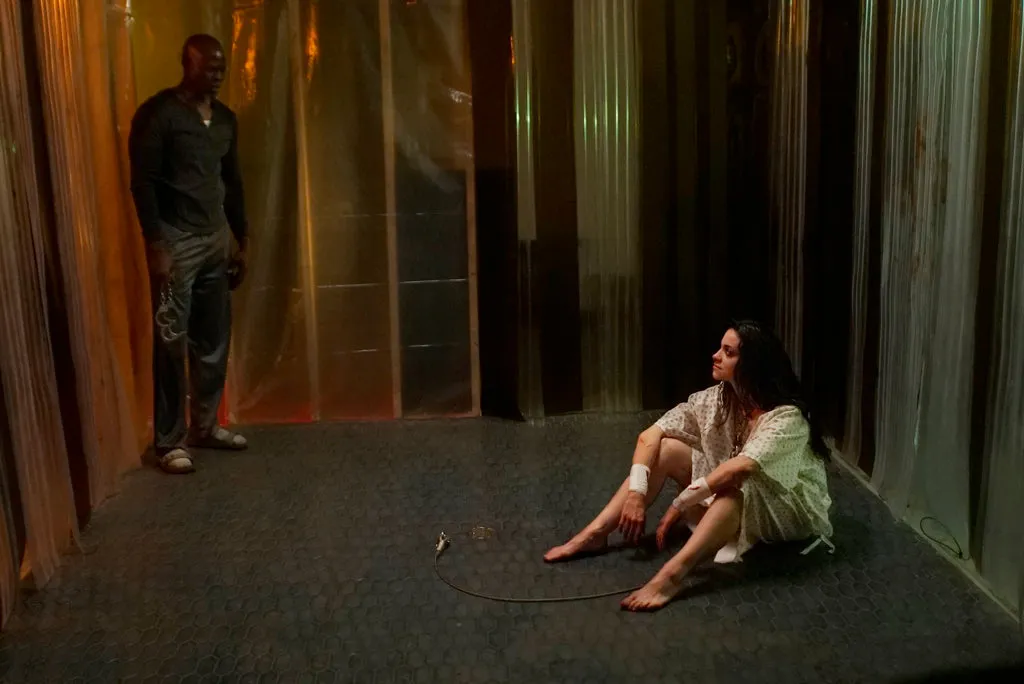
Djimon Hounsou carries the antagonist role with grounded intensity that steadies the film’s more chaotic surges. Grief drives him, yet the performance avoids the familiar caricature of the shouting, manic villain. Kezian reads as a man whose trauma has condensed into cold, clinical obsession, the kind that speaks softly while doing the worst thing in the room.
The script keeps these edges sharp. It declines to sand them down and declines to hand the audience a clean hero to cling to. Even the NYPD detectives, played by Jacob Lukas Anderson and Gina Philips, register as minor impediments, not saviors arriving with narrative sunlight. Neal McDonough adds bureaucratic menace and suggests Kezian emerges from a failing system, not from a vacuum. That framing has bite. It also feels bleakly familiar, like a headline that never stops repeating itself.
With moral clarity withheld, the audience is pushed to re-check its own reflexes about survival and sympathy. The film stages a conflict between two types of predators, each armed with different tools and different alibis. Survival becomes a matter of cold mechanics and opportunistic violence, with “deserving” left on the curb. The discomfort is the point. The movie asks you to watch people who would happily exploit you, then stay in the room long enough to feel what that says about your own appetite for narrative punishment.
The Kidney Bean Theory and the Cost of Progress
The back half introduces a philosophical argument about where the human soul lives inside flesh. Dr. Kezian follows the Kidney Bean Theory, the belief that the essence of self, the “who we are,” occupies a tiny, specific area of the brain. Damage that kidney-bean-sized region and the person disappears, even while the body remains functional. The concept becomes his justification for horrific experiments.
He frames a question with chilling calm: is a body count an acceptable price for medical breakthroughs that could save millions? The question carries an ugly historical shadow. Medical advancement has a long record of ethical collapse in the name of discovery, and the film leans into that lineage without flinching.
Brain surgery arrives with graphic directness that dares the audience to turn away. The sequences aim for a physical cringe by stressing the skull’s vulnerability, a reminder that the “self” may sit behind a thin barrier of bone and faith. A neuroscientist was present on set to keep these macabre procedures anchored in medical reality, which only sharpens the nausea. Realism can be its own form of cruelty.
The script also casts bureaucratic red tape as a central villain. It portrays Kezian’s slide into madness as something fed by institutional stagnation, with rules and oversight presented as suffocating obstacles. He treats human-trial laws as an insult to his genius and his grief. He breaks the law to chase the mystery of consciousness, and the collapse that follows takes down professional standards and human standards together. I kept waiting for the film to moralize. It refuses.
What remains is a messy, violent examination of the human condition, staged through scalpels, locked doors, and the fantasy of precision. Identity looks fragile here, something that can be removed by a sharp blade guided by a cold mind. The final implication lands with a nasty simplicity: a single surgical error can make a stranger out of anyone.
Twisted made its debut on February 6, 2026, marking a return to visceral genre filmmaking for director Darren Lynn Bousman. The film was released by Republic Pictures and is currently available to watch via Digital VOD platforms, where viewers can buy or rent the title. Set against the backdrop of a modern New York real estate scam, the story follows two con artists who find themselves trapped in a psychological nightmare after targeting a surgeon with a dark and experimental agenda.
Full Credits
Title: Twisted
Distributor: Republic Pictures, Paramount Global
Release date: February 6, 2026
Rating: R
Running time: 93 minutes
Director: Darren Lynn Bousman
Writers: Jonathan Bernstein, James Greer
Producers and Executive Producers: Mark Burg, Lee Nelson, David Tish, Lukas Behnken, Trevor Gerszt, Rocky Parker, Curtis Lane, James Greer, Jonathan Bernstein, David Gendron, Viviana Zarragoitia
Cast: Djimon Hounsou, Lauren LaVera, Mia Healey, Gina Philips, Neal McDonough, Alicia Witt, Victor Del Rio, Michael Lombardi
Director of Photography (Cinematographer): Bella Gonzales
Editors: Zeborah Tidwell
Composer: Mark Sayfritz
The Review
Twisted
Twisted is a collision of high-concept medical philosophy and the gritty mechanics of a chamber horror. It succeeds as a technical experiment, using changing aspect ratios and vibrant giallo lighting to visualize a mind in decay. However, the lack of a moral center makes it a cold, often alienating experience. It is a film that values ideas over empathy, leaving the viewer impressed by the craft but detached from the struggle. It remains a messy, stylistically bold entry in the genre of physiological dread.
PROS
- The shifting aspect ratios and genre-morphing visuals are genuinely inventive.
- Djimon Hounsou brings a grounded, tragic weight to a role that could have been a caricature.
- The "Kidney Bean" theory provides a fascinating ethical anchor for the gore.
CONS
- The lack of a sympathetic lead makes it difficult to invest in the survival of the protagonists.
- The narrative occasionally feels unnecessarily cruel, particularly in its treatment of the central romance.
- The transition from urban crime to medical horror feels abrupt and slightly disjointed.